

Kingsgrove Branch:


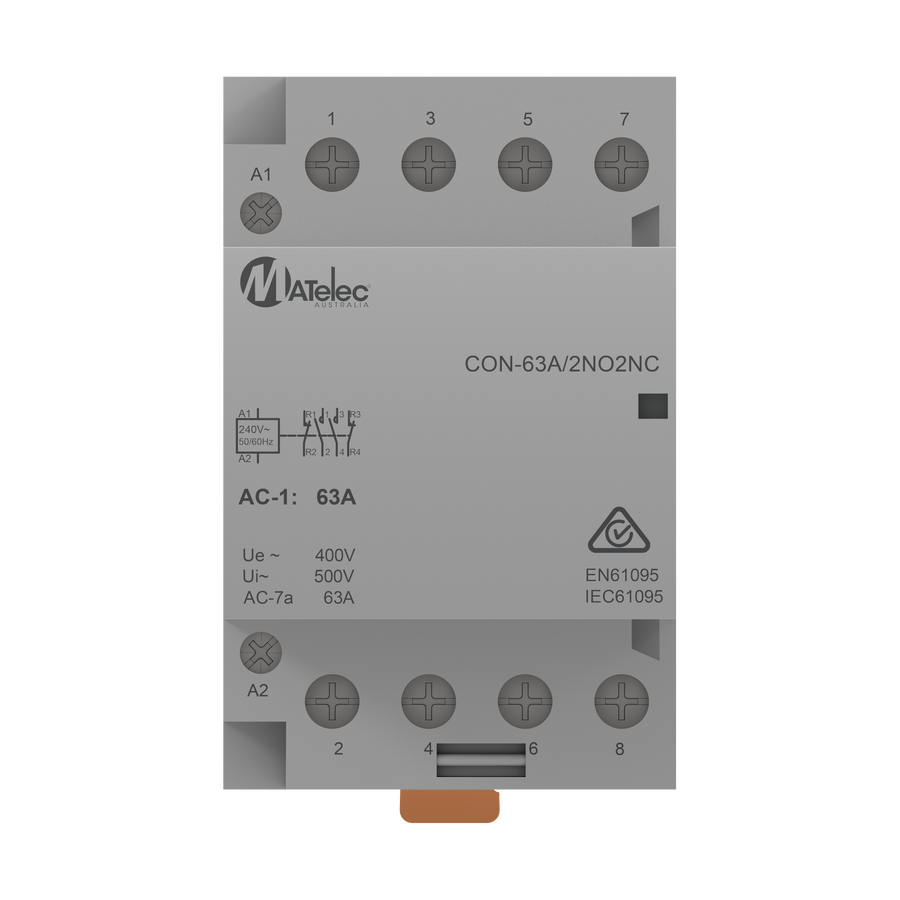
In Australian industrial automation systems, the separation between power switching and control logic is fundamental. While main contactors and circuit breakers manage load currents for motors, heating banks, and distribution circuits, the sequencing and interlocking logic is executed by the Auxiliary Contactor. Installed within motor control centres (MCCs), HVAC plant rooms, mining conveyors, and manufacturing lines, this device governs low-current control circuits that determine machine state and safety compliance. Unlike power contactors designed for AC-3 motor duty, the auxiliary contactor is engineered for high-cycle reliability under AC-15 and DC-13 control applications. Its function is to switch electromagnetic loads such as solenoids, contactor coils, signal lamps, and PLC input circuits while maintaining consistent contact integrity and compliance with recognised switchgear standards.
The defining characteristic of an Auxiliary Contactor is its utilisation category rating. Under IEC 60947-5-1, AC-15 refers to the control of electromagnetic loads on AC systems, while DC-13 applies to switching DC electromagnets.
When a solenoid coil is energised, a magnetic field is established. Upon de-energisation, the collapsing field generates a voltage spike known as back electromotive force (Back EMF). This transient voltage can cause arcing across opening contacts. Auxiliary contactors designed for AC-15 and DC-13 duty incorporate silver-nickel (AgNi) contact materials and arc management geometry to withstand repetitive inductive switching cycles.
This design ensures that control circuits remain operational over millions of switching operations. Failure in this category—such as contact welding—can compromise interlocking logic and create hazardous unintended machine starts.
In safety-related control systems, contact integrity is not optional. Modern industrial safety standards require mechanically linked or positively driven contacts.
Mechanically linked contact arrangements ensure that Normally Open (NO) and Normally Closed (NC) poles cannot be simultaneously closed. If an NO contact welds shut due to a fault, the NC contact remains physically open. This prevents the safety monitoring circuit from receiving a false-safe signal.
Mirror contact design is essential in circuits interfacing with emergency stop systems, safety relays, and monitoring modules. By maintaining defined mechanical linkage between poles, the Auxiliary Contactor provides verifiable safety logic within control panels and ensures predictable state feedback.
Control circuits in modern Australian installations frequently operate at 24V DC or lower. At these voltage levels, contact resistance caused by surface oxidation can result in unreliable signalling.
High-performance auxiliary contactors address this with bifurcated or gold-flashed contact surfaces. Bifurcated contacts split the current path across dual contact points, increasing reliability at low current. Gold flashing resists oxidation and maintains consistent conductivity.
Reliable low-energy switching prevents intermittent PLC input faults and avoids nuisance shutdowns. In complex automation systems, accurate contact feedback is critical for maintaining production continuity and operator safety.
Auxiliary contactors are often configured in base formats such as 4NO, 3NO+1NC, or 2NO+2NC. However, complex control logic may require additional switching poles.
Front-mount and side-mount auxiliary blocks allow expansion of contact count without introducing separate relay coils. These modular extensions mechanically couple to the base contactor, enabling a single coil to actuate multiple circuits simultaneously.
Expanded configurations may include one pole feeding PLC status inputs, another controlling a pilot lamp, and additional poles managing interlocking between forward and reverse motor circuits. Precision mechanical alignment ensures that auxiliary modules operate without binding or chatter.
Inductive switching transients can damage sensitive control electronics. When de-energising coils, surge suppressors or varistor modules are commonly installed across the coil terminals to dampen voltage spikes.
This protection safeguards PLC output cards and reduces electromagnetic interference within the enclosure. Suppression modules are particularly important in high-frequency switching applications where repetitive voltage spikes can degrade control components over time.
Installation of auxiliary contactors within low-voltage assemblies must comply with AS/NZS 3000 for conductor sizing, segregation, and enclosure protection.
Proper termination, secure mounting, and adherence to creepage and clearance requirements ensure safe integration within motor control centres and switchboards. Selection of the correct coil voltage—whether 24V DC, 110V AC, 240V AC, or 415V AC—must align with control transformer specifications and system design.
SCHNAP Electric Products supports control panel construction through complementary accessories that enhance auxiliary contactor performance. Bootlace ferrules ensure secure termination of flexible control conductors, reducing the risk of stray strands causing short circuits.
Surge suppressors and varistor modules help mitigate back EMF effects during coil switching, protecting PLC outputs and maintaining electromagnetic compatibility. Modular expansion accessories allow scalable control logic without increasing panel complexity.
By integrating reliable switching components with compliant wiring and suppression accessories, SCHNAP Electric Products supports structured and durable automation systems across Australian industrial environments.
Auxiliary contactors vary by utilisation rating, contact configuration, coil voltage, and mechanical linkage certification. Using an under-rated relay for inductive control duty can result in premature failure and system downtime.
Professional procurement through a specialised electrical wholesaler ensures correct specification of AC-15 or DC-13 ratings, confirmation of mechanically linked contact design, and compatibility with installed control systems. Verification of technical data sheets prior to installation prevents costly commissioning delays and safety risks.
Correct specification ensures long-term operational reliability and compliance with industrial control requirements.
The Auxiliary Contactor is the logic interface of industrial control systems. Designed for AC-15 and DC-13 inductive switching, it governs interlocking, sequencing, and safety signalling within motor control centres and automation panels. Mechanically linked contacts provide verifiable safety integrity, while low-energy contact optimisation ensures accurate PLC feedback. When installed with proper surge suppression, secure termination, and compliant wiring practices, the auxiliary contactor delivers high-cycle reliability in demanding Australian environments. In control architecture, dependable signalling is fundamental to safe and predictable machine operation.

SCHNAP Electrical Wholesaler - clear, upfront pricing that professional electricians trust

Get what you need in seconds. SCHNAP electrical wholesaler makes ordering quick and simple

Fast delivery anywhere - that's guaranteed. SCHNAP electrical wholesalers ship nationwide with same-day dispatch

Track your order every step of the way. SCHNAP electrical wholesale keeps you updated from click to delivery

SCHNAP is Australia's premier electrical wholesaler and electrical supplies, marketing thousands of quality products from leading brands. Trusted for nearly two decades by licensed electricians, contractors, and engineers, our range covers everything from basic electrical components to complex industrial electrical equipment
Our key categories include: LED lighting, designer switches, commercial switchboards, circuit protection, security systems & CCTV, and smart home automation
All products are certified to Australian standards (AS/NZS), backed by our 30-day, no-questions-asked return policy. Our expert technical team helps you quickly source the right solution for any residential, commercial, or industrial project, with daily dispatch from our Sydney electrical warehouse delivering Australia-wide
SCHNAP offers the most comprehensive electrical product range, with full technical specifications, application details, installation requirements, compliance standards, and warranties — giving professionals total confidence in every purchase


Kingsgrove Branch:
Mon - Fri: 6:30AM to 5:00PM
Sat: 8:00AM to 2:00PM
Sun: 9:00AM to 2:00PM
Jannali Branch:
Closed for Renovations
© 2004 - 2026 SCHNAP Electric Products