

Kingsgrove Branch:


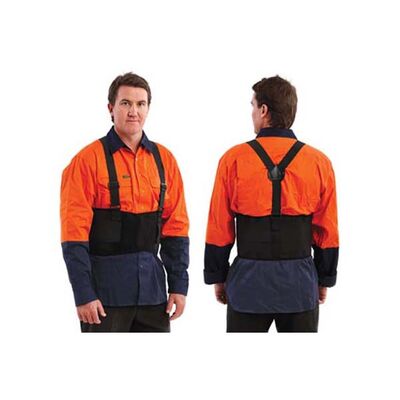
In Australian construction, mining, manufacturing, and infrastructure environments, repetitive lifting and sustained manual handling place significant stress on the lower spine. While impact and electrical hazards are carefully controlled, musculoskeletal injuries remain one of the most common causes of lost-time incidents under Work Health and Safety (WHS) frameworks. Chronic lumbar strain, disc compression, and sciatic nerve irritation frequently result from prolonged bending, twisting, and heavy load manipulation. A Back Support Belt is designed to provide structured lumbar stabilisation during controlled lifting tasks, supporting safer biomechanical posture and reducing excessive spinal load concentration.
The lower lumbar region, particularly the L4-L5 and L5-S1 segments, bears the majority of compressive force during lifting. When improper technique or sudden load shifts occur, intervertebral discs are exposed to elevated shear and compressive stress.
A Back Support Belt functions by increasing intra-abdominal pressure through circumferential compression of the abdominal cavity. This compression creates a stabilising effect similar to an internal brace. By supporting the torso anteriorly and posteriorly, the belt helps reduce isolated load concentration on the lumbar discs.
Dual-tension fastening systems allow the wearer to adjust compression levels depending on task intensity. Properly fitted support can encourage upright posture and controlled lifting mechanics, assisting in load distribution across the pelvis and larger muscle groups rather than concentrating stress exclusively on the lower spine.
It is important to note that a back support belt complements, but does not replace, correct manual handling training and mechanical lifting aids where required.
High-quality Back Support Belts incorporate structured rear panels with integrated support stays. These stays are typically manufactured from flexible polymer or light metal reinforcement strips positioned along the lumbar region.
The purpose of these stays is to resist excessive spinal flexion and provide tactile feedback when the wearer attempts to bend at unsafe angles. By limiting extreme forward curvature, the belt promotes safer lifting posture that utilises leg and core musculature rather than relying solely on spinal structures.
Wide rear panels distribute pressure evenly across the lower back, reducing pressure points and improving overall stability during repetitive handling tasks.
Industrial environments expose PPE to dust, heat, moisture, and repetitive movement. Premium Back Support Belts are constructed from breathable neoprene, elastic mesh, or perforated composite fabrics that allow airflow and moisture evaporation.
Breathable materials reduce heat accumulation around the torso during long shifts, particularly in high-temperature worksites. Adjustable hook-and-loop fastening systems provide secure fit without restricting necessary mobility. Durable stitching and abrasion-resistant fabric ensure longevity under daily operational use.
Comfort is critical for compliance. If the belt is uncomfortable or excessively restrictive, workers are less likely to wear it consistently.
Back Support Belts are commonly used during repetitive lifting, cable pulling, drum handling, equipment relocation, and installation of heavy enclosures. When moving copper sub-mains, positioning switchboards, or handling cable reels, lumbar stability assists in maintaining correct posture under load.
By supporting core engagement and promoting safer biomechanics, the belt helps reduce fatigue accumulation during physically demanding tasks. Improved posture stability also supports precision during subsequent installation procedures requiring measured force application.
Technicians installing heavy-duty enclosures, isolators, brackets, and distribution hardware from Schnap Electric Products often perform repetitive manual handling tasks. Lumbar support during transport and positioning of these components can reduce strain risk and improve operational endurance.
When integrated within broader site safety systems—including correct lifting technique training and mechanical handling equipment—back support belts contribute to a controlled and efficient work environment aligned with WHS manual handling guidelines.
Back Support Belts are typically implemented as part of a workplace manual handling risk management plan. Employers should conduct task assessments to determine appropriate use.
Belts should not be used as justification for exceeding safe lifting limits. They function as a supplementary ergonomic control and are most effective when combined with:
Routine inspection should confirm strap integrity, stitching condition, and structural stay alignment. Worn or damaged belts should be replaced to maintain effectiveness.
Selecting a Back Support Belt requires evaluation of durability, breathability, adjustability, and suitability for specific task demands. Procurement through specialised electrical wholesaler supports access to industrial-grade lumbar support designed for Australian site conditions.
Reliable suppliers ensure continuity of stock across contracting fleets and maintenance teams, supporting consistent manual handling protection during peak operational periods.
The Back Support Belt provides structured lumbar stabilisation for repetitive and moderate manual handling tasks within Australian industrial environments. Through controlled intra-abdominal compression, reinforced lumbar support, and breathable ergonomic materials, it assists in reducing spinal strain and promoting safer lifting posture.
When implemented within a comprehensive WHS manual handling framework and integrated into structured site operations, it supports workforce longevity and sustained operational performance. In industrial environments where physical demands are unavoidable, protecting the lower spine remains a critical element of long-term occupational health management.

SCHNAP Electrical Wholesaler - clear, upfront pricing that professional electricians trust

Get what you need in seconds. SCHNAP electrical wholesaler makes ordering quick and simple

Fast delivery anywhere - that's guaranteed. SCHNAP electrical wholesalers ship nationwide with same-day dispatch

Track your order every step of the way. SCHNAP electrical wholesale keeps you updated from click to delivery

SCHNAP is Australia's premier electrical wholesaler and electrical supplies, marketing thousands of quality products from leading brands. Trusted for nearly two decades by licensed electricians, contractors, and engineers, our range covers everything from basic electrical components to complex industrial electrical equipment
Our key categories include: LED lighting, designer switches, commercial switchboards, circuit protection, security systems & CCTV, and smart home automation
All products are certified to Australian standards (AS/NZS), backed by our 30-day, no-questions-asked return policy. Our expert technical team helps you quickly source the right solution for any residential, commercial, or industrial project, with daily dispatch from our Sydney electrical warehouse delivering Australia-wide
SCHNAP offers the most comprehensive electrical product range, with full technical specifications, application details, installation requirements, compliance standards, and warranties — giving professionals total confidence in every purchase


Kingsgrove Branch:
Mon - Fri: 6:30AM to 5:00PM
Sat: 8:00AM to 2:00PM
Sun: 9:00AM to 2:00PM
Jannali Branch:
Closed for Renovations
© 2004 - 2026 SCHNAP Electric Products