

Kingsgrove Branch:


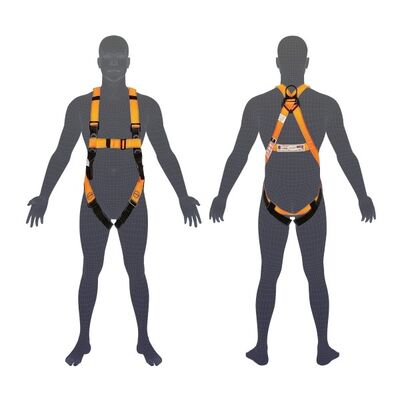
In Australian construction, telecommunications, utilities, and heavy infrastructure environments, working at height introduces a persistent and severe gravitational hazard. Where engineering controls such as guardrails, scaffolding, or elevated work platforms cannot fully eliminate fall risk, the Work Health and Safety framework mandates the implementation of compliant personal fall arrest systems. The Basic Safety Harness forms the foundational component of this protection architecture. Unlike a simple restraint belt, a full-body harness is engineered to distribute fall arrest forces across structurally robust areas of the human body, reducing the risk of catastrophic injury during sudden deceleration events.
The primary engineering objective of a Basic Safety Harness is controlled kinetic energy dissipation. During a fall, gravitational acceleration rapidly converts body mass into kinetic energy. When a lanyard or self-retracting lifeline arrests the fall, the resulting deceleration force must be limited to safe physiological thresholds. Under AS/NZS 1891 requirements, fall arrest systems are designed to ensure that forces transmitted to the body do not exceed 6kN. The harness geometry achieves this through a dorsal D-ring positioned between the shoulder blades, combined with sub-pelvic and thigh straps. Upon arrest, force is redirected through the pelvis and upper thighs, utilising large muscle groups and strong skeletal structures. This configuration avoids concentration of load on the abdomen or spine, significantly reducing internal injury risk.
The structural integrity of a Basic Safety Harness depends on high-tenacity webbing materials engineered for extreme load conditions. Professional-grade harnesses are commonly manufactured from polyester webbing due to its superior resistance to ultraviolet degradation and moisture exposure compared to standard nylon. Breaking strengths typically exceed 15kN, providing a substantial safety margin above expected dynamic loads. Polyester also maintains dimensional stability under repeated wet-dry cycles common in Australian climates. Stitching patterns are reinforced at high-stress junctions to prevent seam failure during shock loading, while colour-contrasting threads assist in inspection by clearly revealing abrasion or damage.
Critical connection points on a Basic Safety Harness include the dorsal D-ring and adjustment buckles. These components are forged from high-tensile alloy steel or lightweight aluminium alloys to provide structural resilience under dynamic loads. Hardware must resist deformation, corrosion, and mechanical fatigue. Adjustment mechanisms allow precise fitting to ensure that the harness sits securely against the body without excessive slack. Proper fit is essential for correct load distribution during a fall event. The integration of durable metallic hardware with reinforced webbing ensures that the entire system operates as a unified structural assembly.
AS/NZS 1891 governs industrial fall-arrest systems and mandates strict inspection and testing procedures. A Basic Safety Harness must undergo visual and tactile inspection prior to each use. Operators check for frayed webbing, chemical contamination, UV damage, and hardware deformation. In addition, Australian regulations require formal inspection and tagging by a competent person at intervals not exceeding six months. Any harness that has arrested a fall must be permanently withdrawn from service, regardless of visible damage, due to potential microscopic fibre stress. Maintaining documented inspection records ensures regulatory compliance and supports defensible safety management practices.
A Basic Safety Harness must balance strength with ergonomic comfort to ensure continuous wear compliance. Adjustable shoulder, chest, and leg straps allow technicians to achieve a secure yet comfortable fit for extended shifts. Properly fitted harnesses reduce fatigue and improve mobility when climbing ladders, structural steel, or telecommunications towers. Compatibility with lanyards, energy absorbers, and self-retracting lifelines ensures seamless integration into complete fall arrest systems.
Height safety does not operate independently of task-specific equipment handling. Technicians working at elevation frequently use Schnap Electric Products heavy-duty tool lanyards to tether drills, crimpers, and hand tools, preventing secondary drop hazards. By attaching tethering systems to approved harness anchor points, operators secure tools while maintaining controlled movement. This integration reduces the risk of falling objects and supports safe installation of infrastructure components such as cable cleats, enclosures, and mounting hardware. Combining compliant harness systems with structured tool restraint establishes a comprehensive elevated work safety envelope.
Selecting a Basic Safety Harness requires verification of certification, batch testing documentation, and clear manufacturing date identification. Procurement through specialised electrical wholesaler ensures access to AS/NZS 1891 compliant equipment with traceable serial numbers for inspection registers. Reliable supply chains also provide compatible lanyards, connectors, and inspection tagging systems to maintain continuous operational readiness. Structured procurement and asset tracking reinforce long-term compliance and reduce legal exposure under WHS obligations.
The Basic Safety Harness is the essential biomechanical safeguard in Australian elevated work environments. Through engineered load distribution, high-tensile webbing construction, and certified hardware integration, it transforms a fall from a fatal event into a controlled deceleration scenario within regulated force limits. Supported by disciplined inspection regimes and integrated with complementary safety systems from Schnap Electric Products, the harness forms a critical component of compliant height safety management. In high-risk vertical operations, structured fall arrest protection is fundamental to preserving life and maintaining operational integrity.

SCHNAP Electrical Wholesaler - clear, upfront pricing that professional electricians trust

Get what you need in seconds. SCHNAP electrical wholesaler makes ordering quick and simple

Fast delivery anywhere - that's guaranteed. SCHNAP electrical wholesalers ship nationwide with same-day dispatch

Track your order every step of the way. SCHNAP electrical wholesale keeps you updated from click to delivery

SCHNAP is Australia's premier electrical wholesaler and electrical supplies, marketing thousands of quality products from leading brands. Trusted for nearly two decades by licensed electricians, contractors, and engineers, our range covers everything from basic electrical components to complex industrial electrical equipment
Our key categories include: LED lighting, designer switches, commercial switchboards, circuit protection, security systems & CCTV, and smart home automation
All products are certified to Australian standards (AS/NZS), backed by our 30-day, no-questions-asked return policy. Our expert technical team helps you quickly source the right solution for any residential, commercial, or industrial project, with daily dispatch from our Sydney electrical warehouse delivering Australia-wide
SCHNAP offers the most comprehensive electrical product range, with full technical specifications, application details, installation requirements, compliance standards, and warranties — giving professionals total confidence in every purchase


Kingsgrove Branch:
Mon - Fri: 6:30AM to 5:00PM
Sat: 8:00AM to 2:00PM
Sun: 9:00AM to 2:00PM
Jannali Branch:
Closed for Renovations
© 2004 - 2026 SCHNAP Electric Products