

Kingsgrove Branch:


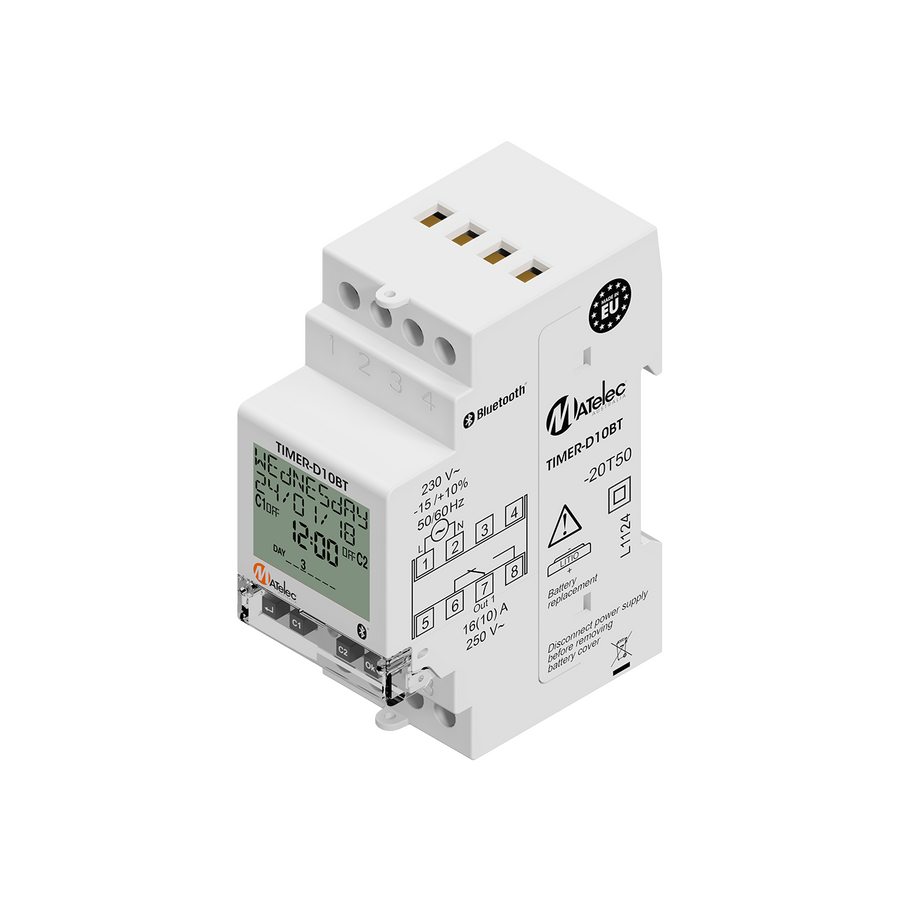
In Australian commercial and industrial environments, the demand for precise, efficient, and safe load scheduling continues to grow. From metropolitan retail precincts to remote mining infrastructure, lighting, HVAC systems, irrigation pumps, and process equipment must operate according to structured time logic to satisfy energy performance obligations and operational efficiency targets.
The Bluetooth Programmable LCD Time Switch represents the next stage in modular automation. It combines the reliability of a hard-wired DIN rail relay with secure local wireless programming via smartphone application. The result is improved configuration accuracy, enhanced safety, and reduced maintenance intervention within live switchboards.
Traditional DIN rail timers require physical interaction with small push buttons and compact LCD menus. Programming adjustments often require the switchboard door to be opened, placing the technician within proximity of live components.
A Bluetooth-enabled time switch removes this requirement. Using Bluetooth Low Energy (BLE) communication, the technician can configure, update, and verify schedules from a safe distance without touching the device. This reduces exposure to arc flash risk and eliminates unnecessary contact with energised enclosures during routine schedule updates.
The smartphone interface presents a full weekly schedule on a high-resolution screen, allowing visual confirmation of ON/OFF sequences and preventing overlapping or conflicting programming commands. This significantly reduces configuration errors common with traditional menu-driven interfaces.
While wireless configuration manages the logic layer, the internal relay performs the physical switching of the electrical load. Modern commercial lighting systems—particularly LED installations—exhibit high capacitive inrush currents during energisation.
If a relay closes at the peak of the AC waveform, significant arcing can occur. Over time, this leads to contact erosion or welding.
Advanced Bluetooth programmable timers incorporate zero-crossing switching. The internal controller monitors the AC sine wave and actuates the relay precisely at the zero-voltage crossing point. By minimising voltage potential at the moment of contact closure, inrush stress and arc energy are significantly reduced.
This improves relay life expectancy and enhances long-term reliability in commercial lighting and inductive control applications.
Wireless control introduces legitimate concerns regarding unauthorised access. Professional Bluetooth time switches operate via local proximity-based BLE communication rather than cloud-based Wi-Fi platforms.
Access is secured through encrypted pairing and PIN authentication, ensuring that only authorised personnel can modify schedules. Because the device operates autonomously without internet dependency, it remains functional regardless of network outages or cloud server availability.
Time synchronisation is achieved automatically when the smartphone connects to the device. The internal quartz oscillator is updated to match the phone’s reference time, ensuring synchronisation across multiple boards within a facility.
The Bluetooth Programmable LCD Time Switch is engineered for 35mm DIN rail mounting within compliant switchboards. Installation must align with AS/NZS 3000 requirements for segregation, termination integrity, and protection against accidental contact.
The device typically occupies two DIN modules and should be mounted with adequate spacing from high-heat components to maintain internal electronics within safe operating temperatures.
Where spare module space exists, blanking modules should be installed to preserve finger-safe protection and enclosure integrity.
Most Bluetooth timers feature relay outputs rated around 16A under resistive load conditions. In high-inrush or inductive environments, direct switching may reduce relay lifespan.
In these cases, the timer functions as a control pilot for a modular contactor. The timer energises the contactor coil, and the contactor handles the heavy load switching. This configuration isolates the timer electronics from high current stress and ensures long-term system durability.
Proper coordination between timer and contactor is essential in commercial lighting banks, HVAC circuits, and pump control installations.
Power interruptions must not compromise operational schedules. High-quality Bluetooth LCD timers incorporate internal battery or supercapacitor backup systems.
The internal quartz clock continues to operate during outages, and all switching programs are stored in non-volatile memory. When supply is restored, the device resumes operation according to the correct time and programmed schedule without manual intervention.
This resilience is critical in facilities where lighting and ventilation schedules must remain consistent for compliance and operational continuity.
Within modular distribution systems, reliable connectivity and circuit protection remain essential. SCHNAP Electric Products supports Bluetooth timer installations with complementary DIN rail accessories, including modular contactors for load switching, surge protection devices for transient suppression, and termination accessories to ensure secure conductor connections.
DIN rail surge protection devices are particularly important for safeguarding sensitive electronic components within the timer from grid transients and voltage spikes.
Bootlace ferrules provide stable, gas-tight termination of fine-stranded control wiring, maintaining long-term connection reliability within vibration-prone or high-temperature environments.
Selection of a Bluetooth Programmable LCD Time Switch must confirm regulatory compliance for Australian installations, including appropriate voltage ratings and environmental operating limits.
Devices should be rated for ambient switchboard temperatures and carry relevant regulatory compliance markings. Verification of relay rating, zero-crossing capability, and power reserve duration ensures suitability for the intended application.
Professional procurement through specialised electrical distribution channels ensures correct specification, compatibility, and long-term support.
The Bluetooth Programmable LCD Time Switch delivers a modern, safe, and precise approach to modular load scheduling. By combining local wireless programming, zero-crossing relay control, quartz-regulated accuracy, and DIN rail integration, it enhances both operational efficiency and technician safety.
When installed in accordance with Australian wiring standards and coordinated with appropriate load switching devices, it transforms a conventional distribution board into a secure and adaptable automation platform. In contemporary facility management, connectivity and precision define performance.

SCHNAP Electrical Wholesaler - clear, upfront pricing that professional electricians trust

Get what you need in seconds. SCHNAP electrical wholesaler makes ordering quick and simple

Fast delivery anywhere - that's guaranteed. SCHNAP electrical wholesalers ship nationwide with same-day dispatch

Track your order every step of the way. SCHNAP electrical wholesale keeps you updated from click to delivery

SCHNAP is Australia's premier electrical wholesaler and electrical supplies, marketing thousands of quality products from leading brands. Trusted for nearly two decades by licensed electricians, contractors, and engineers, our range covers everything from basic electrical components to complex industrial electrical equipment
Our key categories include: LED lighting, designer switches, commercial switchboards, circuit protection, security systems & CCTV, and smart home automation
All products are certified to Australian standards (AS/NZS), backed by our 30-day, no-questions-asked return policy. Our expert technical team helps you quickly source the right solution for any residential, commercial, or industrial project, with daily dispatch from our Sydney electrical warehouse delivering Australia-wide
SCHNAP offers the most comprehensive electrical product range, with full technical specifications, application details, installation requirements, compliance standards, and warranties — giving professionals total confidence in every purchase


Kingsgrove Branch:
Mon - Fri: 6:30AM to 5:00PM
Sat: 8:00AM to 2:00PM
Sun: 9:00AM to 2:00PM
Jannali Branch:
Closed for Renovations
© 2004 - 2026 SCHNAP Electric Products