

Kingsgrove Branch:


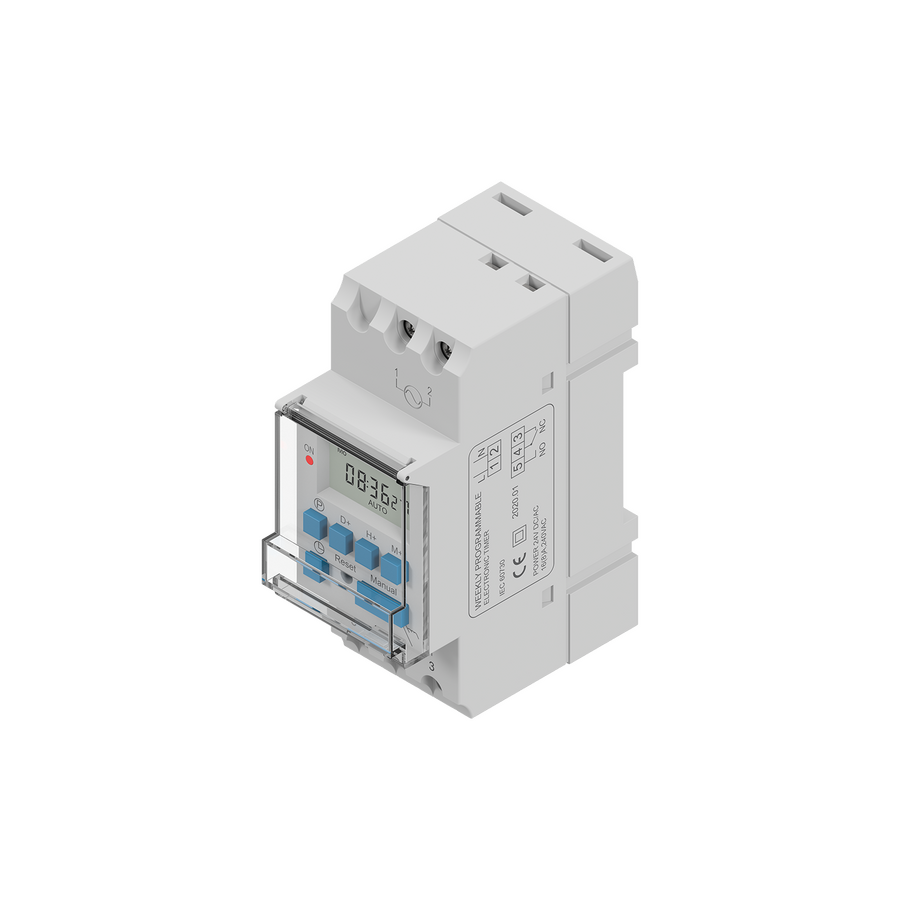
In Australian commercial and industrial facilities, precise scheduling of electrical loads is essential for energy efficiency, compliance, and operational consistency. From HVAC plant rooms in metropolitan office towers to irrigation systems and carpark lighting in regional infrastructure, automated timing control reduces waste and ensures that equipment operates only when required. Mechanical timers with gear-driven motors no longer provide the resolution or reliability demanded by contemporary building standards. The Digital Time Switch is a microprocessor-based control device designed for DIN rail installation within distribution boards, delivering accurate timekeeping, programmable logic, and reliable switching performance suitable for Australian installations.
The defining advantage of a Digital Time Switch is quartz-regulated timing accuracy. Traditional mechanical timers rely on synchronous motors operating at the nominal 50Hz mains frequency. Any deviation in grid frequency or mechanical wear in the gear train results in cumulative time drift.
A digital timer incorporates a quartz crystal oscillator, typically operating at 32.768 kHz, providing stable timekeeping with accuracy commonly within ±1 second per day under normal ambient conditions. This precision ensures reliable activation of lighting, HVAC, and other scheduled loads without progressive drift.
Advanced units also integrate zero-crossing switching technology. The internal microprocessor monitors the AC waveform and triggers the relay contact at the zero-voltage crossing point. By closing the contact when voltage potential is minimal, inrush stress and contact arcing are reduced. This extends relay lifespan, particularly when switching capacitive LED drivers or inductive contactor coils.
Continuity of operation during power interruption is critical in Australian installations, where outages and brownouts may occur. Mechanical timers cease operation immediately when supply voltage is lost, causing schedule misalignment.
A professional Digital Time Switch incorporates an internal power reserve system, typically based on a lithium cell or supercapacitor. This allows the internal clock to maintain accurate time for extended periods without mains supply.
Switching programs are stored in non-volatile EEPROM memory, ensuring that all programmed events are retained even if the power reserve is depleted. Upon restoration of supply, the device resumes operation in accordance with the stored schedule without requiring reprogramming.
Exterior lighting control requires dynamic adjustment based on seasonal daylight variation. Fixed-time switching results in inefficient energy use, particularly in regions where sunset times vary significantly throughout the year.
An astronomical Digital Time Switch eliminates this limitation. By inputting geographic coordinates, the internal processor calculates sunrise and sunset times for the installation location across the full calendar year. The switching cycle automatically adapts to seasonal changes without reliance on external photoelectric sensors.
This approach reduces maintenance associated with PE cells, which are susceptible to dirt accumulation or vandalism, and provides consistent lighting control for carparks, pathways, and security systems.
Beyond simple daily or weekly scheduling, modern facilities often require pulse and cyclic control. A Digital Time Switch can be programmed to deliver short-duration pulses, suitable for school bell systems or signalling circuits.
Cycle mode enables repetitive operation patterns, such as activating a circulation pump for a defined period every hour. This reduces programming complexity compared to entering multiple discrete events and allows efficient control of ventilation and irrigation systems.
These advanced logic functions support precise automation while maintaining a compact DIN rail footprint within the distribution board.
Most Digital Time Switch units include a relay rated for approximately 16A resistive load. However, switching high inrush lighting circuits or motor loads directly through the timer can exceed its endurance capacity.
In higher load applications, the time switch functions as a pilot device, energising the coil of a modular contactor. The contactor then manages the main load current. This configuration protects the timer’s internal electronics from thermal stress and ensures long-term switching reliability in commercial lighting and HVAC applications.
Correct DIN rail mounting and termination practices are essential for reliable operation. Fine-stranded conductors should be terminated with bootlace ferrules to ensure secure clamping within cage terminals and to prevent strand splaying. Neutral integrity is critical; loose terminations may cause display reset or intermittent malfunction.
Installation must comply with AS/NZS 3000, ensuring correct conductor sizing, segregation of control and power circuits, and proper enclosure protection. Devices installed within switchboards must also meet Australian regulatory compliance requirements and electromagnetic compatibility standards to prevent interference with sensitive equipment.
SCHNAP Electric Products supports Digital Time Switch installations through complementary DIN rail components. Bootlace ferrules enhance termination reliability for fine-gauge control wiring. Modular contactors enable safe switching of higher-current loads while using the time switch as a control interface.
Blanking poles and labelling accessories support structured switchboard layout and documentation, ensuring that the timer is clearly identified and accessible for maintenance. By integrating programmable control devices with compliant switching and termination components, SCHNAP Electric Products contributes to reliable and energy-efficient distribution board assemblies.
Digital Time Switch models vary by control voltage, relay rating, number of channels, and programming capability. Selection must align with the intended load profile, supply voltage (12V DC, 24V AC/DC, or 240V AC), and environmental conditions.
Professional procurement through a specialised electrical wholesaler ensures that the device carries appropriate compliance markings and verified EMC performance. Verification of relay durability, power reserve capacity, and programming interface suitability prevents premature failure and operational disruption.
The Digital Time Switch is a precision scheduling device central to modern building automation. Through quartz-regulated accuracy, zero-crossing switching technology, and advanced programmable logic, it provides reliable temporal control of electrical loads. When installed in accordance with Australian wiring standards and supported by structured DIN rail integration practices, it delivers consistent, energy-efficient operation across commercial and industrial facilities. In load scheduling applications, timing precision directly influences performance, compliance, and lifecycle reliability.

SCHNAP Electrical Wholesaler - clear, upfront pricing that professional electricians trust

Get what you need in seconds. SCHNAP electrical wholesaler makes ordering quick and simple

Fast delivery anywhere - that's guaranteed. SCHNAP electrical wholesalers ship nationwide with same-day dispatch

Track your order every step of the way. SCHNAP electrical wholesale keeps you updated from click to delivery

SCHNAP is Australia's premier electrical wholesaler and electrical supplies, marketing thousands of quality products from leading brands. Trusted for nearly two decades by licensed electricians, contractors, and engineers, our range covers everything from basic electrical components to complex industrial electrical equipment
Our key categories include: LED lighting, designer switches, commercial switchboards, circuit protection, security systems & CCTV, and smart home automation
All products are certified to Australian standards (AS/NZS), backed by our 30-day, no-questions-asked return policy. Our expert technical team helps you quickly source the right solution for any residential, commercial, or industrial project, with daily dispatch from our Sydney electrical warehouse delivering Australia-wide
SCHNAP offers the most comprehensive electrical product range, with full technical specifications, application details, installation requirements, compliance standards, and warranties — giving professionals total confidence in every purchase


Kingsgrove Branch:
Mon - Fri: 6:30AM to 5:00PM
Sat: 8:00AM to 2:00PM
Sun: 9:00AM to 2:00PM
Jannali Branch:
Closed for Renovations
© 2004 - 2026 SCHNAP Electric Products