

Kingsgrove Branch:


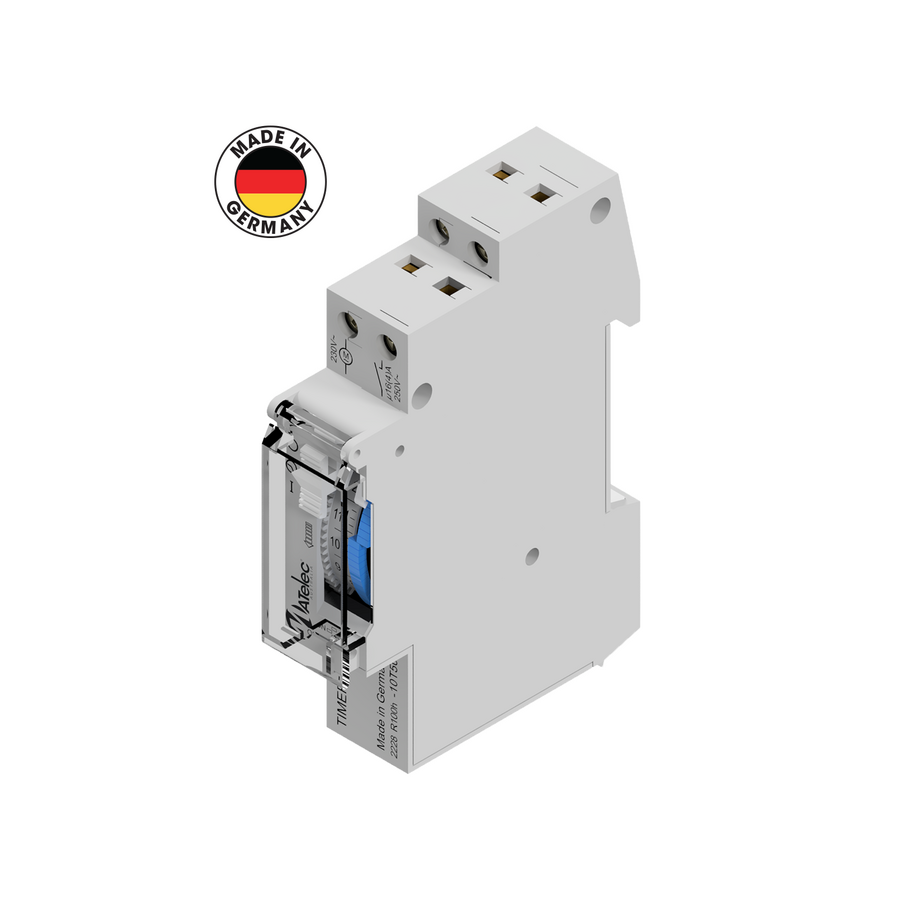
In Australian commercial and industrial installations, decentralised automation within distribution boards is a practical requirement for energy compliance and operational control. From apartment complexes in metropolitan Melbourne to industrial estates in Queensland, electrical loads such as lighting, ventilation, irrigation, and HVAC systems must operate on programmed schedules to reduce energy waste and align with building performance standards. The DIN Rail Timer Switch provides a compact, compliant, and space-efficient solution for time-based switching within switchboards. Designed to mount directly onto the standard 35mm DIN rail, it integrates seamlessly into modular distribution systems while delivering reliable scheduling logic.
DIN rail devices are dimensioned in modules, typically 17.5mm per module. A DIN Rail Timer Switch may occupy one, two, or three modules depending on whether it is mechanical or digital.
Space within a distribution board is limited, and thermal density must be considered. While timer switches themselves generate minimal heat, adjacent circuit breakers and contactors may produce significant thermal output under load. Prolonged exposure to elevated ambient temperatures can reduce the lifespan of internal electronic components, particularly capacitors within digital units.
Best practice installation involves appropriate spacing between the timer and high-current devices to support vertical convection cooling. Maintaining enclosure temperatures within manufacturer specifications preserves reliability and prevents premature component degradation.
Two primary timer technologies are commonly specified: mechanical analogue and digital programmable units.
A mechanical DIN Rail Timer Switch operates using a synchronous motor driven by the 50Hz mains supply. Rotating tappets or segments on the dial determine switching periods, typically in 15-minute increments. This architecture is robust and suitable for repetitive daily loads such as pool pumps or ventilation fans. However, it offers limited scheduling flexibility and coarse resolution.
Digital timer switches utilise a quartz crystal oscillator and microprocessor-based logic. Quartz regulation provides significantly improved timekeeping accuracy compared to synchronous motor designs. Digital units support weekly scheduling, multiple switching events per day, and distinct weekday/weekend programming. For applications requiring minute-level or second-level precision—such as security lighting or signalling circuits—digital control provides superior performance.
Electrical supply interruptions are a reality in many Australian regions. Mechanical timers without reserve capacity stop immediately when power is lost, resulting in schedule drift equal to the outage duration.
Professional DIN Rail Timer Switch units incorporate power reserve systems. Mechanical variants may use rechargeable battery-driven stepper motors, while digital models typically include lithium cells or supercapacitors to maintain internal clock operation.
Program data is stored in non-volatile memory, ensuring that switching schedules remain intact even during extended outages. Upon restoration of supply, the timer resumes operation without manual reconfiguration, maintaining operational continuity.
Most DIN Rail Timer Switch devices include an electromechanical relay rated approximately 16A under resistive load conditions (AC-1). Direct switching of high inrush or inductive loads—such as LED lighting arrays or motor-driven equipment—can reduce relay lifespan or cause contact welding.
In higher-load applications, the timer functions as a pilot device controlling a modular contactor. The timer energises the contactor coil, and the contactor switches the primary load current. This arrangement isolates the timer’s internal relay from arc stress and ensures durability under inductive or capacitive load conditions.
Proper coordination between timer and contactor improves switching reliability and reduces maintenance frequency in commercial lighting and HVAC control systems.
Installation of a DIN Rail Timer Switch must comply with AS/NZS 3000. Live parts must remain protected against accidental contact, and conductor sizing and segregation must meet regulatory requirements.
When mounting the timer within the switchboard escutcheon, any adjacent unused module spaces should be filled with blanking modules to maintain IP2X finger-safe protection. Secure termination using bootlace ferrules ensures consistent clamping force in cage terminals and prevents strand splaying.
Clear labelling of timer-controlled circuits assists maintenance personnel in identifying associated loads quickly and accurately.
SCHNAP Electric Products supports modular switchboard installations through complementary DIN rail accessories. Modular contactors provide safe switching of higher-current loads when used in conjunction with timer switches. Bootlace ferrules improve termination integrity for fine-stranded control wiring.
Blanking poles maintain enclosure safety where spare module space exists, preserving finger-safe compliance. DIN rail enclosures enable remote mounting where direct integration within the primary board is not feasible.
By combining programmable timing devices with compliant switching and termination accessories, SCHNAP Electric Products contributes to structured and durable automation systems within Australian facilities.
DIN Rail Timer Switch models vary by voltage rating, channel configuration, program capacity, and mechanical or digital architecture. Selection must align with the intended load type, supply voltage (12V DC, 24V AC/DC, or 240V AC), and environmental conditions within the enclosure.
Professional procurement through a specialised electrical wholesaler ensures that the device carries appropriate regulatory compliance marking and verified electromagnetic compatibility performance. Confirmation of relay rating, power reserve capacity, and enclosure suitability prevents operational issues and supports long-term reliability.
The DIN Rail Timer Switch provides structured and space-efficient time-based automation within distribution boards. Whether mechanical or digital, it enables reliable scheduling of lighting, HVAC, and process loads in compliance with Australian installation standards. Through careful consideration of modular spacing, load coordination, and proper wiring practices, it transforms a static distribution board into a responsive control system. When integrated with compliant switching and accessory components, it delivers consistent and maintainable automation across commercial and industrial projects.

SCHNAP Electrical Wholesaler - clear, upfront pricing that professional electricians trust

Get what you need in seconds. SCHNAP electrical wholesaler makes ordering quick and simple

Fast delivery anywhere - that's guaranteed. SCHNAP electrical wholesalers ship nationwide with same-day dispatch

Track your order every step of the way. SCHNAP electrical wholesale keeps you updated from click to delivery

SCHNAP is Australia's premier electrical wholesaler and electrical supplies, marketing thousands of quality products from leading brands. Trusted for nearly two decades by licensed electricians, contractors, and engineers, our range covers everything from basic electrical components to complex industrial electrical equipment
Our key categories include: LED lighting, designer switches, commercial switchboards, circuit protection, security systems & CCTV, and smart home automation
All products are certified to Australian standards (AS/NZS), backed by our 30-day, no-questions-asked return policy. Our expert technical team helps you quickly source the right solution for any residential, commercial, or industrial project, with daily dispatch from our Sydney electrical warehouse delivering Australia-wide
SCHNAP offers the most comprehensive electrical product range, with full technical specifications, application details, installation requirements, compliance standards, and warranties — giving professionals total confidence in every purchase


Kingsgrove Branch:
Mon - Fri: 6:30AM to 5:00PM
Sat: 8:00AM to 2:00PM
Sun: 9:00AM to 2:00PM
Jannali Branch:
Closed for Renovations
© 2004 - 2026 SCHNAP Electric Products