

Kingsgrove Branch:


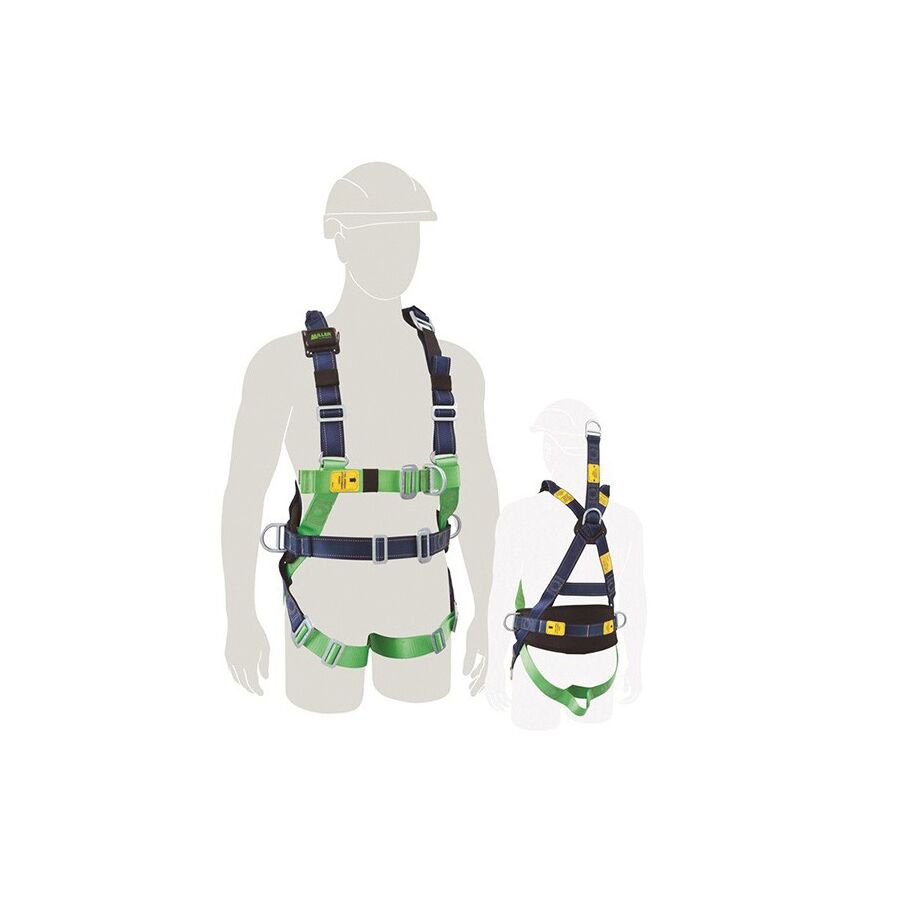
In Australian construction, utilities and heavy industry, working at height introduces significant gravitational risk.
When elimination and engineering controls cannot fully remove the hazard, personal protective systems must comply with AS/NZS 1891.
The Fall Protection Harness is the primary life-support component of any fall arrest system.
It is engineered to transform the violent physics of a fall into a survivable deceleration event.
During a fall, gravitational acceleration converts body mass into kinetic energy.
When a lanyard or inertia reel arrests the fall, this energy must be absorbed instantly.
Australian Standards limit the maximum arrest force applied to the body to 6kN.
A compliant full-body harness distributes this load across:
• Shoulders • Chest • Pelvis • Upper thighs
The dorsal D-ring located between the shoulder blades acts as the primary connection point.
During deceleration, the sub-pelvic strap system engages, redirecting forces into the stronger skeletal structures of the pelvis and femur rather than the spine or abdomen.
This biomechanical load distribution prevents catastrophic internal injury.
Industrial environments expose harnesses to:
• Intense UV radiation • Heat cycling • Moisture • Abrasion • Chemical exposure
High-quality harnesses are constructed from high-tenacity polyester webbing.
Polyester provides:
• Superior UV resistance • Reduced moisture absorption • High tensile strength • Long-term structural integrity
Breaking strength ratings typically exceed 15kN to ensure safety margins under dynamic loading.
Metallic hardware components such as D-rings and buckles are manufactured from:
• High-tensile alloy steel • Corrosion-resistant coatings • Aerospace-grade aluminium in lightweight variants
These components must withstand repeated dynamic shock loading without deformation or fracture.
Arresting a fall is only the first stage of survival.
A suspended worker faces the risk of suspension trauma (orthostatic intolerance).
When hanging motionless:
• Blood pools in the lower limbs • Venous return decreases • Cerebral oxygen supply drops
Advanced harnesses incorporate integrated trauma relief straps.
These deployable loops allow the suspended worker to stand partially upright within the harness.
Engaging the leg muscles restores blood circulation and extends survivable suspension time until rescue.
Harness design must balance strength with comfort.
Adjustable features include:
• Shoulder strap adjusters • Chest buckles • Leg strap padding • Breathable back panels
Proper adjustment ensures:
• Even load distribution • Reduced pressure points • Improved mobility • Lower fatigue during extended tasks
Comfort directly influences compliance and correct usage.
Working at height introduces secondary hazards from dropped tools.
Harnesses commonly include integrated tool loops for equipment management.
SCHNAP Electric Products supports elevated work safety with:
• Heavy-duty tool lanyards • Insulated hand tools • Secure fastening accessories
Tool tethering prevents dropped object incidents, protecting personnel working below.
Integrated tool management enhances overall height safety protocols.
Fall protection harnesses require:
• Pre-use visual inspection • Six-monthly formal inspection • Serial number tracking • Date-of-manufacture identification
Compliance documentation ensures alignment with AS/NZS 1891 requirements.
Procurement through specialised electrical wholesaler ensures:
• Certified batch testing • Manufacturer compliance documentation • Traceable inspection registers • Approved hardware compatibility
Fall Protection Harness systems are essential for:
• Transmission tower maintenance • Commercial high-rise construction • Industrial plant shutdowns • Utility pole installations • Roof-mounted equipment servicing
Correct selection depends on work positioning, restraint or fall arrest configuration.
The Fall Protection Harness is the critical interface between human biomechanics and gravitational force.
By redistributing arrest loads, utilising UV-resistant webbing and incorporating suspension trauma mitigation, it converts a potentially fatal fall into a survivable event.
When integrated with compliant anchorage systems and supported by professional tooling accessories from SCHNAP Electric Products, it forms the backbone of height safety management in Australian industry.
In vertical operations, engineered preparation is the ultimate safeguard against gravity.

SCHNAP Electrical Wholesaler - clear, upfront pricing that professional electricians trust

Get what you need in seconds. SCHNAP electrical wholesaler makes ordering quick and simple

Fast delivery anywhere - that's guaranteed. SCHNAP electrical wholesalers ship nationwide with same-day dispatch

Track your order every step of the way. SCHNAP electrical wholesale keeps you updated from click to delivery

SCHNAP is Australia's premier electrical wholesaler and electrical supplies, marketing thousands of quality products from leading brands. Trusted for nearly two decades by licensed electricians, contractors, and engineers, our range covers everything from basic electrical components to complex industrial electrical equipment
Our key categories include: LED lighting, designer switches, commercial switchboards, circuit protection, security systems & CCTV, and smart home automation
All products are certified to Australian standards (AS/NZS), backed by our 30-day, no-questions-asked return policy. Our expert technical team helps you quickly source the right solution for any residential, commercial, or industrial project, with daily dispatch from our Sydney electrical warehouse delivering Australia-wide
SCHNAP offers the most comprehensive electrical product range, with full technical specifications, application details, installation requirements, compliance standards, and warranties — giving professionals total confidence in every purchase


Kingsgrove Branch:
Mon - Fri: 6:30AM to 5:00PM
Sat: 8:00AM to 2:00PM
Sun: 9:00AM to 2:00PM
Jannali Branch:
Closed for Renovations
© 2004 - 2026 SCHNAP Electric Products