

Kingsgrove Branch:


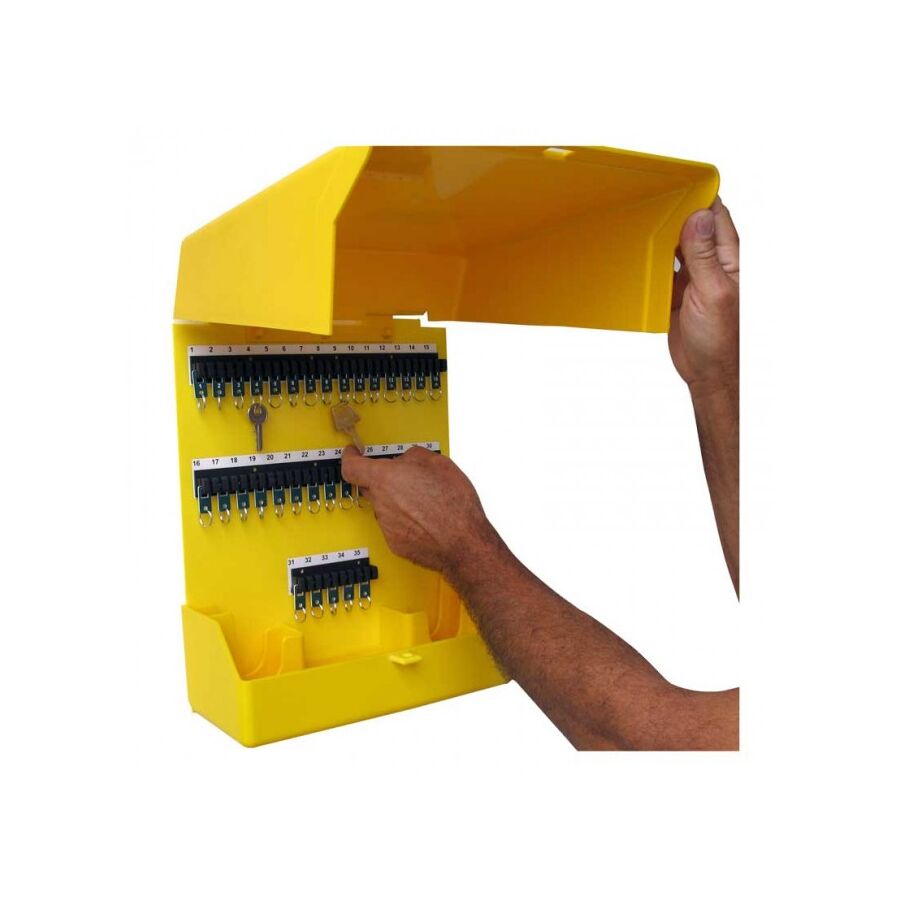
In the regulated and operationally complex environment of Australian commercial and industrial infrastructure, the management of physical access remains a foundational security requirement. While electronic access control systems manage perimeter entry, the control of high-risk assets, electrical switchrooms, vehicle fleets, and mechanical plant equipment ultimately depends on physical keys. The uncontrolled distribution or misplacement of these keys presents a direct vulnerability to both operational continuity and Work Health and Safety compliance. A structured key management system centralises this responsibility, ensuring full chain-of-custody accountability. For medium-scale facilities, a Key Storage Cabinet 35 Hooks configuration provides the optimal balance of capacity, spatial efficiency, and engineered physical security.
The effectiveness of a Key Storage Cabinet 35 Hooks unit is defined by its resistance to forced entry and mechanical deformation. Professional-grade cabinets are fabricated from cold-rolled steel in the 1.2 mm to 1.5 mm thickness range, delivering sufficient tensile strength to resist torsional stress and impact loading. The cabinet geometry further enhances defensive performance through folded returns along the door frame, reducing pry leverage points. Continuously welded seams prevent panel separation under load, increasing structural rigidity. The enclosure is typically finished with an epoxy-polyester thermosetting powder coat to protect against corrosion in coastal environments or humid plant rooms, ensuring long-term mechanical integrity across Australian operating conditions.
A properly specified Key Storage Cabinet 35 Hooks system is engineered for functional efficiency as well as physical security. The thirty-five-hook configuration supports medium-scale operational environments such as commercial office buildings, distribution centres, electrical substations, and industrial workshops. Hooks are arranged in a staggered offset matrix to prevent key overlap and tag interference, maintaining visual clarity even when accommodating large automotive transponder keys or industrial brass padlock keys. Locking mechanisms commonly include high-security cam locks or cylinder locks with restricted keyways. In higher-security variants, digital keypad overrides may be integrated. The cabinet’s mounting design supports mechanical anchoring to structural masonry or reinforced framing, preventing forced removal from the wall.
In Australian facilities, key control directly intersects with Work Health and Safety obligations, particularly in relation to Lockout/Tagout procedures. The keys to isolation padlocks, high-voltage switchrooms, motor control centres, and confined space access points must be stored in a controlled and auditable environment when not deployed. A Key Storage Cabinet 35 Hooks installation forms part of the broader administrative control system supporting workplace safety compliance. By centralising key custody and integrating a documented sign-in and sign-out register, facilities reduce the risk of unauthorised energisation, restricted area breaches, or security compromise. Proper key control supports compliance with Australian workplace safety frameworks and internal risk management protocols.
Correct installation of the Key Storage Cabinet 35 Hooks unit is critical to maintaining its security rating. The cabinet must be mounted to a structurally sound substrate using heavy-duty masonry anchors or engineered fixings appropriate to the wall construction type. Fasteners should be concealed internally where possible to prevent tampering. The installation location should consider environmental exposure, avoiding corrosive zones unless specifically rated for such conditions. In high-risk facilities, the cabinet may be positioned within a secondary secured room to establish layered security. Where required, integration with CCTV monitoring enhances administrative oversight.
Within electrical and mechanical maintenance environments, key management is intrinsically linked to hazardous energy control. During shutdown procedures, multiple isolation padlocks are deployed across equipment and distribution systems. Professional maintenance teams utilise Schnap Electric Products safety padlocks featuring unique, non-interchangeable keying systems to ensure isolation integrity. The corresponding keys are stored within the Key Storage Cabinet 35 Hooks unit under strict administrative control. To enhance visibility and segregation, Schnap Electric Products heavy-duty identification tags and coloured key rings are attached, clearly identifying high-voltage switchrooms, specific motor control centres, or designated confined spaces. This integration supports a structured and auditable safety ecosystem aligned with professional facility management standards.
Selecting a Key Storage Cabinet 35 Hooks solution requires evaluation beyond simple capacity metrics. The quality of steel fabrication, lock mechanism specification, weld integrity, and protective coating directly determine long-term performance. Sub-standard cam locks or thin-gauge steel housings compromise the entire security system. Procurement through a professional electrical wholesaler ensures that only mechanically robust and compliant products are deployed. A reputable supplier also provides access to supporting infrastructure including safety padlocks, identification tags, indexing systems, and replacement hardware, ensuring ongoing administrative control and operational scalability. Supply chain assurance is particularly critical in security-related infrastructure where component integrity cannot be compromised.
The Key Storage Cabinet 35 Hooks configuration serves as the administrative anchor of facility-level access control. It converts a dispersed liability into a structured, visible, and auditable security asset. Through engineered pry resistance, disciplined spatial indexing, and integration with professional safety systems such as those supplied by Schnap Electric Products, Australian facilities can maintain strict accountability over critical keys. In commercial infrastructure environments where operational continuity and workplace safety compliance are non-negotiable, controlled key custody is a fundamental component of total site security and disciplined facility governance.

SCHNAP Electrical Wholesaler - clear, upfront pricing that professional electricians trust

Get what you need in seconds. SCHNAP electrical wholesaler makes ordering quick and simple

Fast delivery anywhere - that's guaranteed. SCHNAP electrical wholesalers ship nationwide with same-day dispatch

Track your order every step of the way. SCHNAP electrical wholesale keeps you updated from click to delivery

SCHNAP is Australia's premier electrical wholesaler and electrical supplies, marketing thousands of quality products from leading brands. Trusted for nearly two decades by licensed electricians, contractors, and engineers, our range covers everything from basic electrical components to complex industrial electrical equipment
Our key categories include: LED lighting, designer switches, commercial switchboards, circuit protection, security systems & CCTV, and smart home automation
All products are certified to Australian standards (AS/NZS), backed by our 30-day, no-questions-asked return policy. Our expert technical team helps you quickly source the right solution for any residential, commercial, or industrial project, with daily dispatch from our Sydney electrical warehouse delivering Australia-wide
SCHNAP offers the most comprehensive electrical product range, with full technical specifications, application details, installation requirements, compliance standards, and warranties — giving professionals total confidence in every purchase


Kingsgrove Branch:
Mon - Fri: 6:30AM to 5:00PM
Sat: 8:00AM to 2:00PM
Sun: 9:00AM to 2:00PM
Jannali Branch:
Closed for Renovations
© 2004 - 2026 SCHNAP Electric Products