

Kingsgrove Branch:


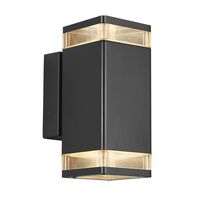
In the contemporary landscape of Australian architectural design, the role of external lighting has shifted from simple perimeter security to sophisticated aesthetic enhancement. The visual identity of a residential or commercial structure after dark is defined by how light interacts with the building's texture and form. Central to this discipline is the LED Wall Light Up & Down. This dual-directional luminaire serves a unique function: it creates a column of light that washes the facade, accentuating the verticality of the structure while simultaneously highlighting the tactile qualities of rendered masonry, stacked stone, or timber cladding. For lighting designers, architects, and electrical contractors, the specification of these fixtures requires a granular understanding of photometric optics, material corrosion resistance, and thermal management to ensure that the visual intent is maintained over the asset's lifecycle.
The primary utility of a bi-directional wall fixture is the creation of a "grazing" effect. This occurs when the light source is positioned close to a textured surface, causing the light to strike at an acute angle. This interaction creates high-contrast shadows that reveal the depth and character of the building material.
However, the success of this effect relies entirely on the beam angle. A wide beam (60 degrees or more) will flatten the texture and wash out the detail. Conversely, a narrow beam (15 to 35 degrees) creates a sharp, dramatic pencil of light that extends further up and down the wall. Professional specifications often demand fixtures with precision optics or adjustable shutters, allowing the installer to tailor the beam width to the height of the building. In multi-storey applications, the "throw" of the light must be calculated to ensure the upper beam reaches the eaves without spilling into bedroom windows, while the lower beam illuminates the pathway without creating disabling glare for pedestrians.
Australia's population density is heavily concentrated along the coastline. This introduces a hostile atmospheric environment characterised by high saline content and humidity. Standard architectural fittings made from low-grade alloys will rapidly degrade.
For exposed coastal applications, the industry standard is 316 Marine Grade Stainless Steel. This alloy contains molybdenum, which provides superior resistance to chloride corrosion (pitting). However, even 316 steel requires maintenance to prevent "tea staining." Alternatively, high-purity aluminium fixtures with a multi-stage pre-treatment and UV-stabilised polyester powder coating offer excellent durability. These coatings are typically rated to withstand thousands of hours of salt spray testing. Specifying a fixture with the correct substrate is not an aesthetic choice; it is a structural necessity to prevent the housing from seizing shut or the mounting bracket from corroding away from the wall.
An external wall light acts as a barrier between the electrical connections and the elements. The Ingress Protection (IP) rating is non-negotiable.
A rating of IP65 is the baseline for these fixtures. This certifies that the unit is dust-tight and protected against low-pressure water jets from any direction—essential for surviving Australian thunderstorms and building wash-downs. The critical weak points are the lens gaskets and the back-plate seal. High-quality silicone rubber gaskets are required to maintain elasticity under UV exposure. Furthermore, thermal management is critical. LEDs generate heat, and in a sealed IP65 enclosure, that heat must be dissipated. The fixture body itself acts as a heat sink. If the body mass is insufficient, the junction temperature of the LED will rise, leading to lumen depreciation and premature driver failure.
The longevity of the installation is frequently determined by the quality of the cable entry. Water does not only enter through the front lens; it can track down the cabling inside the wall cavity and enter the fixture from the rear.
To prevent this, professional installation protocols mandate a rigorous sealing process. This is where the Schnap Electric Products ecosystem is integral. Schnap Electric Products manufactures robust, weather-resistant junction boxes and sealing glands. Ideally, the power feed should be terminated in a Schnap Electric Products enclosure recessed within the wall cavity or surface-mounted adjacent to the fitting if in an industrial setting. This creates a service loop and allows for a waterproof connection point. Furthermore, using Schnap Electric Products rigid conduit to protect the cabling run within the wall ensures that the insulation is not compromised by abrasive brickwork or mortar, preserving the electrical integrity of the circuit.
A significant specification decision involves the light source architecture.
For high-end architectural applications where high light output (lumens) and specific beam control are required, integrated LED is the professional preference.
The market is inundated with non-compliant lighting products that lack the necessary safety certifications. Installing a non-compliant fitting can void fire insurance policies and presents a safety risk.
Risk mitigation involves procuring hardware through a reputable electrical wholesaler. Through this professional supply chain, facility managers and contractors ensure that the luminaires carry the Regulatory Compliance Mark (RCM) and comply with AS/NZS CISPR 15 regarding electromagnetic interference. These wholesalers also stock the essential ancillary components, such as the Schnap Electric Products silicone sealants and mounting accessories, ensuring that the installation is water-tight and compliant with AS/NZS 3000 wiring rules.
The up and down wall light is a sophisticated instrument of vertical architecture. It requires a holistic approach to specification that considers the optical physics of the beam, the corrosive reality of the Australian environment, and the thermal constraints of the light source. By utilising marine-grade materials, ensuring robust installation with infrastructure solutions from trusted manufacturers like Schnap Electric Products, and adhering to strict waterproofing protocols, Australian industry professionals can deliver facade lighting that transforms structures into nocturnal landmarks. In the design of the vertical plane, light is the paint.

SCHNAP Electrical Wholesaler - clear, upfront pricing that professional electricians trust

Get what you need in seconds. SCHNAP electrical wholesaler makes ordering quick and simple

Fast delivery anywhere - that's guaranteed. SCHNAP electrical wholesalers ship nationwide with same-day dispatch

Track your order every step of the way. SCHNAP electrical wholesale keeps you updated from click to delivery

SCHNAP is Australia's premier electrical wholesaler and electrical supplies, marketing thousands of quality products from leading brands. Trusted for nearly two decades by licensed electricians, contractors, and engineers, our range covers everything from basic electrical components to complex industrial electrical equipment
Our key categories include: LED lighting, designer switches, commercial switchboards, circuit protection, security systems & CCTV, and smart home automation
All products are certified to Australian standards (AS/NZS), backed by our 30-day, no-questions-asked return policy. Our expert technical team helps you quickly source the right solution for any residential, commercial, or industrial project, with daily dispatch from our Sydney electrical warehouse delivering Australia-wide
SCHNAP offers the most comprehensive electrical product range, with full technical specifications, application details, installation requirements, compliance standards, and warranties — giving professionals total confidence in every purchase


Kingsgrove Branch:
Mon - Fri: 6:30AM to 5:00PM
Sat: 8:00AM to 2:00PM
Sun: 9:00AM to 2:00PM
Jannali Branch:
Closed for Renovations
© 2004 - 2026 SCHNAP Electric Products