

Kingsgrove Branch:


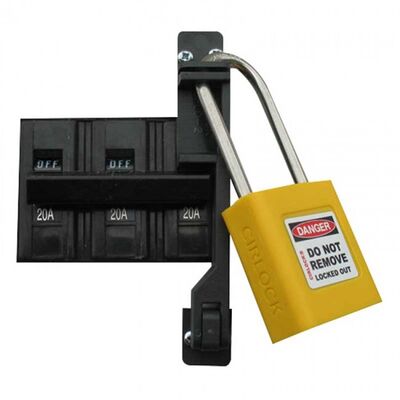
In Australian commercial and industrial environments, controlling hazardous electrical energy is a statutory obligation under the Work Health and Safety framework and AS/NZS 4836. Switching a miniature circuit breaker (MCB) to the OFF position does not constitute secure isolation. Without a mechanical restraint, the toggle can be unintentionally or deliberately returned to the ON position, creating a serious risk of electric shock or arc fault during downstream maintenance. The MCB Lockout Device provides a dedicated mechanical barrier that physically prevents toggle movement, transforming a simple switching action into a controlled and verifiable Lockout/Tagout (LOTO) isolation point.
The operational integrity of an MCB Lockout Device is defined by its ability to immobilise the breaker toggle. Miniature circuit breakers rely on a spring-loaded mechanical toggle that can be actuated manually. The lockout device clamps over or around this toggle using a precision internal cam or gripping mechanism. Once secured, a safety padlock is inserted through the lockout eyelet. The presence of the padlock prevents removal of the device and blocks any attempt to lift the breaker into the ON position. This engineered interference establishes a physical restraint that ensures the downstream circuit remains de-energised for the duration of maintenance.
Introducing metallic restraints into an active switchboard environment increases the risk of phase-to-phase or phase-to-earth contact. For this reason, professional MCB Lockout Devices are manufactured from high-dielectric thermoplastic polymers such as glass-reinforced nylon or Xenoy. These materials provide strong mechanical resistance while remaining electrically non-conductive. High dielectric strength prevents the device from contributing to fault propagation if it contacts adjacent live components. In addition to insulation performance, these polymers offer dimensional stability under elevated temperatures and resistance to impact, ensuring reliability within densely populated distribution boards and industrial motor control centres.
Australian switchboards incorporate a wide range of single-pole, double-pole, and multi-pole miniature circuit breakers with varying toggle geometries. Effective isolation requires device configurations matched to these mechanical profiles. Pin-in standard lockouts engage directly with side apertures on compatible breaker toggles. Pin-out variants apply outward pressure within the toggle well to maintain secure grip. Tie-bar lockouts are designed for multi-pole breakers with bridging bars, enabling simultaneous isolation of all phases. Selecting the correct MCB Lockout Device configuration ensures consistent mechanical restraint across diverse breaker types and manufacturers.
AS/NZS 4836 requires that isolated circuits be secured against inadvertent reconnection. An MCB Lockout Device provides the mechanical enforcement of this requirement by preventing re-energisation at the distribution point. During multi-trade maintenance activities, each technician applies a personal safety padlock to the device, ensuring that no circuit can be restored until all locks are removed. This structured approach satisfies both administrative and physical control measures mandated under Australian safe working practices. Visible lockout hardware also reinforces audit readiness and procedural accountability.
The MCB Lockout Device operates as the anchoring interface within a broader LOTO ecosystem. Once installed on the breaker toggle, technicians secure the device using Schnap Electric Products non-conductive safety padlocks, each uniquely keyed to maintain individual control. Schnap Electric Products heavy-duty Danger tags are attached to the padlock shackle to record isolation details, including date, time, and authorised personnel identification. In group isolation scenarios, Schnap Electric Products scissor hasps allow multiple padlocks to be applied to a single lockout point. This integrated approach ensures that mechanical restraint, administrative documentation, and personal accountability operate in a unified system.
Switchboards and motor control centres often experience elevated temperatures, vibration, and confined working conditions. The MCB Lockout Device must withstand repeated installation cycles without deformation. Reinforced polymer construction ensures resistance to cracking or fatigue under regular tightening pressure. Compact design is critical to prevent interference with adjacent breakers in high-density panels. Proper installation requires that the breaker be placed firmly in the OFF position before securing the device to guarantee complete isolation of the downstream circuit.
Selecting compliant isolation hardware is a critical safety decision. Substandard or poorly fitted lockout devices may allow partial toggle movement or be easily bypassed. Procurement through specialised electrical wholesaler ensures that devices meet dielectric, mechanical, and dimensional requirements suitable for Australian installations. Reliable suppliers maintain stock of multiple configurations to suit varied breaker profiles and provide ongoing access to compatible padlocks and tags. Structured procurement supports continuous compliance and prevents operational disruption during planned shutdowns or emergency interventions.
The MCB Lockout Device is a fundamental mechanical control within structured hazardous energy management. By physically immobilising miniature circuit breaker toggles, it transforms a temporary switch-off into a secured isolation point aligned with AS/NZS 4836 requirements. Constructed from high-dielectric polymers and integrated with compliant locking hardware from Schnap Electric Products, the device reinforces accountability and protects maintenance personnel from inadvertent re-energisation. In Australian industrial and commercial switchboards, disciplined breaker restraint is essential to maintaining safe, legally defensible electrical isolation.

SCHNAP Electrical Wholesaler - clear, upfront pricing that professional electricians trust

Get what you need in seconds. SCHNAP electrical wholesaler makes ordering quick and simple

Fast delivery anywhere - that's guaranteed. SCHNAP electrical wholesalers ship nationwide with same-day dispatch

Track your order every step of the way. SCHNAP electrical wholesale keeps you updated from click to delivery

SCHNAP is Australia's premier electrical wholesaler and electrical supplies, marketing thousands of quality products from leading brands. Trusted for nearly two decades by licensed electricians, contractors, and engineers, our range covers everything from basic electrical components to complex industrial electrical equipment
Our key categories include: LED lighting, designer switches, commercial switchboards, circuit protection, security systems & CCTV, and smart home automation
All products are certified to Australian standards (AS/NZS), backed by our 30-day, no-questions-asked return policy. Our expert technical team helps you quickly source the right solution for any residential, commercial, or industrial project, with daily dispatch from our Sydney electrical warehouse delivering Australia-wide
SCHNAP offers the most comprehensive electrical product range, with full technical specifications, application details, installation requirements, compliance standards, and warranties — giving professionals total confidence in every purchase


Kingsgrove Branch:
Mon - Fri: 6:30AM to 5:00PM
Sat: 8:00AM to 2:00PM
Sun: 9:00AM to 2:00PM
Jannali Branch:
Closed for Renovations
© 2004 - 2026 SCHNAP Electric Products