

Kingsgrove Branch:


Across Australia’s expansive and often challenging terrain, reliable mobile coverage remains uneven. In outer metropolitan fringes, rural properties and remote commercial facilities, cellular blackspots limit communication, reduce productivity and create safety risks. Signal attenuation caused by distance from the base station, terrain obstruction and the shielding effect of modern metal-clad construction significantly weakens indoor reception.
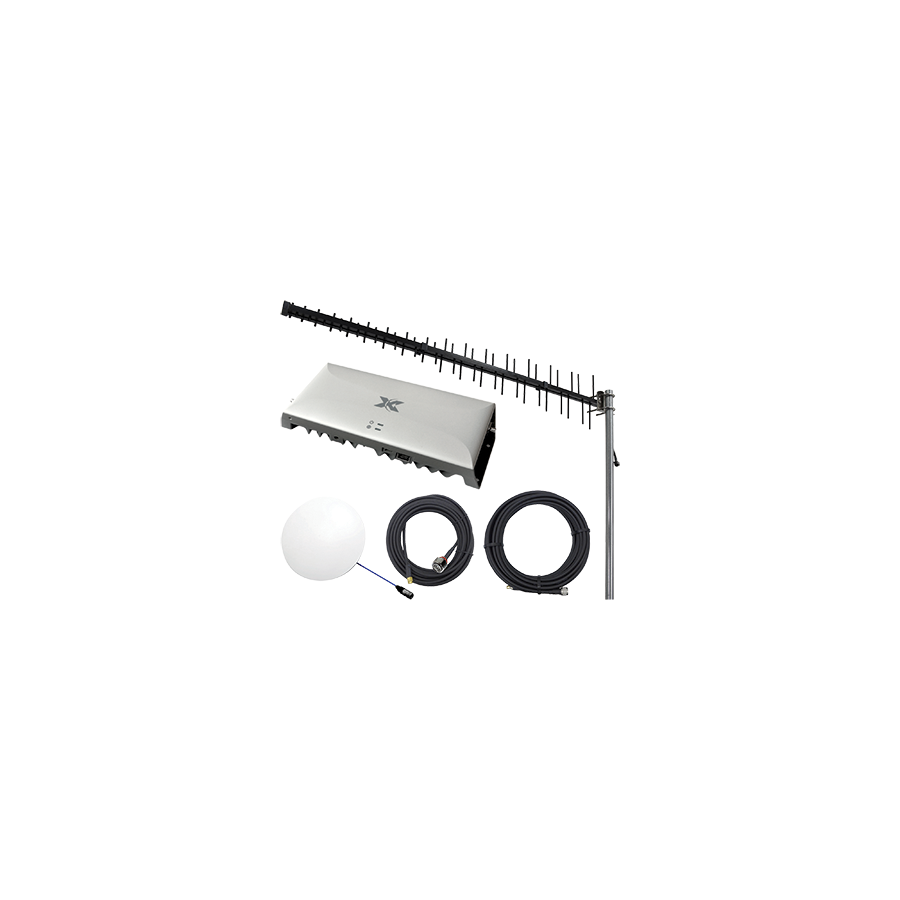
The engineered solution to this challenge is a professionally configured Mobile Signal Repeater Kit. Unlike standalone components that risk impedance mismatch and compliance failure, a complete kit provides a matched ecosystem. It typically includes a donor antenna, an ACMA approved smart repeater unit, 50-ohm low-loss coaxial cable and an internal service antenna. All components are designed to operate together within Australian regulatory requirements and telecommunications standards.
A properly selected kit ensures reliable performance while protecting the integrity of carrier networks.
At the core of the Mobile Signal Repeater Kit is the active smart repeater unit. This device is not a simple amplifier but a controlled digital signal processor. It receives the weak RF signal captured by the external donor antenna, processes it, removes noise and then amplifies it before retransmitting indoors through the service antenna.
The amplification process must be intelligent. Blind amplification raises the network noise floor and can interfere with the base station. ACMA approved smart repeaters continuously monitor path loss, signal strength and interference levels. If oscillation or excessive feedback is detected, the device automatically reduces gain to protect the network.
This dynamic gain management is what distinguishes compliant smart systems from illegal wideband boosters. It ensures strong indoor coverage without degrading the carrier infrastructure.
One of the most common causes of installation failure is incorrect cabling. Mobile telecommunications systems operate at 50-ohm impedance, while television systems use 75-ohm cable. Substituting TV-grade cable introduces impedance mismatch and elevated Voltage Standing Wave Ratio.
High VSWR reflects RF energy back toward the amplifier rather than delivering it to the antenna. This not only reduces performance but may also overheat the repeater. Professional Mobile Signal Repeater Kits include LMR-400 or LMR-240 grade 50-ohm coaxial cable to minimise attenuation and maintain impedance stability.
At higher frequencies such as 2100MHz and 2600MHz, cable attenuation becomes significant. Excessive cable length using inferior materials can negate antenna gain entirely. Engineered kits account for these losses and ensure the link budget remains positive across operating bands.
The donor antenna determines how effectively the system captures external signal. Its selection depends on the surrounding RF environment.
In regional areas where the base station may be more than 20 kilometres away, high-gain directional antennas such as Yagi or log periodic arrays are required. These antennas focus reception in a narrow beam, increasing effective gain and improving signal clarity.
In suburban environments where signal is available outdoors but blocked by building materials, omni-directional antennas may be suitable. These capture signal from multiple directions and support carrier aggregation across several frequency bands.
Correct antenna selection ensures the repeater amplifies a clean and stable source signal rather than background interference.
Proper antenna isolation is critical to system stability. If the internal service antenna is placed too close to the external donor antenna, a feedback loop can occur. This oscillation mirrors acoustic feedback in sound systems and prevents the repeater from operating effectively.
Engineering best practice requires physical and electromagnetic separation between antennas greater than the system gain. Structural barriers such as concrete slabs, combined with vertical and horizontal distance, improve isolation. Smart repeater software will reduce output power if oscillation is detected, but correct placement ensures maximum performance.
A complete Mobile Signal Repeater Kit includes mounting hardware designed to support optimal antenna positioning.
Installing a repeater kit involves rooftop antenna mounting and routing coaxial cable into the building’s electrical environment. This introduces exposure to lightning and surge events.
SCHNAP Electric Products supports compliant installations by providing protective infrastructure components. Coaxial surge protectors divert high-voltage transients to earth, protecting the repeater unit. Surge-protected power outlets stabilise the 240V supply and shield sensitive electronics from grid disturbances.
Proper conduit systems and cable management accessories protect LMR cable from UV degradation and mechanical damage. Supporting infrastructure ensures the repeater system remains durable and compliant under Australian environmental conditions.
The Australian market contains many illegal and non-compliant booster devices sold through international platforms. Installing such equipment may result in substantial fines and network disruption.
Only ACMA approved smart repeater systems should be deployed. Professional procurement through a specialised electrical wholesaler ensures the kit supports the correct frequency bands for Telstra, Optus or Vodafone. It also ensures that connectors and cabling are correctly matched and certified.
SCHNAP Electric Products supports telecommunications professionals with compliant installation accessories and protective infrastructure components. Selecting verified hardware protects both the installer and the carrier network.
Mobile Signal Repeater Kits are widely deployed in agricultural stations, warehouses, office buildings, underground car parks and remote facilities. In regional areas, they restore communication where macro coverage is weak. In commercial buildings, they overcome the shielding effects of metal roofing and energy-efficient glazing.
Reliable indoor coverage improves operational efficiency, enhances safety communication and supports business continuity. When engineered correctly, repeater systems provide stable voice and data performance without compromising regulatory compliance.
The Mobile Signal Repeater Kit provides a complete and engineered solution for overcoming indoor cellular blackspots. Through intelligent amplification, correct impedance matching and proper antenna isolation, compliant systems deliver reliable coverage in challenging Australian environments.
By sourcing approved hardware and supporting infrastructure from SCHNAP Electric Products, professionals can install legal, durable and high-performance mobile coverage systems. In modern commercial and regional settings, dependable connectivity is essential infrastructure, and precision engineering ensures it is delivered responsibly and effectively.

SCHNAP Electrical Wholesaler - clear, upfront pricing that professional electricians trust

Get what you need in seconds. SCHNAP electrical wholesaler makes ordering quick and simple

Fast delivery anywhere - that's guaranteed. SCHNAP electrical wholesalers ship nationwide with same-day dispatch

Track your order every step of the way. SCHNAP electrical wholesale keeps you updated from click to delivery

SCHNAP is Australia's premier electrical wholesaler and electrical supplies, marketing thousands of quality products from leading brands. Trusted for nearly two decades by licensed electricians, contractors, and engineers, our range covers everything from basic electrical components to complex industrial electrical equipment
Our key categories include: LED lighting, designer switches, commercial switchboards, circuit protection, security systems & CCTV, and smart home automation
All products are certified to Australian standards (AS/NZS), backed by our 30-day, no-questions-asked return policy. Our expert technical team helps you quickly source the right solution for any residential, commercial, or industrial project, with daily dispatch from our Sydney electrical warehouse delivering Australia-wide
SCHNAP offers the most comprehensive electrical product range, with full technical specifications, application details, installation requirements, compliance standards, and warranties — giving professionals total confidence in every purchase


Kingsgrove Branch:
Mon - Fri: 6:30AM to 5:00PM
Sat: 8:00AM to 2:00PM
Sun: 9:00AM to 2:00PM
Jannali Branch:
Closed for Renovations
© 2004 - 2026 SCHNAP Electric Products