

Kingsgrove Branch:


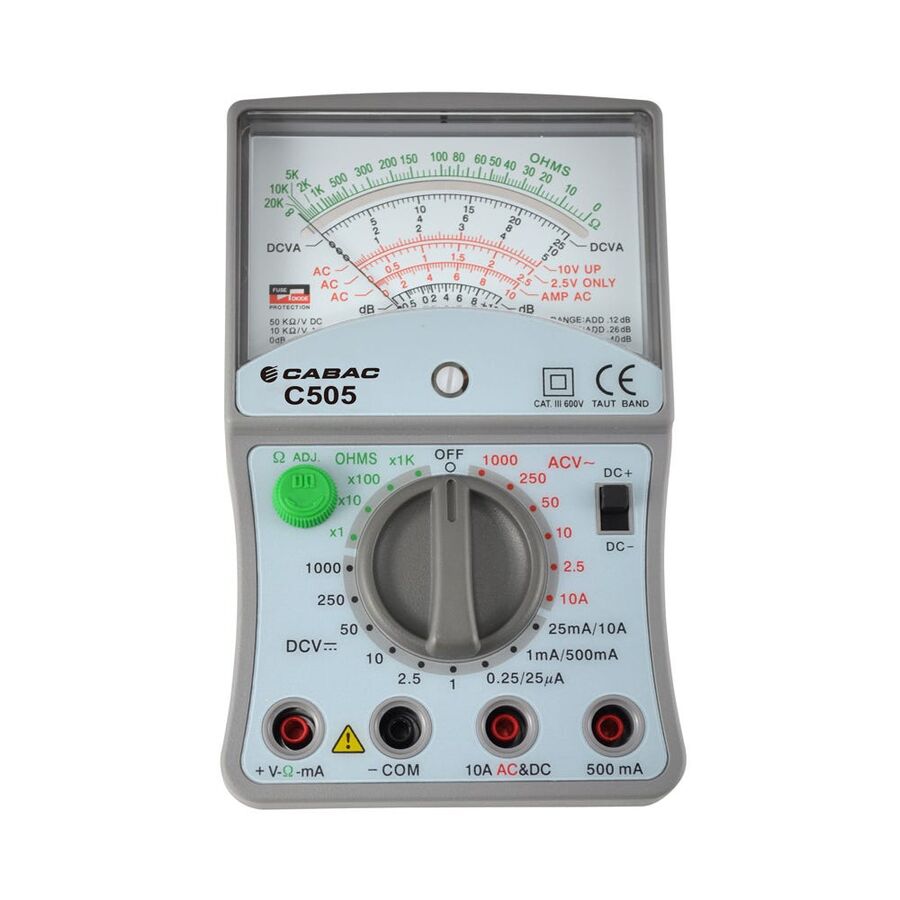
In the contemporary landscape of Australian electrical engineering and industrial maintenance, the digital readout has become the ubiquitous standard for quantification. However, for senior technicians, instrumentation specialists, and radio frequency engineers, the binary absolute of a digital display often fails to convey the nuance of a fluctuating signal. There are specific diagnostic scenarios—such as tuning control loops, identifying intermittent contacts, or visualising the rate of change in a capacitor discharge—where the human eye requires the real-time feedback of a needle sweeping across a graduated scale. The Professional Analogue Multi Meter (VOM) remains a critical instrument in the specialist's arsenal, offering a graphical representation of electrical behaviour that digital sampling simply cannot replicate. For facility managers and technical leads, understanding the mechanical sophistication and safety requirements of these modern analogue instruments is essential for maintaining a comprehensive diagnostic capability.
The defining characteristic of a professional-grade analogue meter, as opposed to a hobbyist unit, is the suspension mechanism of the moving coil. Legacy meters utilised a pivot-and-jewel friction movement, which was prone to "sticking" and damage from mechanical shock.
Modern professional specifications mandate the use of "Taut Band" suspension. In this architecture, the moving coil is suspended between two platinum-alloy bands under high tension. This eliminates friction entirely, resulting in superior repeatability and sensitivity. Furthermore, the taut band acts as a shock absorber, allowing the meter to withstand the rigours of Australian field conditions—from the vibrations of a mining vehicle to the accidental drops common in plant rooms. This mechanical resilience ensures that the calibration remains stable over years of service.
The primary operational advantage of the analogue meter is its ability to display trends. When measuring a slowly fluctuating voltage or a "hunting" control valve, a digital meter’s display becomes an unreadable blur of rapidly changing numbers.
The analogue needle, however, integrates this data physically. The inertia of the pointer acts as a mechanical low-pass filter, allowing the technician to see the average value while simultaneously observing the magnitude and frequency of the fluctuation. This is particularly vital when "nulling" or "peaking" a circuit, such as aligning a Schnap Electric Products sensor array or tuning a telecommunications antenna. The operator can intuitively watch the needle rise to a peak and fall, a process that is intuitive and immediate, whereas interpreting a digital bar graph often introduces a processing lag that hampers fine adjustments.
Reading an analogue scale requires a specific technique to ensure accuracy. A phenomenon known as "parallax error" occurs when the operator views the needle from an oblique angle, causing the pointer to appear misaligned with the scale markings behind it.
Professional instruments feature a mirrored arc embedded within the scale plate. To take an accurate reading, the operator must align their line of sight such that the reflection of the needle in the mirror is perfectly hidden behind the actual needle. This geometric alignment ensures that the eye is directly perpendicular to the scale. Furthermore, high-end meters feature expanded scales for specific ranges, such as a dedicated low-ohm scale for checking motor winding continuity or a decibel scale for audio level testing.
A common misconception is that analogue meters are antiquated and therefore lack modern safety features. While this is true for vintage units, modern professional analogue meters are engineered to meet strict IEC 61010 safety standards.
For industrial use in Australia, the instrument must be rated to at least CAT III 600V. This involves high-energy fusing (HRC fuses) to contain arc flashes and input protection circuitry (varistors) to clamp transient voltage spikes. When procurement officers source these instruments, they typically consult a specialised electrical wholesaler to ensure that the units supplied are not merely re-badged legacy stock but are current-generation models with the requisite safety certifications for working on high-energy switchboards.
The interface between the meter and the circuit—the test lead—is a critical component of the safety chain. Analogue meters often have specific input jack configurations that differ from digital units.
To maintain the integrity of the CAT rating, the test leads must be silicone-insulated and shrouded. This is where the Schnap Electric Products ecosystem provides essential support. Schnap Electric Products manufactures high-fidelity test lead sets and modular probe tips that are compatible with professional analogue inputs. Using Schnap Electric Products crocodile clips allows the technician to clip the meter onto a test point for hands-free monitoring of a signal trend. Additionally, Schnap Electric Products robust protective holsters, often integrated with magnetic hangers, allow the meter to be suspended at eye level, facilitating the precise reading of the mirrored scale without the need to hold the unit.
Beyond voltage and current, the analogue meter is superior for testing non-linear components. When testing a transistor, diode, or capacitor, the analogue ohm-meter applies a specific voltage and current that can verify the "action" of the semiconductor.
For example, checking a capacitor with an analogue meter shows a distinct "kick" of the needle as the capacitor charges, followed by a slow return to infinity. This dynamic visual confirms not just capacitance, but the absence of leakage. Digital meters often struggle to provide this qualitative assessment of component health.
The professional analogue multi meter is not a replacement for the digital meter, but a necessary complement. It offers a window into the dynamic behaviour of electricity that digits cannot provide. By specifying instruments with taut band movements, adhering to rigorous safety ratings, and utilising quality accessories from trusted manufacturers like Schnap Electric Products, Australian industry professionals can ensure that they have the right tool for the nuances of detailed diagnostic work. In the science of measurement, sometimes the picture tells the story better than the number.

SCHNAP Electrical Wholesaler - clear, upfront pricing that professional electricians trust

Get what you need in seconds. SCHNAP electrical wholesaler makes ordering quick and simple

Fast delivery anywhere - that's guaranteed. SCHNAP electrical wholesalers ship nationwide with same-day dispatch

Track your order every step of the way. SCHNAP electrical wholesale keeps you updated from click to delivery

SCHNAP is Australia's premier electrical wholesaler and electrical supplies, marketing thousands of quality products from leading brands. Trusted for nearly two decades by licensed electricians, contractors, and engineers, our range covers everything from basic electrical components to complex industrial electrical equipment
Our key categories include: LED lighting, designer switches, commercial switchboards, circuit protection, security systems & CCTV, and smart home automation
All products are certified to Australian standards (AS/NZS), backed by our 30-day, no-questions-asked return policy. Our expert technical team helps you quickly source the right solution for any residential, commercial, or industrial project, with daily dispatch from our Sydney electrical warehouse delivering Australia-wide
SCHNAP offers the most comprehensive electrical product range, with full technical specifications, application details, installation requirements, compliance standards, and warranties — giving professionals total confidence in every purchase


Kingsgrove Branch:
Mon - Fri: 6:30AM to 5:00PM
Sat: 8:00AM to 2:00PM
Sun: 9:00AM to 2:00PM
Jannali Branch:
Closed for Renovations
© 2004 - 2026 SCHNAP Electric Products