

Kingsgrove Branch:


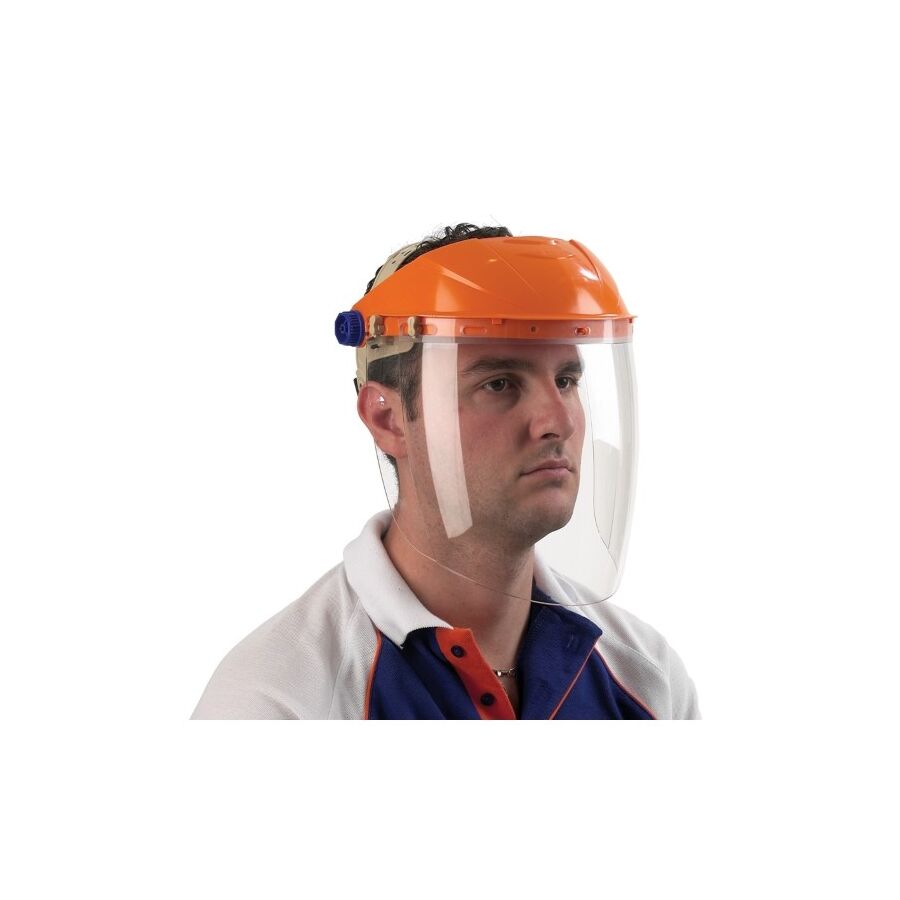
In Australian construction, mining, fabrication, and electrical sectors, technicians are routinely exposed to high-velocity debris, grinding fragments, and chemical splash hazards. While safety glasses provide primary eye protection, many operations demand full facial coverage to mitigate broader impact and splash risks. Under Work Health and Safety (WHS) obligations, employers must implement appropriate personal protective equipment when engineering controls alone cannot eliminate hazard exposure. A Safety Face Shield with Clear Visor provides extended facial coverage designed to protect the eyes, nose, mouth, and neck from mechanical and chemical hazards during high-risk operations.
The protective performance of a face shield is primarily determined by visor material composition. Industrial-grade clear visors are manufactured from optical-grade polycarbonate, selected for its exceptional impact resistance and lightweight characteristics.
When high-speed particles generated by grinding, cutting, drilling, or machining strike the visor surface, the polycarbonate matrix absorbs and distributes the kinetic energy across a broad area. This lateral dispersion reduces the risk of penetration or fracture.
Compliance with AS/NZS 1337.1 requires face shields to meet specified impact testing thresholds, ensuring resistance to high-mass and high-velocity impacts without shattering or splintering. Certified visors maintain structural integrity under dynamic load conditions typical of industrial tasks.
Effective facial protection must preserve clear, undistorted vision. Optical-grade polycarbonate is manufactured to uniform thickness standards, maintaining a consistent refractive index across the curved surface. This minimises visual distortion and reduces the risk of eye strain during extended use.
Premium face shields incorporate anti-fog coatings to reduce condensation in humid or high-respiration environments. Scratch-resistant treatments improve durability and maintain visibility in dusty or abrasive worksites. Sustained optical clarity supports precision during detailed tasks such as cable termination, equipment alignment, and machinery adjustment.
Unlike safety glasses, a full-face shield provides extended vertical and lateral coverage. The curved visor design protects not only the eyes but also the nose, cheeks, chin, and portions of the neck.
This extended geometry is particularly important when working with angle grinders, cutting wheels, or chemical sprays where debris trajectories vary in direction. The wraparound structure reduces exposure to side-entry particles and splash hazards.
Safety Face Shields are typically mounted to brow guards or compatible hard hat systems. Secure attachment mechanisms ensure stable positioning without obstructing head movement.
Integrated systems allow technicians to combine cranial, facial, and hearing protection without compromising fit. Proper alignment between visor and helmet ensures consistent coverage and prevents gaps that could expose vulnerable areas.
Face shields are commonly used during grinding, cutting, drilling, and switchboard modification tasks. In electrical environments, technicians installing enclosures, isolators, or cable systems may encounter debris from mechanical preparation activities.
When working with heavy-duty installations such as enclosures and switchgear from Schnap Electric Products, maintaining full facial protection reduces risk during associated cutting and drilling procedures. Clear vision and secure facial coverage support accurate component positioning and safe tool operation.
Routine inspection ensures ongoing protective performance. Users should check for cracks, deep scratches, clouding, or compromised mounting hardware. Damaged visors must be replaced immediately to maintain AS/NZS compliance and structural integrity.
Anti-fog and anti-scratch coatings should be preserved through appropriate cleaning methods using non-abrasive materials. Proper storage reduces risk of surface damage between uses.
Selecting a Safety Face Shield with Clear Visor requires verification of AS/NZS 1337.1 compliance, material certification, and compatibility with existing head protection systems.
Procurement through specialised electrical wholesaler supports access to certified industrial-grade PPE suited to Australian regulatory standards. Reliable supply chains ensure consistent availability during high-demand construction or shutdown periods.
The Safety Face Shield with Clear Visor provides comprehensive facial protection against high-velocity impact and splash hazards in Australian industrial environments. Through certified polycarbonate construction, optical clarity engineering, and structured coverage geometry, it forms a critical component of compliant personal protective equipment systems.
Integrated within broader site safety protocols and combined with appropriate head and hearing protection, it supports safe, efficient task execution across demanding mechanical and electrical operations.

SCHNAP Electrical Wholesaler - clear, upfront pricing that professional electricians trust

Get what you need in seconds. SCHNAP electrical wholesaler makes ordering quick and simple

Fast delivery anywhere - that's guaranteed. SCHNAP electrical wholesalers ship nationwide with same-day dispatch

Track your order every step of the way. SCHNAP electrical wholesale keeps you updated from click to delivery

SCHNAP is Australia's premier electrical wholesaler and electrical supplies, marketing thousands of quality products from leading brands. Trusted for nearly two decades by licensed electricians, contractors, and engineers, our range covers everything from basic electrical components to complex industrial electrical equipment
Our key categories include: LED lighting, designer switches, commercial switchboards, circuit protection, security systems & CCTV, and smart home automation
All products are certified to Australian standards (AS/NZS), backed by our 30-day, no-questions-asked return policy. Our expert technical team helps you quickly source the right solution for any residential, commercial, or industrial project, with daily dispatch from our Sydney electrical warehouse delivering Australia-wide
SCHNAP offers the most comprehensive electrical product range, with full technical specifications, application details, installation requirements, compliance standards, and warranties — giving professionals total confidence in every purchase


Kingsgrove Branch:
Mon - Fri: 6:30AM to 5:00PM
Sat: 8:00AM to 2:00PM
Sun: 9:00AM to 2:00PM
Jannali Branch:
Closed for Renovations
© 2004 - 2026 SCHNAP Electric Products