

Kingsgrove Branch:


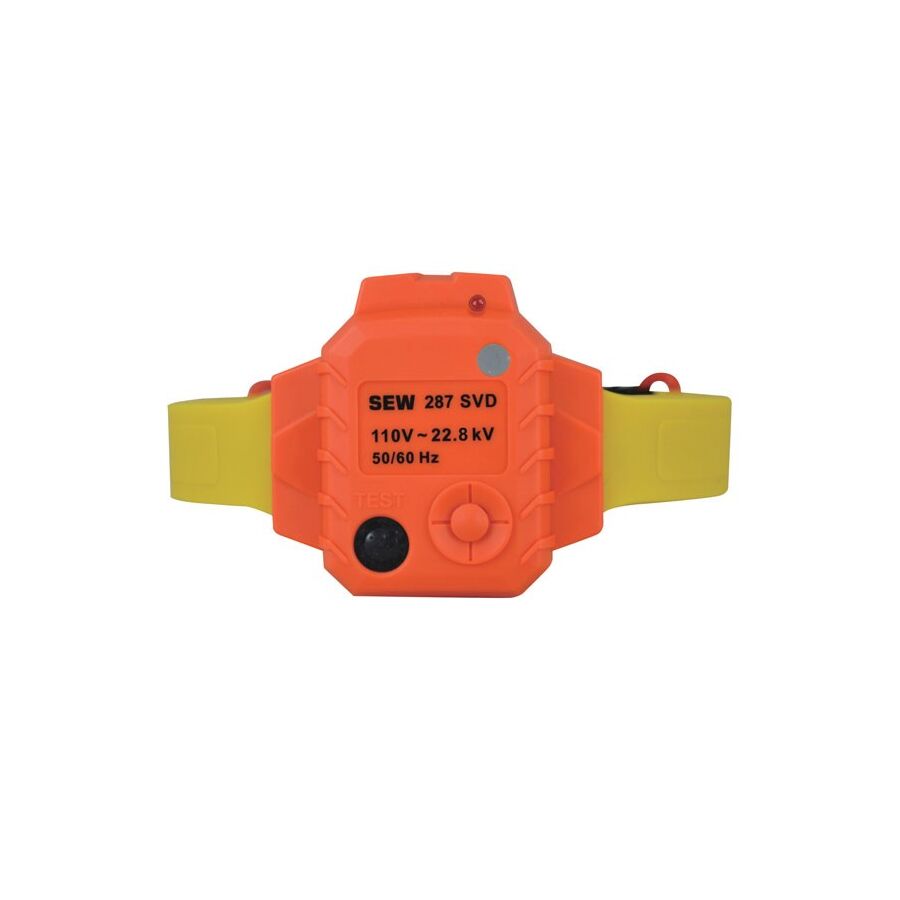
In Australian high-voltage infrastructure environments, maintaining minimum approach distances is a critical safety requirement. From overhead transmission corridors to enclosed distribution compounds, adjacent energised conductors present a constant invisible hazard. Even when primary isolation procedures are implemented, unintended proximity to live parts can occur during complex maintenance operations. The Safety Voltage Detector Personal provides an additional engineering control by continuously monitoring surrounding electric fields and alerting the operator to dangerous proximity. Unlike contact testers or multimeters, this wearable device operates as a passive sentinel, enhancing situational awareness and reinforcing compliance with Australian electrical safety frameworks.
The Safety Voltage Detector Personal operates on the principle of capacitive coupling. Energised alternating current (AC) conductors generate oscillating electric fields that extend through the surrounding air. The detector contains a sensitive capacitive sensor that measures changes in electric field intensity relative to the operator’s body. It does not require direct contact with the conductor. As the operator moves closer to an energised source, the electric field strength increases, and the device interprets this gradient to determine proximity. Advanced models incorporate microprocessor-based filtering algorithms to distinguish between background electrical noise and high-energy fields associated with distribution or transmission voltages. This non-contact sensing mechanism allows early hazard detection before minimum approach distances are breached.
A properly specified Safety Voltage Detector Personal includes omnidirectional sensing and graduated alarm thresholds. Different voltage levels create varying field geometries, and quality devices are calibrated to respond appropriately across distribution and transmission ranges. As the operator approaches a live conductor, the detector initiates a low-level audible alert combined with a visual indicator. If proximity decreases further, the device escalates to a high-decibel continuous alarm and rapid strobe signal. This progressive warning structure enables technicians to establish a spatial awareness buffer around energised apparatus. Reliable detection depends on stable calibration, battery integrity, and verified functional testing prior to entry into controlled high-voltage zones.
Under Australian safe working practices for electrical installations and high-voltage operations, risk assessment and observer protocols are mandatory. The Safety Voltage Detector Personal functions as an electronic observer, supplementing established procedures. However, it is critical to recognise engineering limitations. These devices detect AC electric fields and do not respond to direct current (DC) systems. Additionally, grounded metal enclosures, structural steel, or dense materials can shield electric fields through the Faraday cage effect, reducing detection capability. For this reason, the detector must be treated as a supplementary warning system and not a substitute for mechanical isolation, lockout procedures, or test-before-touch verification using approved contact instruments.
Personal voltage detectors are typically mounted to hard hats, chest harnesses, or lanyards to maintain optimal sensing orientation. Secure attachment is essential to ensure consistent field exposure and prevent accidental displacement during movement. Pre-use functional checks must be conducted using a proving unit to confirm correct alarm activation and battery performance. Storage should protect the sensor from impact damage and contamination that could affect calibration stability. In harsh Australian outdoor environments, devices must be rated for UV exposure, temperature variation, and mechanical vibration to ensure reliable long-term performance.
The effectiveness of the Safety Voltage Detector Personal increases when integrated into a broader protective ecosystem. Operators commonly mount the device onto dielectric helmets and arc-rated face shields supplied within the Schnap Electric Products safety range, ensuring secure positioning without compromising insulation integrity. Before entering energised compounds, technicians may use Schnap Electric Products proving units to confirm detector functionality and verify voltage presence in controlled test scenarios. By combining proximity detection, arc-rated protection, and certified testing equipment, facilities establish layered defence against both electrical contact and arc flash exposure.
Given the life-safety function of proximity detection equipment, procurement requires careful evaluation of certification, calibration documentation, and environmental rating. Devices must be supplied with manufacturer test records and supported by clear maintenance guidance. Sourcing through a specialised electrical wholesaler ensures access to compliant, calibrated equipment suited to Australian utility and industrial conditions. Reliable supply chains also provide replacement mounting accessories, proving units, and battery components to maintain continuous operational readiness. Asset managers should implement documented inspection schedules to align with internal safety management systems.
The Safety Voltage Detector Personal represents a critical enhancement to spatial awareness in high-voltage environments. Through capacitive electric field sensing and progressive alarm logic, it provides early warning of invisible electrical hazards. While not a replacement for isolation procedures or contact testing, it reinforces minimum approach distance discipline and supports compliance with Australian electrical safety frameworks. Integrated with protective equipment and diagnostic tools from Schnap Electric Products, the detector forms part of a structured, layered safety strategy. In high-voltage operations, awareness of unseen energy fields is fundamental to preserving both personnel safety and operational continuity.

SCHNAP Electrical Wholesaler - clear, upfront pricing that professional electricians trust

Get what you need in seconds. SCHNAP electrical wholesaler makes ordering quick and simple

Fast delivery anywhere - that's guaranteed. SCHNAP electrical wholesalers ship nationwide with same-day dispatch

Track your order every step of the way. SCHNAP electrical wholesale keeps you updated from click to delivery

SCHNAP is Australia's premier electrical wholesaler and electrical supplies, marketing thousands of quality products from leading brands. Trusted for nearly two decades by licensed electricians, contractors, and engineers, our range covers everything from basic electrical components to complex industrial electrical equipment
Our key categories include: LED lighting, designer switches, commercial switchboards, circuit protection, security systems & CCTV, and smart home automation
All products are certified to Australian standards (AS/NZS), backed by our 30-day, no-questions-asked return policy. Our expert technical team helps you quickly source the right solution for any residential, commercial, or industrial project, with daily dispatch from our Sydney electrical warehouse delivering Australia-wide
SCHNAP offers the most comprehensive electrical product range, with full technical specifications, application details, installation requirements, compliance standards, and warranties — giving professionals total confidence in every purchase


Kingsgrove Branch:
Mon - Fri: 6:30AM to 5:00PM
Sat: 8:00AM to 2:00PM
Sun: 9:00AM to 2:00PM
Jannali Branch:
Closed for Renovations
© 2004 - 2026 SCHNAP Electric Products