

Kingsgrove Branch:


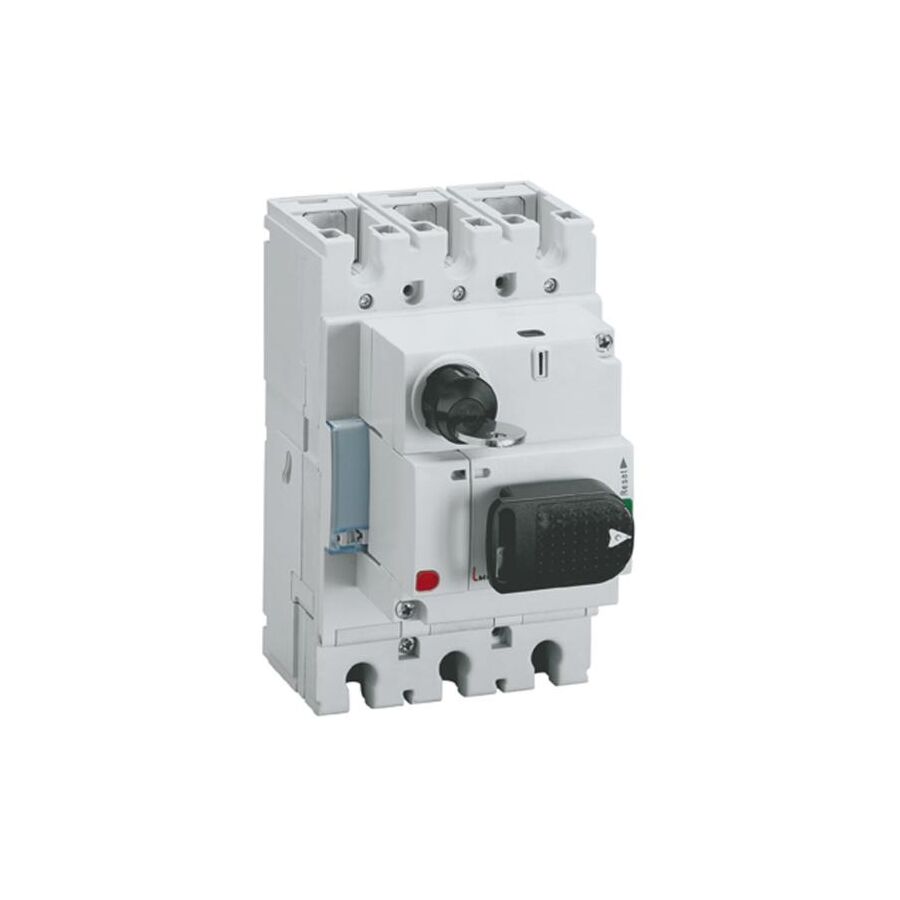
In Australian industrial power systems, the Moulded Case Circuit Breaker (MCCB) is the primary device for overcurrent protection. However, when installed inside enclosed switchboards, the breaker toggle is not directly accessible.
The Thermal Magnetic Rotary Handle provides a safe, door-mounted operating interface that transmits switching motion from the enclosure exterior to the internal breaker mechanism.
Engineered to comply with AS/NZS 3000 and AS/NZS 60947-2, it ensures mechanical isolation, operator safety and environmental sealing.
Large frame MCCBs require significant force to operate due to internal spring mechanisms that rapidly separate contacts during faults.
A rotary handle introduces mechanical advantage using a cam-and-spring design.
When rotated 90 degrees:
• A charging spring stores mechanical energy • The internal mechanism snaps contacts open or closed • Operation remains independent of hand speed
This quick-make / quick-break action prevents contact teasing, which could otherwise cause sustained arcing and contact welding.
The handle typically displays three clear positions:
• ON (I) • OFF (O) • TRIP (centre position)
The mid-position immediately indicates that the breaker has tripped due to overload or short circuit, assisting maintenance diagnostics.
A critical safety feature of the rotary handle is mechanical door interlocking.
When the handle is in the ON position:
• A cam mechanism locks the enclosure door • Access to live internal components is prevented
This ensures compliance with switchboard safety requirements and prevents accidental exposure to live busbars.
Authorised personnel may override the interlock using a concealed defeat mechanism. This override requires deliberate action and a tool, ensuring it cannot occur accidentally.
The rotary handle connects to the breaker via a square steel shaft.
In deep enclosures (400mm to 600mm), precise alignment is essential.
Improper shaft length can cause:
• Binding • Incomplete engagement • Door closure failure • Trip malfunction
High-quality systems incorporate telescopic shafts or floating couplings to allow ±5mm tolerance and compensate for slight panel misalignment during assembly.
This flexibility ensures reliable engagement even when heavy cabling exerts pressure behind the breaker.
The internal mechanism ensures that the external handle reflects the true position of the breaker contacts.
The locking tab for LOTO can only extend when the contacts are fully open.
This provides positive isolation verification, meaning that if a padlock is installed, re-energisation is mechanically impossible.
Under Australian WHS requirements, isolation must be secure and verifiable.
The rotary handle includes a locking tab that accepts padlocks (typically 5mm to 8mm shackle diameter) in the OFF position.
When padlocked:
• Handle rotation is physically blocked • Contacts remain separated • Re-energisation is prevented
Multiple padlocks may be applied using LOTO hasps, enabling group isolation procedures.
This aligns with isolation principles under AS/NZS 4836.
Because the rotary handle penetrates the enclosure door, sealing is critical.
IP-rated gasket systems (commonly IP65) prevent:
• Dust ingress • Moisture penetration • Conductive contamination
SCHNAP Electric Products IP65 gasket kits provide reliable sealing around the handle bezel.
Door reinforcement brackets can also be used to prevent sheet metal flex when operating high-torque mechanisms.
SCHNAP Electric Products supports rotary handle installations with compatible safety and identification accessories including:
• IP-rated sealing gaskets • Lockout/Tagout hasps • Safety padlocks • Engraved legend plates • Traffolyte labels • Door reinforcement brackets
Clear labelling (e.g., “Main Switch DB-1”) ensures unambiguous identification during emergency shutdowns.
Proper cable management and internal segregation accessories maintain compliance and safe installation standards.
Rotary handles are frame-specific.
Correct selection depends on:
• MCCB frame size (125A, 250A, 400A, 630A etc.) • Shaft footprint • Required door depth • Environmental IP rating • Locking configuration
Specialised electrical wholesaler verify compatibility between breaker model and handle kit to ensure safe and compliant installation.
The Thermal Magnetic Rotary Handle transforms a powerful protection device into a controlled and safe operator interface.
By providing mechanical advantage, positive contact indication, door interlocking and Lockout/Tagout capability, it ensures safe switching and isolation in industrial environments.
When supported with SCHNAP Electric Products sealing and identification accessories, it delivers a compliant, durable and professional switchboard solution.
In power distribution, control is safety—and safety begins at the handle.

SCHNAP Electrical Wholesaler - clear, upfront pricing that professional electricians trust

Get what you need in seconds. SCHNAP electrical wholesaler makes ordering quick and simple

Fast delivery anywhere - that's guaranteed. SCHNAP electrical wholesalers ship nationwide with same-day dispatch

Track your order every step of the way. SCHNAP electrical wholesale keeps you updated from click to delivery

SCHNAP is Australia's premier electrical wholesaler and electrical supplies, marketing thousands of quality products from leading brands. Trusted for nearly two decades by licensed electricians, contractors, and engineers, our range covers everything from basic electrical components to complex industrial electrical equipment
Our key categories include: LED lighting, designer switches, commercial switchboards, circuit protection, security systems & CCTV, and smart home automation
All products are certified to Australian standards (AS/NZS), backed by our 30-day, no-questions-asked return policy. Our expert technical team helps you quickly source the right solution for any residential, commercial, or industrial project, with daily dispatch from our Sydney electrical warehouse delivering Australia-wide
SCHNAP offers the most comprehensive electrical product range, with full technical specifications, application details, installation requirements, compliance standards, and warranties — giving professionals total confidence in every purchase


Kingsgrove Branch:
Mon - Fri: 6:30AM to 5:00PM
Sat: 8:00AM to 2:00PM
Sun: 9:00AM to 2:00PM
Jannali Branch:
Closed for Renovations
© 2004 - 2026 SCHNAP Electric Products