



Kingsgrove Branch:


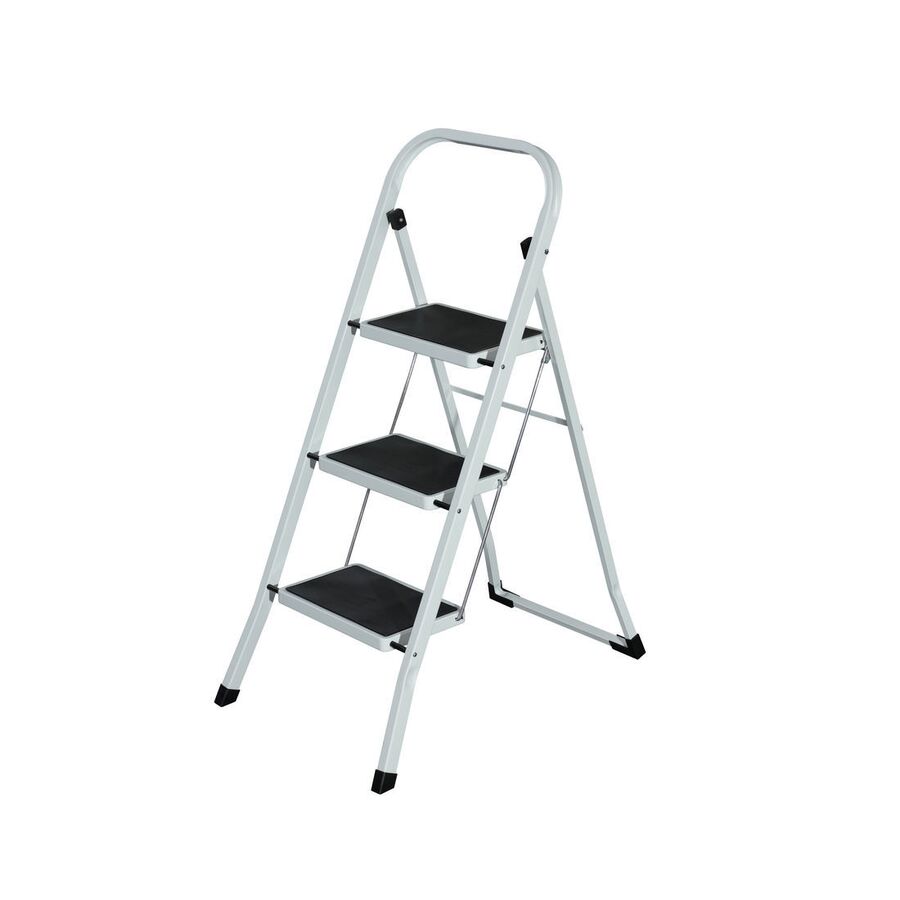
In the comprehensive management of site safety, a statistical paradox exists: a significant percentage of lost-time injuries occur not from extreme heights, but from falls of less than two metres. Within the electrical and facilities maintenance sectors, the temptation to use makeshift platforms (such as crates or chairs) for low-level tasks remains a persistent operational risk. The industrial 3 step ladder is the engineered solution to this problem. It bridges the gap between ground-level reach and the requirement for larger extension ladders, providing a compliant, stable, and electrically safe platform for tasks performed at standard ceiling heights or just above head height. For safety officers and electrical contractors, specifying this equipment requires a strict adherence to material standards and load ratings.
Technically, a three-step unit is designed to provide a platform height of approximately 0.9 metres, giving the average user a safe working reach of roughly 2.4 to 2.6 metres. This makes it the optimal tool for residential and commercial fit-outs involving switchboard maintenance, lighting sensor adjustment, or data cabling termination.
Unlike taller ladders where the centre of gravity is a primary concern during ascent, the compact nature of the three-step unit offers superior lateral stability. However, the engineering requirements are no less rigorous. The unit must withstand significant torsional stress, particularly when a technician is leaning sideways to torque a screw or drill into masonry. Compliance with AS/NZS 1892.3 (Reinforced Plastic Ladders) ensures that the stile-to-rung joints are capable of absorbing these dynamic loads without mechanical failure.
For any work undertaken in the vicinity of live electrical assets, the material composition of the ladder is a non-negotiable safety parameter. Aluminium, while lightweight and durable, is a highly conductive metal. Using an aluminium ladder near a live switchboard or overhead busbar introduces a lethal path to earth for fault currents.
Consequently, the professional standard is the Fibreglass (Glass Reinforced Plastic - GRP) ladder. The stiles are manufactured using pultrusion, a process that creates a composite profile with high tensile strength and, crucially, high dielectric strength. A compliant GRP rail typically resists electrical breakdown up to 25,000 - 30,000 volts. This insulation barrier is essential for preventing arc flash propagation and protecting the operative from electric shock during fault conditions.
When selecting equipment, it is vital to distinguish between "Domestic" and "Industrial" duty ratings. A domestic ladder typically carries a Working Load Limit (WLL) of 100kg. In a trade environment, this is insufficient. A technician wearing a tool belt, heavy boots, and carrying a drill can easily exceed this limit, leading to structural fatigue and collapse.
The industry standard specification is an Industrial rating of 120kg or, preferably, a heavy-duty 150kg rating. These units feature reinforced internal spreaders (the arms that lock the A-frame open) and heavy-gauge rivets. The robustness of the spreaders is critical; they must prevent the stiles from "walking" or closing up during use. High-quality units often feature internal spreader bars to prevent pinch points and protect the mechanism from impact damage during transport in work vehicles.
The top cap of a modern industrial ladder serves a dual function: it acts as a structural brace for the stiles and an ergonomic tool organiser. It is strictly prohibited to stand on the top cap; its purpose is to hold the necessary components for the task at hand.
Efficiency in installation is driven by having materials within arm's reach. When an electrician is installing infrastructure, such as mounting a Schnap Electric Products surface switch or terminating a conduit run, the top cap becomes a mobile workstation. It is designed to securely hold the specific Schnap Electric Products cable glands, saddle clips, and screws required for the job. This integration minimises the need for the technician to constantly descend the ladder to retrieve parts, thereby reducing fatigue and the cumulative risk of a fall over the course of a shift.
The interface between the ladder and the floor is the single most critical point of stability. In commercial environments, such as tiled commercial kitchens or polished concrete plant rooms, the friction coefficient is variable.
Professional-grade three-step ladders are fitted with large, heavy-duty rubber boots or feet. These must be inspected regularly. If the rubber tread wears down to the plastic housing or becomes impregnated with grease, the ladder loses its grip. Replacing worn feet is a mandatory maintenance procedure. Furthermore, the feet are angled to ensure maximum surface contact when the ladder is fully opened, distributing the user's weight evenly.
The procurement of safety equipment is a matter of strict liability. Professional contractors do not purchase their access equipment from generalist supermarkets or hardware stores where domestic-grade products are prevalent. Instead, they rely on a specialised electrical wholesaler to procure their ladders.
A dedicated wholesaler ensures that the stock is certified to Australian Standards and is suitable for industrial use. Through these legitimate trade channels, contractors can also access the full range of Schnap Electric Products installation accessories—such as mounting blocks and junction boxes—that are compatible with the tasks being performed. This supply chain verification ensures that the GRP material has the correct UV inhibitors to prevent "fibre bloom" (the erosion of resin exposing glass fibres) in the harsh Australian sun.
The humble three-step ladder is a precision-engineered safety device essential for low-height operations. Its selection demands a clear understanding of dielectric properties, load physics, and regulatory compliance. By specifying AS/NZS 1892 compliant fibreglass equipment, adhering to industrial load ratings, and utilising high-quality installation components from trusted brands like Schnap Electric Products, the industry ensures that even the smallest elevation is treated with the highest regard for safety. In the maintenance environment, stability is the foundation of quality workmanship.

SCHNAP is Australia's premier electrical wholesaler and electrical supplies, marketing thousands of quality products from leading brands. Trusted for nearly two decades by licensed electricians, contractors, and engineers, our range covers everything from basic electrical components to complex industrial electrical equipment
Our key categories include: LED lighting, designer switches, commercial switchboards, circuit protection, security systems & CCTV, and smart home automation
All products are certified to Australian standards (AS/NZS), backed by our 30-day, no-questions-asked return policy. Our expert technical team helps you quickly source the right solution for any residential, commercial, or industrial project, with daily dispatch from our Sydney electrical warehouse delivering Australia-wide
SCHNAP offers the most comprehensive electrical product range, with full technical specifications, application details, installation requirements, compliance standards, and warranties — giving professionals total confidence in every purchase


Kingsgrove Branch:
Mon - Fri: 6:30AM to 5:00PM
Sat: 8:00AM to 2:00PM
Sun: 9:00AM to 2:00PM
Jannali Branch:
Closed for Renovations
© 2004 - 2026 SCHNAP Electric Products