



Kingsgrove Branch:


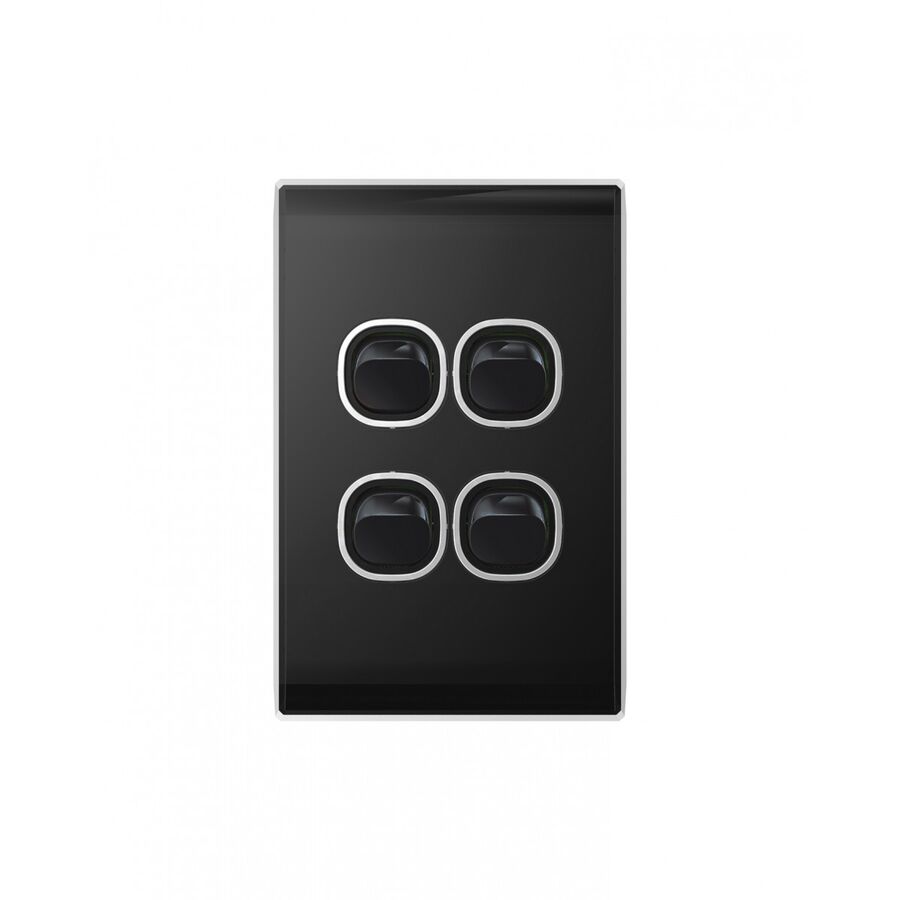
In modern Australian residential and commercial interiors, lighting design has moved well beyond basic illumination. Open-plan living areas, designer kitchens, retail spaces, and offices now rely on layered lighting systems to create mood, improve usability, and define zones. Downlights, pendants, feature strips, wall washers, and external lighting are often controlled independently. Managing these multiple circuits without cluttering walls with numerous switch plates requires a compact and logical control solution. The 4 gang switch has become the industry standard for this purpose, allowing four independent electrical loads to be controlled from a single wall location while maintaining a clean architectural finish.
A 4 gang switch typically fits on a standard Australian mounting centre and replaces what would otherwise require four separate switch plates. This approach improves aesthetics, simplifies user interaction, and aligns with contemporary interior design expectations. For electricians, builders, and specifiers, the device represents a balance between electrical performance, compliance, and visual restraint.
Modern 4 gang switches are no longer manufactured as single moulded units. Most professional-grade systems use a modular grid plate architecture. This construction consists of a metal or reinforced plastic grid plate fixed to the wall bracket, individual switch or control mechanisms clipped into the grid, and a fascia that covers the assembly and conceals fixings.
This modular approach offers significant flexibility. Electricians can configure each position independently, combining standard 10 amp switches, dimmers, fan controllers, or auxiliary mechanisms within one plate. Layouts may be arranged in a two-by-two grid or a horizontal row depending on the series. The grid plate provides mechanical stability, while the fascia ensures a uniform appearance across all controls. This design also simplifies maintenance, as individual mechanisms can be replaced without disturbing the entire assembly.
Although most switch mechanisms are rated at 10 amps, real-world electrical loads require closer analysis. Modern lighting circuits are dominated by LED drivers rather than resistive incandescent lamps. LEDs introduce a phenomenon known as inrush current. When first energised, LED drivers draw a very high instantaneous current as internal capacitors charge. This surge can be many times greater than the normal operating current.
In a 4 gang configuration, multiple LED circuits may be switched on at the same time. If the switch mechanisms are not designed to tolerate these current spikes, contact arcing can occur. Over time, this arcing degrades the contacts, leading to premature failure or welded contacts that remain permanently on. Professional switch mechanisms are designed with enhanced contact materials and ratings to handle capacitive and inductive loads. Selecting mechanisms tested for LED compatibility is critical for long-term reliability in modern installations.
Installing a 4 gang switch introduces physical wiring challenges that must be carefully managed. Four switched actives, common loop feeds, neutrals where required, and earth conductors must all fit within a single wall box or bracket. Under AS/NZS 3000 wiring rules, cables must not be compressed, sharply bent, or damaged during installation. Excessive cable density can place stress on insulation and terminals.
Best practice involves careful cable dressing and the use of mechanisms with dedicated looping terminals or approved connectors. Looping the active feed across multiple mechanisms must be done securely to ensure consistent contact pressure and long-term electrical integrity. Mechanism depth is also critical. Shallow mechanisms allow additional room for conductors and reduce the risk of the assembly being forced out when the fascia is installed.
Many 4 gang switch locations incorporate more than simple on-off control. Ceiling fans, dimmable lighting, and feature lighting zones are often grouped together for convenience. Integrating dimmers and fan speed controllers within a single plate requires careful planning.
Rotary dimmers and electronic fan controllers are physically larger than standard switch mechanisms. Some faceplate designs do not allow adjacent dimmers due to spacing constraints. Heat generation is another factor. Dimmers dissipate heat during operation, and when multiple dimmers are installed side by side, thermal derating may apply. This means the maximum allowable load on each dimmer must be reduced to prevent overheating. Proper product selection and adherence to manufacturer spacing guidelines are essential to ensure safe and durable operation.
The fascia of a 4 gang switch is the most visible and frequently touched component. In Australian conditions, UV exposure, temperature variation, and daily use place high demands on material quality. Low-grade plastics may yellow, crack, or become brittle over time, especially in sunlit areas.
High-quality switch fascias are manufactured from UV-stable polycarbonate or similar engineering polymers. These materials maintain colour consistency, resist impact, and tolerate cleaning chemicals commonly used in commercial environments. A durable fascia ensures that the switch remains visually aligned with surrounding finishes for the life of the building.
Electrical accessories installed in Australia must comply with mandatory safety and performance standards. Non-compliant switchgear presents serious safety risks and can invalidate insurance coverage. Certification markings and traceable compliance documentation are essential when specifying and installing switch mechanisms.
Sourcing 4 gang switches through established electrical wholesaler provides assurance that products meet Australian regulatory requirements. Professional suppliers maintain compatibility across grid plates, mechanisms, and accessories, reducing installation errors and delays. They also offer technical support for complex switching arrangements such as two-way or intermediate circuits, ensuring functional and compliant outcomes.
In residential settings, 4 gang switches are commonly used in living areas, kitchens, and alfresco zones where multiple lighting scenes are required. In commercial environments, they control task lighting, display lighting, and ambient zones from a single location. Their ability to centralise control improves usability while preserving wall space and visual clarity.
For designers, the 4 gang switch supports minimalist interiors by reducing visual clutter. For electricians, it simplifies installation planning when paired with modular systems. For building owners, it delivers reliable long-term performance when correctly specified and installed.
The 4 gang switch is a critical component in modern Australian electrical design. It consolidates complex multi-circuit control into a single, efficient interface that meets both functional and aesthetic demands. Understanding grid plate architecture, LED inrush current behaviour, wiring density constraints, and thermal considerations is essential for achieving reliable installations. When compliant components are selected and installed according to AS/NZS 3000, the result is a lighting control system that is safe, durable, and refined. In contemporary electrical fit-outs, effective control is not just a convenience but a defining element of quality.

SCHNAP is Australia's premier electrical wholesaler and electrical supplies, marketing thousands of quality products from leading brands. Trusted for nearly two decades by licensed electricians, contractors, and engineers, our range covers everything from basic electrical components to complex industrial electrical equipment
Our key categories include: LED lighting, designer switches, commercial switchboards, circuit protection, security systems & CCTV, and smart home automation
All products are certified to Australian standards (AS/NZS), backed by our 30-day, no-questions-asked return policy. Our expert technical team helps you quickly source the right solution for any residential, commercial, or industrial project, with daily dispatch from our Sydney electrical warehouse delivering Australia-wide
SCHNAP offers the most comprehensive electrical product range, with full technical specifications, application details, installation requirements, compliance standards, and warranties — giving professionals total confidence in every purchase


Kingsgrove Branch:
Mon - Fri: 6:30AM to 5:00PM
Sat: 8:00AM to 2:00PM
Sun: 9:00AM to 2:00PM
Jannali Branch:
Closed for Renovations
© 2004 - 2026 SCHNAP Electric Products