



Kingsgrove Branch:


In the increasingly digitised landscape of Australian building automation, smart relays, cloud dashboards, and app-based scheduling dominate specification documents. Yet alongside this digital expansion exists a critical operational reality: not all environments benefit from software-driven control. For facility managers, strata committees, security contractors, and industrial electricians, the priority is often not flexibility but certainty. When perimeter lighting, access gates, signage illumination, or critical plant equipment must operate every day without exception, immunity to software failure becomes essential.
The analogue security timer occupies this niche. It is an electromechanical scheduling device designed to operate independently of networks, firmware updates, and cloud services. By relying on physical motion rather than code execution, it provides a level of predictability that digital systems struggle to guarantee over long service lives. In applications where downtime creates safety risks or security exposure, the analogue timer remains a deliberate and often superior engineering choice.
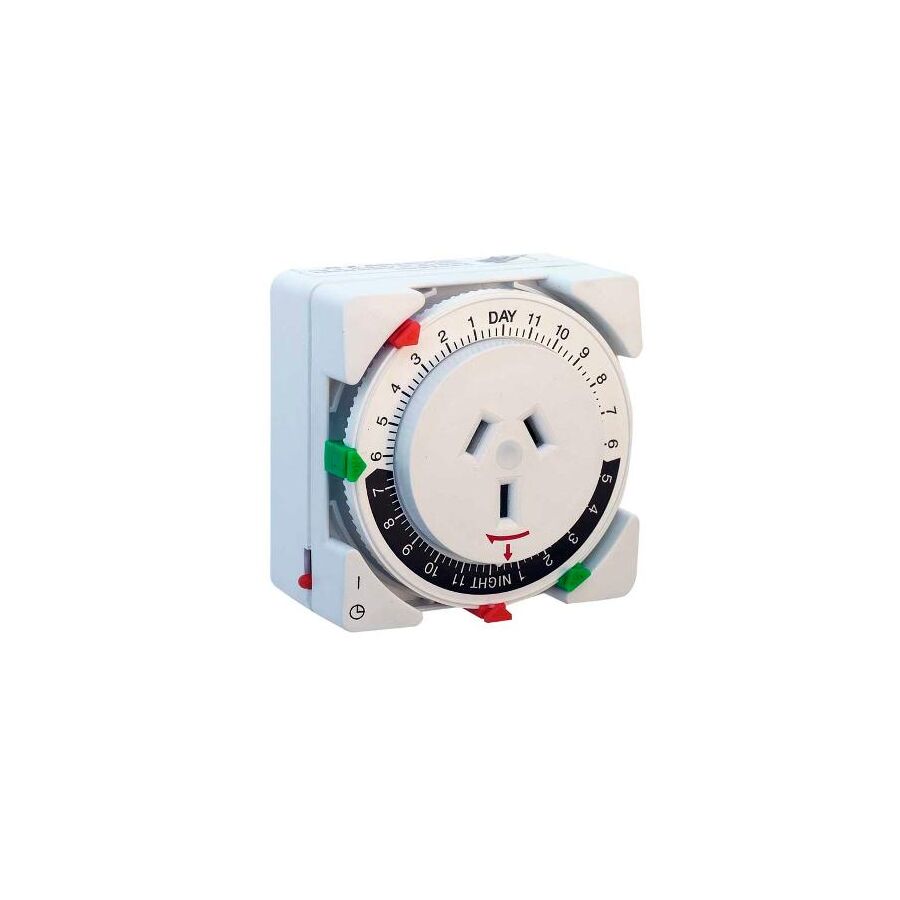
The defining characteristic of an analogue security timer is its captive tappet programming interface. Instead of screens and menus, the user interacts with a rotating dial that represents a full 24-hour cycle. Around this dial sit mechanical segments, commonly set in 15-minute or 30-minute increments.
Programming is achieved by physically engaging these tappets. When a tappet is pushed into its active position, it mechanically primes an internal cam. As the dial rotates, the cam actuates a microswitch at the programmed time, closing or opening the electrical circuit. This action is purely mechanical. There is no interpretation layer, no firmware logic, and no dependency on stored memory states.
This physicality offers an operational advantage that is often overlooked. The programmed schedule is visible at all times. A caretaker walking past a switchboard can confirm the lighting schedule with a glance. If a tenant complains that lights are activating too early, the cause is immediately apparent. This transparency reduces fault-finding time, eliminates training requirements, and removes ambiguity during handovers.
Analogue security timers are available with either synchronous or quartz drive mechanisms. Synchronous models rely on the stability of the mains supply frequency. While accurate under normal conditions, they stop immediately during a power failure and resume from an incorrect time once power returns.
For security and compliance-critical systems, quartz drive timers are the engineering standard. These units use a quartz crystal oscillator to control a stepper motor, maintaining precise timekeeping independent of mains frequency. An internal battery, commonly lithium or NiMH, preserves the clock during outages that may last days or weeks.
This capability is essential in real-world Australian conditions. Power interruptions caused by storms, bushfire mitigation shutoffs, or infrastructure upgrades are common. Without quartz backup, lighting schedules drift silently, often remaining incorrect until manually discovered. With quartz drive, the system resumes normal operation automatically, ensuring security lighting and controlled services remain synchronised without human intervention.
A frequent cause of analogue timer failure is incorrect load management. While many units are rated at 16 amps, this figure typically applies to resistive loads. Modern electrical systems rarely present purely resistive characteristics. LED drivers, discharge lighting, and motorised equipment generate high inrush currents and inductive transients that can exceed contact ratings by several multiples.
Professional practice treats the analogue security timer as a control device rather than a load-bearing switch. The timer energises a control circuit that drives a modular contactor. The contactor absorbs the electrical stress, protecting the timer’s internal relay and preserving timing accuracy over decades of service.
Within Australian switchboards, this approach is routinely implemented using components from the Schnap Electric Products ecosystem. Their DIN-rail contactors are engineered for high inrush tolerance and frequent switching cycles, allowing analogue timers to perform their scheduling role without exposure to destructive electrical forces. This separation of logic and power is fundamental to long-term reliability.
Industrial and commercial electrical rooms are rarely benign. Variable speed drives, lift motors, refrigeration plant, and switch-mode power supplies generate significant electromagnetic interference. Digital devices exposed to this environment may suffer resets, corrupted memory states, or frozen processors.
The analogue security timer is inherently immune to EMI. Its operation is based on gears, cams, and mechanical switches. Electrical noise has no effect on the rotation of the dial or the engagement of tappets. This resilience makes analogue timers particularly suitable for industrial sites, car parks, pump rooms, and external enclosures where digital reliability cannot be guaranteed.
Temperature tolerance further reinforces this advantage. Mechanical timers continue operating reliably in roof spaces and outdoor enclosures where sustained heat would shorten the lifespan of microprocessor-based controls.
In many security applications, timers must be both protected and observable. Exposed installations require environmental protection without sacrificing visual access to the dial. Transparent-front enclosures allow time verification while maintaining ingress protection against dust, moisture, and tampering.
Professional installations frequently specify IP-rated enclosures with UV-stabilised windows to prevent yellowing and loss of visibility over time. Maintaining clear visibility ensures schedules are not altered unknowingly and enables rapid verification during audits or incident investigations.
Despite advances in randomised digital lighting algorithms, analogue timers remain widely used for occupancy simulation. By manually staggering tappets, lighting patterns can be made irregular enough to suggest human presence. While less sophisticated than software-driven randomness, the mechanical approach offers consistency and immunity to system crashes.
In environments where security lighting must activate regardless of network health or software state, predictability outweighs complexity. The analogue timer’s simplicity becomes its greatest strength.
The market includes many low-cost mechanical timers with plastic gears and minimal contact ratings. These devices often fail silently, creating security vulnerabilities. Professional procurement mitigates this risk.
Specialised electrical wholesaler act as quality gatekeepers, supplying RCM-compliant devices designed for Australian electrical conditions. They also provide complementary accessories such as bootlace ferrules, identification systems, and mounting hardware that ensure clean terminations and long-term thermal stability.
Correct procurement extends service life, reduces callouts, and aligns installations with insurance and compliance expectations.
The analogue security timer remains a cornerstone of dependable building automation. Its mechanical clarity, quartz-driven accuracy, and immunity to digital failure make it indispensable in security-critical environments. By isolating loads correctly, selecting robust enclosures, and integrating proven infrastructure from manufacturers such as Schnap Electric Products, Australian industry professionals can deliver automation systems that function reliably for decades.
In an era dominated by software, the analogue security timer demonstrates that sometimes the most advanced solution is the one that cannot crash.

SCHNAP is Australia's premier electrical wholesaler and electrical supplies, marketing thousands of quality products from leading brands. Trusted for nearly two decades by licensed electricians, contractors, and engineers, our range covers everything from basic electrical components to complex industrial electrical equipment
Our key categories include: LED lighting, designer switches, commercial switchboards, circuit protection, security systems & CCTV, and smart home automation
All products are certified to Australian standards (AS/NZS), backed by our 30-day, no-questions-asked return policy. Our expert technical team helps you quickly source the right solution for any residential, commercial, or industrial project, with daily dispatch from our Sydney electrical warehouse delivering Australia-wide
SCHNAP offers the most comprehensive electrical product range, with full technical specifications, application details, installation requirements, compliance standards, and warranties — giving professionals total confidence in every purchase


Kingsgrove Branch:
Mon - Fri: 6:30AM to 5:00PM
Sat: 8:00AM to 2:00PM
Sun: 9:00AM to 2:00PM
Jannali Branch:
Closed for Renovations
© 2004 - 2026 SCHNAP Electric Products