

Kingsgrove Branch:


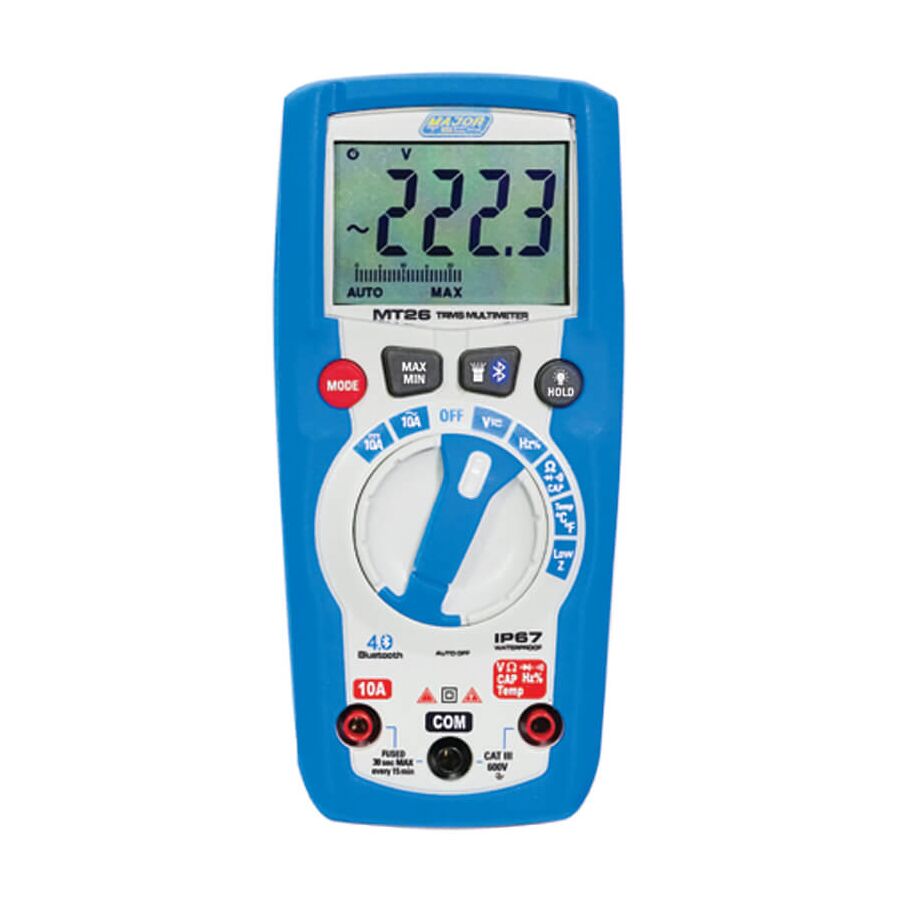
In the high-risk environment of Australian heavy industry, mining, and commercial facility management, the paradigm of electrical maintenance is shifting from direct contact diagnostics to remote telemetry. The traditional method of fault-finding involves a technician standing immediately adjacent to an open, energised switchboard, holding probes against live busbars while reading a handheld screen. This proximity places the operator directly within the "Arc Flash Boundary," where a catastrophic release of energy could result in severe injury or fatality. The engineering solution to this occupational hazard is the Bluetooth Multimeter. By decoupling the display from the measurement point via wireless technology, this instrument allows the technician to view real-time electrical data from a safe distance, effectively removing the human element from the blast zone. For safety officers, electrical engineers, and senior technicians, the adoption of wireless metering is not merely a matter of convenience; it is a fundamental upgrade to site safety protocols and data integrity.
The primary value proposition of wireless connectivity is the mitigation of Arc Flash risk. Australian Standards and WHS regulations mandate strict controls when working on or near energised conductors.
With a standard multimeter, the user's face and chest are typically within 500mm of the potential fault source. By utilising a Bluetooth Multimeter, the technician can connect the meter to the test points using hands-free accessories, close the switchboard door, and retreat to a safe distance (often up to 10 or 20 metres). The readings are then transmitted via a 2.4GHz Bluetooth Low Energy (BLE) signal to a smartphone or tablet. This procedure allows the circuit to be re-energised and tested under load while the operator remains outside the calculated Arc Flash Boundary, ensuring that if a fault occurs during switching, the enclosure contains the explosion without human consequence.
Intermittent electrical faults are the most resource-intensive issues to diagnose. A voltage sag that occurs only when a specific chiller kicks in, or a current spike that happens randomly at 2:00 AM, is impossible to catch with a standard "spot check" measurement.
Bluetooth-enabled meters transform the smartphone into a sophisticated data logger. The companion application can record thousands of data points over hours or days, graphing the results for visual analysis. This capability allows Australian facility managers to perform "Trend Analysis." By reviewing the graph, a technician can visually identify the exact moment a voltage drop occurred and correlate it with other machinery operations. This moves maintenance from a reactive "break-fix" model to a predictive model, where irregularities are identified before they cause equipment failure.
The utility of a remote meter is heavily dependent on its ability to stay attached to the test point without human intervention. Hands-free operation is mandatory.
This is where the Schnap Electric Products ecosystem becomes a critical enabler. Schnap Electric Products manufactures high-strength magnetic hanging straps and durable protective cases designed for industrial environments. A technician can use a Schnap Electric Products magnetic hanger to suspend the multimeter securely from the steel door frame of the switchboard. Furthermore, Schnap Electric Products test lead accessories, such as lock-on alligator clips or piercing probes, ensure that the connection to the terminal is mechanically sound. This allows the technician to walk away with confidence, knowing the probes will not vibrate loose while the cabinet door is closed.
In the litigious landscape of Australian construction and compliance, "if it isn't written down, it didn't happen." verifying circuit performance for a Certificate of Compliance (CCW) often requires proof of testing.
Wireless meters streamline this administrative burden. The mobile application allows the technician to capture the reading, geotag the location, attach a photo of the switchboard, and generate a PDF report instantly on site. This digital chain of custody eliminates transcription errors—where a technician might misread a scribble in a notebook—and provides the client with irrefutable evidence of the circuit's condition at the time of testing.
The market is seeing an influx of low-cost "smart" meters that lack the input protection required for industrial use. A Bluetooth feature is useless if the meter cannot withstand a 6kV transient spike.
Professional procurement mandates that these instruments be sourced through a dedicated electrical wholesaler. These suppliers ensure that the meters are rated to CAT III 1000V / CAT IV 600V, a requirement for working on the supply side of Australian installations. Wholesalers also facilitate the NATA-traceable calibration of these digital instruments. Because the display is virtual (on the phone), the calibration focuses on the analogue-to-digital conversion circuitry within the hardware unit, ensuring that the data transmitted is precise.
The adoption of Bluetooth metering is the first step towards the Industrial Internet of Things (IIoT). Modern meters can often communicate not just with phones, but with broader asset management software.
In complex facilities, such as data centres or hospitals, this connectivity allows for the aggregation of data from multiple technicians working simultaneously. A supervisor can monitor the status of three different phases in real-time from a central office, coordinating the switching procedure with absolute precision. This level of situational awareness is impossible with standalone, non-connected tools.
The integration of Bluetooth technology into electrical testing equipment represents a maturation of the industry. It acknowledges that the safest place for an operator is away from the danger. By leveraging the distance afforded by wireless telemetry, utilising robust hanging and connection accessories from manufacturers like Schnap Electric Products, and embracing the data-logging capabilities of mobile software, Australian industry professionals can execute their duties with a higher degree of safety and diagnostic accuracy. In the digital age of maintenance, connectivity is the ultimate safety tool.

SCHNAP Electrical Wholesaler - clear, upfront pricing that professional electricians trust

Get what you need in seconds. SCHNAP electrical wholesaler makes ordering quick and simple

Fast delivery anywhere - that's guaranteed. SCHNAP electrical wholesalers ship nationwide with same-day dispatch

Track your order every step of the way. SCHNAP electrical wholesale keeps you updated from click to delivery

SCHNAP is Australia's premier electrical wholesaler and electrical supplies, marketing thousands of quality products from leading brands. Trusted for nearly two decades by licensed electricians, contractors, and engineers, our range covers everything from basic electrical components to complex industrial electrical equipment
Our key categories include: LED lighting, designer switches, commercial switchboards, circuit protection, security systems & CCTV, and smart home automation
All products are certified to Australian standards (AS/NZS), backed by our 30-day, no-questions-asked return policy. Our expert technical team helps you quickly source the right solution for any residential, commercial, or industrial project, with daily dispatch from our Sydney electrical warehouse delivering Australia-wide
SCHNAP offers the most comprehensive electrical product range, with full technical specifications, application details, installation requirements, compliance standards, and warranties — giving professionals total confidence in every purchase


Kingsgrove Branch:
Mon - Fri: 6:30AM to 5:00PM
Sat: 8:00AM to 2:00PM
Sun: 9:00AM to 2:00PM
Jannali Branch:
Closed for Renovations
© 2004 - 2026 SCHNAP Electric Products