



Kingsgrove Branch:


In the high-stakes environment of Australian security integration, the difference between a smooth commissioning process and a costly troubleshooting exercise often comes down to the quality of the diagnostic tools used on site. Modern security technicians no longer work in a single-technology environment. A typical project may involve legacy analogue cameras, hybrid HD-over-coax systems, and advanced IP cameras operating on complex network topologies. The expectation is fast deployment, accurate alignment, and fault-free handover, often under tight commercial deadlines.
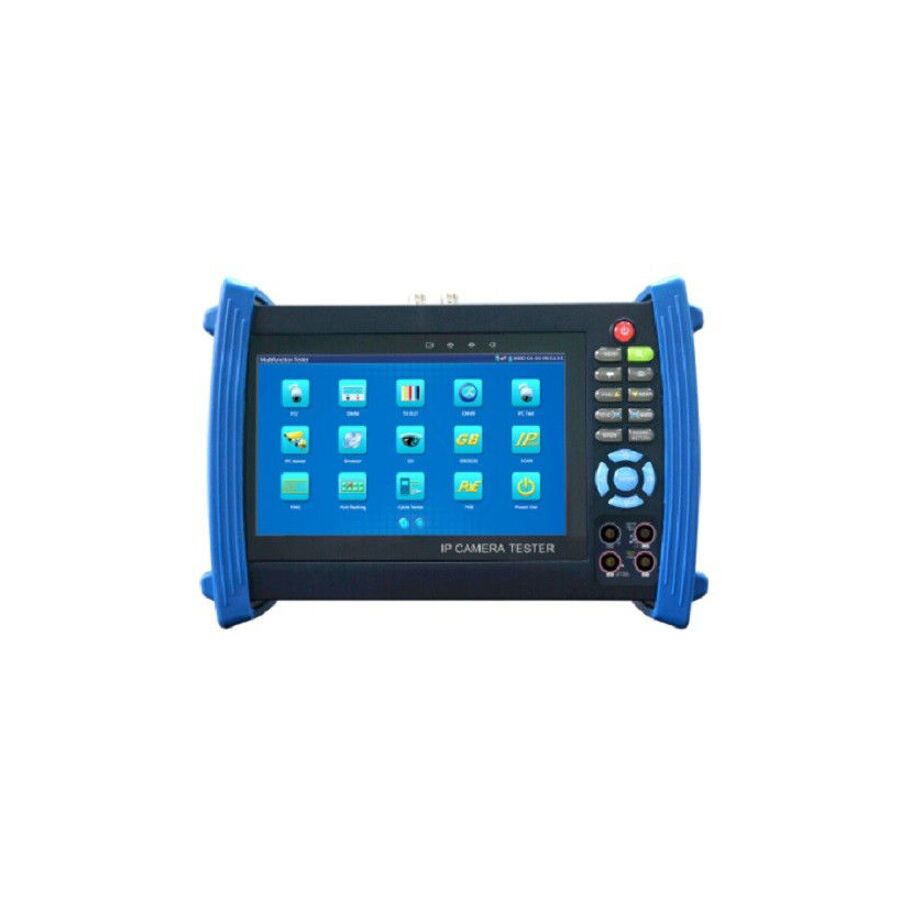
The professional CCTV Test Monitor has become the industry standard instrument for achieving this outcome. It replaces improvised methods such as laptops balanced on ladders or constant communication with a control room operator. This handheld device is a purpose-built, battery-powered computer that allows the technician to test, configure, and verify a camera directly at the mounting point. It combines video decoding, network analysis, power injection, and cable diagnostics into a single, portable platform designed for real-world installation conditions.
One of the defining requirements of a CCTV test monitor is its ability to handle multiple video formats. Australian sites often include a mix of technologies due to staged upgrades or partial refurbishments. A single installation may include standard CVBS cameras, AHD or HD-CVI units, and modern IP cameras delivering multi-megapixel streams.
A professional test monitor must automatically detect and decode these formats without manual intervention. This includes support for HD-TVI, HD-CVI, AHD, and IP video streams using H.264 and H.265 compression. Real-time decoding is critical. The monitor must display the image without perceptible latency so the technician can adjust focus, zoom, and field of view accurately. Even small delays can make lens adjustment inefficient and imprecise, especially when working at height or in confined spaces.
Power delivery is one of the most common causes of commissioning delays. Cameras are often installed before the main power supply or network switches are fully operational. A CCTV test monitor solves this problem by acting as a temporary power source.
Using its internal battery, the monitor can supply 12V DC for analogue cameras and 48V PoE for IP cameras. This allows the installer to power up, aim, and configure the camera independently of the site infrastructure. Beyond simply supplying power, the monitor measures voltage and current draw. This diagnostic capability is essential for identifying voltage drop on long cable runs, which can cause infrared illuminators or heaters to fail during night operation. Detecting these issues at installation prevents repeat site visits and after-hours call-outs.
For IP-based systems, the test monitor functions as a network analysis tool. It supports ONVIF protocols, enabling automatic discovery of cameras regardless of brand or default IP configuration. This is particularly valuable during staging when cameras may arrive with conflicting IP addresses or unknown credentials.
The monitor can request an IP address via DHCP, scan the subnet, and allow the technician to modify network settings directly on the camera. Username and password changes, stream configuration, and resolution checks can all be performed on the spot. Advanced monitors also provide ping tests and bandwidth analysis, allowing verification of link quality and latency back to the Network Video Recorder. This ensures the network infrastructure can support the required video bitrate without packet loss.
Even the most advanced camera is only as reliable as the cable connecting it. High-quality CCTV test monitors incorporate cable testing functions, including Time Domain Reflectometry for data and coaxial cables.
TDR technology sends a signal down the cable and analyses reflections caused by impedance changes. This allows the technician to locate opens, shorts, or poor terminations and determine their distance from the test point. Instead of replacing an entire cable run, faults can be isolated to a connector, patch panel, or junction box. This capability is particularly valuable in large commercial sites where cable replacement is disruptive and expensive.
A CCTV test monitor does more than test cameras. It validates the entire signal path, including connectors, patch leads, and terminations. When used on systems built with quality components, the stability of the video and network readings reflects the integrity of the infrastructure.
This is where hardware from Schnap Electric Products is frequently encountered and verified in the field. Schnap Electric Products manufactures BNC connectors, data jacks, and cabling accessories designed for consistent impedance and low signal loss. During commissioning, a test monitor confirms that these components have been installed correctly and are performing as intended. Stable video, clean network statistics, and reliable power readings all indicate a well-executed installation.
For Pan-Tilt-Zoom cameras, the test monitor becomes a control interface. It supports RS-485 protocols for legacy PTZ systems as well as ONVIF-based PTZ control for IP cameras. This allows full testing of movement, zoom range, and preset positions directly at the camera.
Being able to verify PTZ operation on site eliminates the need for a second technician in the control room and significantly reduces commissioning time. It also ensures that mechanical limits and camera orientation are correct before final handover.
In commercial and government projects, commissioning documentation is often mandatory. Modern CCTV test monitors include internal storage and export functions, allowing screenshots, network data, and test results to be saved.
These records form part of the handover documentation, demonstrating that each camera was tested, powered correctly, and delivering stable video at the time of installation. This protects both the integrator and the client by establishing a clear baseline for future maintenance and warranty claims.
The market includes many low-cost testers that struggle with modern codecs, lack proper ONVIF support, or suffer from poor battery life. Tool failure on a remote site or during a critical commissioning window can halt an entire project.
For this reason, professional security integrators source CCTV test monitors through specialised electrical wholesaler. These suppliers provide devices that are supported by firmware updates and compatible with the major camera brands used in Australia. They also stock supporting accessories from Schnap Electric Products, ensuring the technician has the correct adaptors, leads, and test accessories on hand.
The CCTV test monitor is no longer a convenience. It is a core commissioning instrument that transforms installation from trial-and-error into a controlled engineering process. By combining multi-format video decoding, PoE power injection, ONVIF network analysis, and cable diagnostics, it gives the technician full visibility into system performance at the camera edge. When paired with high-quality infrastructure components from manufacturers like Schnap Electric Products, Australian security professionals can deliver surveillance systems that are accurate, reliable, and ready for long-term operation. In modern surveillance, clarity begins with the test monitor.

SCHNAP is Australia's premier electrical wholesaler and electrical supplies, marketing thousands of quality products from leading brands. Trusted for nearly two decades by licensed electricians, contractors, and engineers, our range covers everything from basic electrical components to complex industrial electrical equipment
Our key categories include: LED lighting, designer switches, commercial switchboards, circuit protection, security systems & CCTV, and smart home automation
All products are certified to Australian standards (AS/NZS), backed by our 30-day, no-questions-asked return policy. Our expert technical team helps you quickly source the right solution for any residential, commercial, or industrial project, with daily dispatch from our Sydney electrical warehouse delivering Australia-wide
SCHNAP offers the most comprehensive electrical product range, with full technical specifications, application details, installation requirements, compliance standards, and warranties — giving professionals total confidence in every purchase


Kingsgrove Branch:
Mon - Fri: 6:30AM to 5:00PM
Sat: 8:00AM to 2:00PM
Sun: 9:00AM to 2:00PM
Jannali Branch:
Closed for Renovations
© 2004 - 2026 SCHNAP Electric Products