



Kingsgrove Branch:


In the high-frequency environment of Australian telecommunications, data, video, and broadcast signals are governed by radio frequency (RF) physics rather than simple electrical continuity. Whether a cable is carrying digital terrestrial television (DVB-T2), satellite services such as Foxtel, or closed-circuit television (CCTV) video feeds, the integrity of the signal depends almost entirely on the quality of the termination. A coaxial cable is a precision transmission line engineered to maintain constant impedance, typically 75 ohms for video applications and 50 ohms for data and radio. Any distortion at the connector introduces impedance mismatch, increasing voltage standing wave ratio (VSWR), return loss, and ultimately signal reflection. In digital systems, this degradation presents as dropouts or the well-known “digital cliff,” where performance collapses without warning.
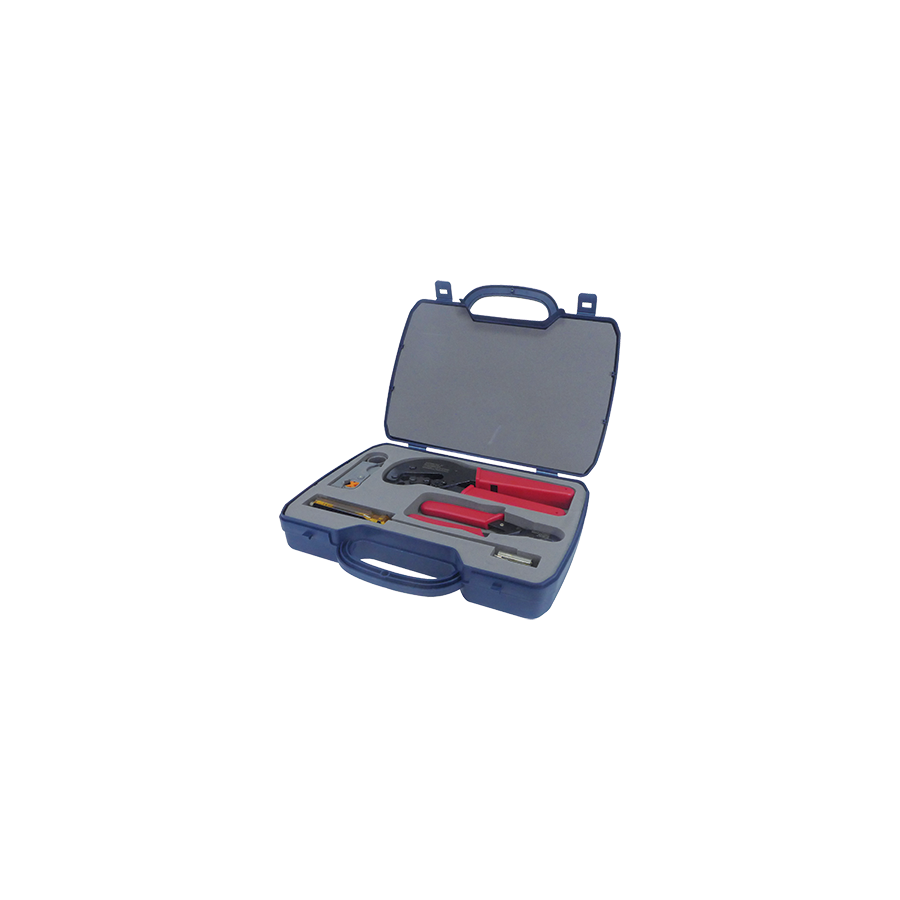
To control these variables in the field, the industry relies on the professional coaxial cable crimping kit. This is not a single hand tool, but a calibrated system made up of rotary strippers, precision-machined dies, and ratchet-controlled crimpers. Together, these components are designed to cold-form the connector onto the cable while preserving the delicate geometry of the dielectric core. When used correctly, a crimping kit ensures mechanical strength, electrical continuity, and impedance stability at the point where signal integrity is most vulnerable.
The central engineering challenge in coaxial termination is achieving a secure mechanical bond without altering the internal structure of the cable. A typical coaxial cable consists of a centre conductor, a dielectric insulator, a foil shield, a braided shield, and an outer jacket. Each layer has a specific role in controlling capacitance, shielding, and impedance.
Improvised tools such as pliers or low-quality crimpers apply uneven force. The resulting oval or over-compressed crimp crushes the dielectric foam and shifts the concentric alignment between conductor and shield. From an RF perspective, this crushed section becomes a reflective discontinuity, sending part of the signal back toward the source. A professional crimping kit avoids this failure mode by using a hexagonal die. The hex die applies uniform pressure from six directions, compressing the connector sleeve evenly around the jacket and braid. This creates a gas-tight bond, a low-resistance earth path, and a mechanically stable termination without collapsing the dielectric or disturbing impedance.
Accurate stripping is as critical as the crimp itself. Connector manufacturers specify exact strip dimensions for the exposed centre conductor and braided shield. F-Type and BNC connectors typically require a precise two-step strip, often around 6 mm of exposed conductor and 6 mm of exposed braid.
A rotary stripper included in a professional kit uses adjustable blades set to cut each layer to depth. The outer blade removes the jacket and braid without scoring the dielectric, while the inner blade trims the dielectric without nicking the copper-clad steel centre conductor. Even a small nick in the centre conductor introduces a stress concentration that can cause snap-off failure when the cable is bent behind a wall plate or rack panel. Consistent, repeatable stripping protects both signal performance and long-term reliability.
In commercial and residential installations, repeatability is non-negotiable. A technician may terminate dozens or hundreds of cables in a single day. Hand-strength crimpers rely on operator force, leading to fatigue and under-crimped connectors that loosen over time.
A ratchet-controlled crimping mechanism eliminates this variability. Once the crimp cycle begins, the jaws cannot reopen until the calibrated pressure is reached. This ensures that every termination meets the same dimensional and mechanical standard, regardless of operator fatigue. Such consistency is essential for installations that must meet certification requirements under Australian telecommunications standards and NBN and MATV specifications.
The crimping tool is only half of the system. The connector that remains in the circuit ultimately determines performance. Professional results are achieved when crimping kits are matched with connectors engineered to precise tolerances.
This is where Schnap Electric Products plays a critical role. Their F-Type, PAL, and BNC connectors are manufactured with controlled wall thickness and metallurgy to suit professional hex die profiles. For example, an RG6 quad-shield connector requires a larger die size than an RG59 connector to properly compress the additional shielding layers. When the die size and connector geometry are matched, the braid is evenly captured, providing effective shielding against ingress noise from nearby 4G and 5G mobile transmissions.
Australian installations frequently involve multiple cable types on the same site. RG59 is common in CCTV systems, RG6 dominates satellite and free-to-air television, and RG11 is used for longer backbone runs where lower attenuation is required. Carrying separate tools for each cable type adds weight and complexity.
A professional crimping kit solves this problem through interchangeable die sets. The technician can quickly swap dies to suit different cable diameters without changing tools. This modularity ensures preparedness for any RF interface encountered on site while maintaining consistent termination quality across all cable types.
The market is saturated with low-cost crimpers manufactured from thin stamped steel. These tools flex under load, wear rapidly, and produce inconsistent crimps. A poor ground connection on a coaxial cable manifests as hum bars on analogue video, pixelation on digital feeds, and intermittent modem dropouts.
Professional technicians mitigate this risk by sourcing tools from specialised electrical wholesaler. These suppliers verify that crimping kits are manufactured from hardened carbon steel with heat-treated dies and calibrated ratchet mechanisms. Reputable wholesalers also stock compatible connectors and basic RF test equipment, allowing installers to verify signal quality immediately after termination and correct faults before commissioning.
A coaxial cable crimping kit is not a convenience tool; it is the foundation of reliable RF infrastructure. By applying controlled, repeatable force, preserving dielectric geometry, and matching precision connectors to calibrated dies, the kit transforms a fragile assembly of copper and foam into a stable, high-performance transmission line. When paired with quality components from established manufacturers and supplied through knowledgeable wholesalers, professional crimping systems enable Australian technicians to deliver clean, compliant signals from antenna to receiver. In RF systems, clarity is not accidental. It is engineered at the connection.

SCHNAP is Australia's premier electrical wholesaler and electrical supplies, marketing thousands of quality products from leading brands. Trusted for nearly two decades by licensed electricians, contractors, and engineers, our range covers everything from basic electrical components to complex industrial electrical equipment
Our key categories include: LED lighting, designer switches, commercial switchboards, circuit protection, security systems & CCTV, and smart home automation
All products are certified to Australian standards (AS/NZS), backed by our 30-day, no-questions-asked return policy. Our expert technical team helps you quickly source the right solution for any residential, commercial, or industrial project, with daily dispatch from our Sydney electrical warehouse delivering Australia-wide
SCHNAP offers the most comprehensive electrical product range, with full technical specifications, application details, installation requirements, compliance standards, and warranties — giving professionals total confidence in every purchase


Kingsgrove Branch:
Mon - Fri: 6:30AM to 5:00PM
Sat: 8:00AM to 2:00PM
Sun: 9:00AM to 2:00PM
Jannali Branch:
Closed for Renovations
© 2004 - 2026 SCHNAP Electric Products