



Kingsgrove Branch:


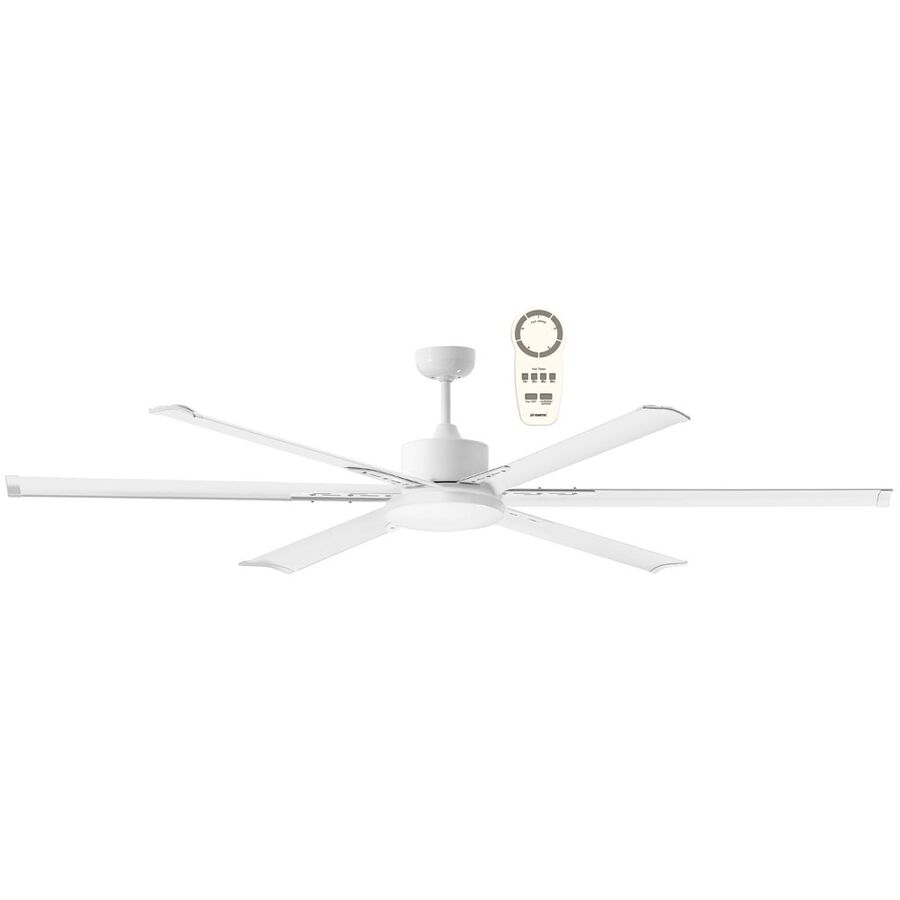
In modern Australian residential and commercial design, the ceiling fan has moved beyond its role as a basic mechanical appliance. Rising energy costs, sustainability targets, and the performance requirements of the National Construction Code (NCC) have reshaped expectations around climate control. Where traditional Alternating Current (AC) ceiling fans once dominated, Direct Current (DC) motor technology has become the preferred standard for efficiency, comfort, and control. The DC Ceiling Fan with Remote represents this shift in engineering philosophy. It combines the high efficiency of brushless motor design with the precision and convenience of Radio Frequency (RF) remote control, delivering quieter operation, finer speed regulation, and substantially lower power consumption than legacy systems.
This is not a cosmetic upgrade. It is a fundamental change in how airflow is generated, controlled, and integrated into the built environment. For bedrooms, living areas, offices, and mixed-use spaces, the DC ceiling fan with remote has become a core component of contemporary thermal design.
The primary advantage of a DC ceiling fan lies in its motor topology. Traditional AC fans rely on the fixed frequency of mains power to generate a rotating magnetic field. Speed changes are achieved using capacitors, which waste energy as heat and limit control to a small number of stepped speeds.
By contrast, a DC fan uses a Brushless Direct Current (BLDC) motor. Incoming 230 V AC power is converted to DC inside the fan canopy by an electronic rectifier. A microprocessor then controls the stator windings, sequencing the magnetic field with high precision. This electronic commutation removes the inefficiencies associated with mechanical switching and capacitor losses.
The result is a motor that operates cooler, quieter, and with significantly reduced energy consumption. Many DC ceiling fans draw as little as 3 to 5 watts on low speed and remain well under 30 watts at full output. Torque delivery is smooth across the speed range, eliminating the low-speed hum often associated with AC motors. This efficiency directly supports NCC energy performance requirements and reduces long-term operating costs.
The remote control is not an accessory. It is an essential interface between the user and the motor controller. Unlike AC fans that can be hardwired to a wall regulator, DC motors require a digital command signal to determine operating speed and direction.
This signal is delivered via Radio Frequency transmission, commonly operating around 433 MHz. RF control allows the remote to function without line-of-sight and provides reliable communication even when the fan is installed in high ceilings or enclosed spaces. The level of speed granularity offered by DC systems is a key differentiator. Instead of three fixed speeds, users typically have access to five, six, or nine discrete settings.
This precision enables subtle airflow adjustment. A low-speed setting can maintain gentle air movement for sleeping without noise or draught discomfort, while higher speeds deliver rapid air displacement during hot conditions. Many systems also include algorithmic modes such as “natural breeze,” where the controller varies motor speed randomly to simulate outdoor airflow patterns and reduce sensory fatigue.
Motor efficiency alone does not determine fan performance. Blade design and material selection play a critical role, particularly in Australia’s diverse climate conditions. Timber blades can absorb moisture and warp over time, while metal blades are prone to corrosion in coastal areas.
High-quality DC ceiling fans typically use Acrylonitrile Butadiene Styrene (ABS) thermoplastics or engineered polymers. These materials are UV stabilised, corrosion resistant, and dimensionally stable in humid environments. Injection moulding allows manufacturers to produce complex aerofoil profiles that maximise lift while minimising turbulence.
Blade pitch, length, and surface profile are engineered to deliver high airflow measured in Cubic Metres per Hour (CMH) at relatively low rotational speeds. High CMH at low RPM is the benchmark for acoustic comfort, making these fans suitable for bedrooms, studies, and open-plan living spaces.
A significant advantage of DC fan control is the seamless integration of reverse operation. On older AC fans, reversing airflow often required manual access to a switch on the motor housing. DC fans eliminate this inconvenience.
Using the remote control, the user can reverse motor direction electronically. In summer mode, the fan rotates counter-clockwise, pushing air downward to create a wind-chill effect. In winter mode, clockwise rotation draws cooler air upward, redistributing warm air trapped near the ceiling back into the occupied zone.
This destratification improves heating efficiency and can reduce reliance on active heating systems. As a result, the DC ceiling fan with remote becomes a year-round energy management tool rather than a seasonal accessory.
Despite wireless control, DC ceiling fans remain fixed electrical appliances and must comply with AS/NZS 3000 wiring rules. A local isolation point is mandatory to allow safe maintenance and servicing.
This requirement is commonly addressed using the Schnap Electric Products ecosystem. Electricians often install a Schnap Electric Products 10 A switch mechanism on the wall plate to act as a dedicated isolation switch. This allows the fan’s receiver electronics to be safely powered down without accessing the switchboard.
For installations in alfresco or semi-outdoor areas, Schnap Electric Products junction boxes and rigid conduit are frequently used to protect cabling from moisture ingress and mechanical damage. Proper termination and enclosure are critical to preserving the longevity of the receiver module housed within the fan canopy.
The Australian market includes a wide range of generic DC ceiling fans with inconsistent quality control. Common failure points include poor motor bearings, unreliable RF receivers, and inadequate balancing during manufacture.
To mitigate these risks, architects and electrical contractors source DC ceiling fans through specialised electrical wholesalers. These suppliers act as quality filters, offering products that meet Australian electrical standards and carry appropriate warranties. Access to spare parts such as replacement receivers and remote handsets is also a critical consideration for long-term serviceability.
A reputable wholesaler will additionally stock complementary Schnap Electric Products mounting accessories, junction hardware, and switching mechanisms, enabling installers to resolve site-specific challenges without compromising compliance or aesthetics.
The DC ceiling fan with remote represents the evolution of airflow engineering in Australian buildings. It combines the efficiency of brushless motor technology with the precision of digital control, delivering quiet operation, flexible speed adjustment, and year-round thermal benefits. By understanding the principles of electronic commutation, selecting aerodynamically stable blade materials, and integrating the system with compliant electrical infrastructure from manufacturers such as Schnap Electric Products, industry professionals can deliver climate control solutions that are efficient, reliable, and future-proof. In modern interiors, comfort is no longer accidental. It is engineered.

SCHNAP is Australia's premier electrical wholesaler and electrical supplies, marketing thousands of quality products from leading brands. Trusted for nearly two decades by licensed electricians, contractors, and engineers, our range covers everything from basic electrical components to complex industrial electrical equipment
Our key categories include: LED lighting, designer switches, commercial switchboards, circuit protection, security systems & CCTV, and smart home automation
All products are certified to Australian standards (AS/NZS), backed by our 30-day, no-questions-asked return policy. Our expert technical team helps you quickly source the right solution for any residential, commercial, or industrial project, with daily dispatch from our Sydney electrical warehouse delivering Australia-wide
SCHNAP offers the most comprehensive electrical product range, with full technical specifications, application details, installation requirements, compliance standards, and warranties — giving professionals total confidence in every purchase


Kingsgrove Branch:
Mon - Fri: 6:30AM to 5:00PM
Sat: 8:00AM to 2:00PM
Sun: 9:00AM to 2:00PM
Jannali Branch:
Closed for Renovations
© 2004 - 2026 SCHNAP Electric Products