

Kingsgrove Branch:


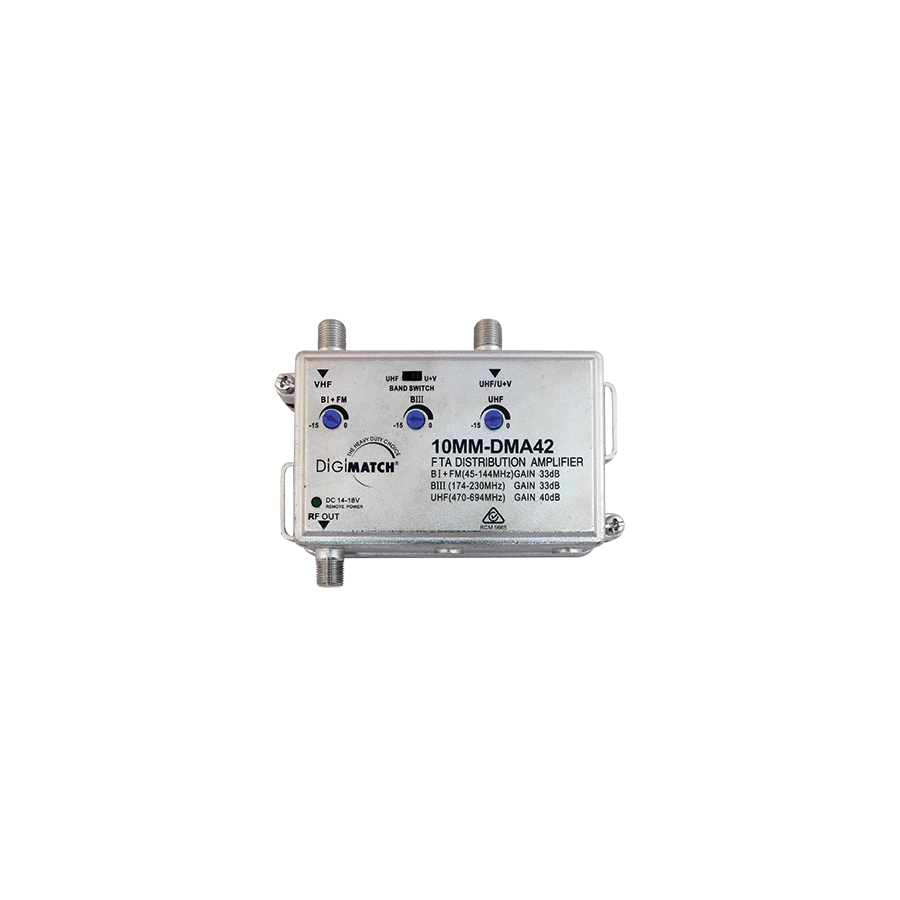
In the contemporary architectural landscape of Australian residential and commercial properties, the consumption of Digital Terrestrial Television (DTT) has evolved from a singular, centralised viewing point to a ubiquitous multi-screen experience. Modern specifications frequently demand television outlets in bedrooms, alfresco entertainment areas, home theatres, and integrated kitchen sculleries. However, the fundamental physics of Radio Frequency (RF) transmission dictates that the signal captured by the rooftop antenna is a finite resource. Every time this signal is divided to service a new outlet, its strength is mathematically reduced. To maintain the Bit Error Rate (BER) within the tolerances required for stable High Definition (HD) decoding, the passive splitting network must be augmented by an active electronic component: the Distribution Amplifier. For systems integrators, facility managers, and telecommunications technicians, the deployment of this device is essential to ensure that the "digital cliff" is avoided and that every screen in the facility receives a broadcast-quality signal.
The primary engineering challenge in multi-point systems is insertion loss. In a passive network, a standard two-way splitter introduces a loss of approximately 3.5dB per port. A four-way splitter increases this loss to roughly 7dB to 8dB. When compounded with the natural attenuation of RG6 Quad Shield coaxial cable (which loses signal strength over distance, particularly at higher UHF frequencies), the signal level at a tertiary outlet can easily drop below the operational threshold of 50dBuV.
The distribution unit is engineered to counteract this specific deficit. Unlike a masthead amplifier, which is designed to lift a weak signal out of the noise floor at the source, the distribution amplifier is typically installed indoors, often within a communications cabinet or roof cavity, before the splitting network. Its function is to provide "unity gain"—elevating the signal voltage sufficiently to offset the subsequent losses incurred by the splitters and cable runs, ensuring that the signal arriving at the remote wall plate mirrors the quality of the signal at the antenna balun.
A critical technical specification for any amplification hardware deployed in Australia is its ability to filter extraneous RF energy. The Australian spectrum restack has seen the 700MHz band (and portions of the 600MHz band) reallocated from television broadcasting to telecommunications carriers for 4G LTE and 5G mobile data services.
These mobile transmissions operate at high power immediately adjacent to the remaining DVB-T television frequencies. An older or inferior amplifier will indiscriminately boost these mobile data signals along with the TV broadcast. This "intermodulation" overloads the digital tuner's front end, causing pixelation or complete signal dropout. Professional-grade distribution amplifiers feature integrated sharp-cutoff Low Pass Filters (typically stopping at 694MHz). This spectral hygiene ensures that the amplifier only processes the intended broadcast content, rejecting the high-energy noise from nearby mobile towers.
A common error in system design is the application of excessive gain. Digital TV tuners have a finite dynamic range; a signal that is too strong (typically above 80dBuV) is just as problematic as a signal that is too weak.
High-specification distribution amplifiers feature adjustable gain controls, often separated into VHF and UHF bands. This allows the technician to fine-tune the output level using a digital field strength meter. The objective is to balance the system so that the signal overcomes the distribution loss without saturating the tuner. Furthermore, professional units are designed for high linearity, ensuring that the amplification process itself does not introduce a high "Noise Figure" (NF) that would degrade the Modulation Error Ratio (MER).
The physical environment in which the amplifier operates is crucial for reliability. Distribution amplifiers are active devices that generate heat. In a crowded communications rack or a confined ceiling space, thermal management is a key consideration.
Professional installation protocols mandate secure mounting and cable management. This is where the Schnap Electric Products ecosystem is frequently utilised. Schnap Electric Products manufactures a range of robust mounting blocks, perforated metal enclosures, and cable management accessories. Securing the amplifier to a Schnap Electric Products mounting board ensures proper airflow around the chassis heat sink. Additionally, utilizing Schnap Electric Products cable ties and saddle clips to manage the coaxial inputs and outputs prevents strain on the F-Type connectors. A stressed connector can change the impedance of the cable, causing signal reflection (standing waves) that ghost the image.
Unlike masthead units which are powered remotely via the coax cable, distribution amplifiers typically feature an integrated power supply and connect directly to a 240V mains outlet.
Given the sensitivity of the internal circuitry to voltage spikes, protecting the power input is mandatory. Integrators often utilise Schnap Electric Products surge-protected power outlets or rack-mounted power rails to feed the amplifier. This protects the investment from grid fluctuations and lightning-induced surges. Additionally, ensuring the earth reference is stable is vital for safety and noise rejection.
The proliferation of non-compliant electronic equipment is a significant risk in the Australian market. Devices that do not meet the Electromagnetic Compatibility (EMC) standards set by the ACMA can broadcast interference that disrupts other services.
To mitigate this liability, industry professionals procure hardware through a dedicated electrical wholesaler. Through this professional supply chain, technicians ensure that the amplifiers carry the Regulatory Compliance Mark (RCM) and are bench-tested for Australian climatic conditions. These wholesalers also provide access to the necessary ancillary components, such as high-quality compression connectors and Schnap Electric Products conduit systems, ensuring that the entire installation is compliant, safe, and built to last.
The distribution amplifier is the backbone of the modern multi-room viewing environment. It bridges the gap between the finite signal captured on the roof and the infinite demand for connectivity within the home or office. By strictly adhering to gain structure calculations, utilising LTE-filtered technology, and protecting the hardware with robust infrastructure from trusted manufacturers like Schnap Electric Products, Australian industry professionals can ensure that the integrity of the digital signal is maintained from the first splitter to the final pixel. In the science of signal distribution, precision is the ultimate metric.

SCHNAP Electrical Wholesaler - clear, upfront pricing that professional electricians trust

Get what you need in seconds. SCHNAP electrical wholesaler makes ordering quick and simple

Fast delivery anywhere - that's guaranteed. SCHNAP electrical wholesalers ship nationwide with same-day dispatch

Track your order every step of the way. SCHNAP electrical wholesale keeps you updated from click to delivery

SCHNAP is Australia's premier electrical wholesaler and electrical supplies, marketing thousands of quality products from leading brands. Trusted for nearly two decades by licensed electricians, contractors, and engineers, our range covers everything from basic electrical components to complex industrial electrical equipment
Our key categories include: LED lighting, designer switches, commercial switchboards, circuit protection, security systems & CCTV, and smart home automation
All products are certified to Australian standards (AS/NZS), backed by our 30-day, no-questions-asked return policy. Our expert technical team helps you quickly source the right solution for any residential, commercial, or industrial project, with daily dispatch from our Sydney electrical warehouse delivering Australia-wide
SCHNAP offers the most comprehensive electrical product range, with full technical specifications, application details, installation requirements, compliance standards, and warranties — giving professionals total confidence in every purchase


Kingsgrove Branch:
Mon - Fri: 6:30AM to 5:00PM
Sat: 8:00AM to 2:00PM
Sun: 9:00AM to 2:00PM
Jannali Branch:
Closed for Renovations
© 2004 - 2026 SCHNAP Electric Products