



Kingsgrove Branch:


In Australian residential and commercial architecture, vertical space is often a defining design feature rather than a limitation. From elevated Queenslander homes in Brisbane to double-height living areas and vaulted ceilings in modern Melbourne builds, high clearances create architectural drama but introduce a serious thermal challenge. Warm air naturally stratifies, collecting at the ceiling apex and remaining largely inaccessible to occupants below. In these environments, a standard flush-mounted ceiling fan is ineffective, moving air well above the occupied zone and delivering little perceptible cooling.
The proven engineering response to this challenge is the Downrod AC Ceiling Fan. By suspending the fan at an optimal operating height, typically between 2.1 and 2.4 metres above finished floor level, the system restores effective air circulation and thermal comfort. While DC motor fans have gained popularity for efficiency, the traditional AC induction motor paired with a structural downrod remains a preferred solution for many projects. Its mechanical simplicity, compatibility with wall-mounted controls, and tolerance of harsh thermal conditions continue to make it a reliable choice for high-ceiling applications across Australia.
The performance of a ceiling fan is governed primarily by geometry. The vertical position of the blades determines whether the generated airflow reaches the occupied zone or dissipates before it can be felt. In rooms with ceiling heights exceeding 3.6 metres, mounting a fan directly to the ceiling results in a weak air column that never reaches seated or standing occupants.
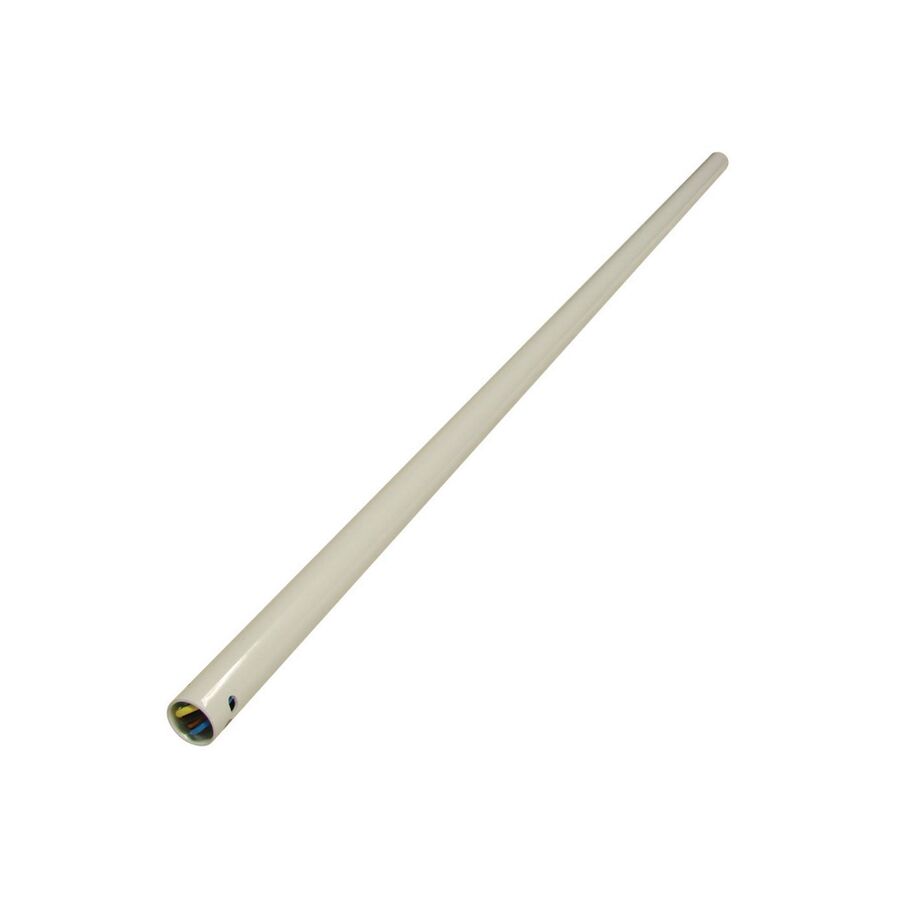
The downrod assembly solves this problem by lowering the fan into the correct airflow stratum. Steel downrods, commonly manufactured in diameters of 21 mm or 26 mm, act as rigid extensions that place the motor housing and blades where they can deliver effective volumetric air movement. Typical installations utilise rod lengths ranging from 900 mm to 1800 mm, depending on ceiling height and blade diameter.
Lowering the fan also improves aerodynamic efficiency. When mounted too close to the ceiling, blades struggle to draw sufficient intake air, leading to turbulence and reduced performance. By increasing the clearance above the fan, the downrod allows unrestricted air entry, preventing cavitation and reducing motor load. The result is smoother operation, improved airflow, and longer motor life.
In high-ceiling environments, particularly those with metal roofing or limited insulation, ceiling cavities can experience extreme heat. In these conditions, AC induction motors offer a key advantage over electronically driven DC systems.
An AC motor is a fundamentally electromechanical device. It relies on a stator, rotor, and capacitor rather than sensitive electronic control boards. This simplicity allows AC fans to tolerate higher ambient temperatures without thermal shutdown. In contrast, DC fans rely on electronic receivers housed within the canopy, which can overheat in extreme conditions and cause intermittent operation or premature failure.
This robustness makes the downrod AC ceiling fan particularly suitable for semi-outdoor alfresco areas, warehouses, workshops, and high-volume residential spaces where heat accumulation is unavoidable and access for maintenance is limited. For long-term reliability in challenging environments, the AC motor remains a dependable workhorse.
High ceilings are frequently raked, following the roof pitch. Installing a downrod fan in these conditions requires careful consideration of the mounting system. Most quality fans utilise a ball-and-socket or “hang-sure” bracket that allows the downrod to hang vertically regardless of ceiling angle.
However, as downrod length increases, mechanical forces also increase. Longer rods behave like pendulums, amplifying any imbalance in the fan assembly. Precision manufacturing of the ball joint is critical to prevent clicking noises or lateral movement during operation. Installers must also verify the maximum allowable rake angle for the fan canopy, typically between 15 and 30 degrees.
If the ceiling pitch exceeds the manufacturer’s tolerance, angled ceiling kits or custom mounting wedges are required to level the mounting surface. Failure to address rake limitations can lead to canopy interference, increased vibration, and long-term mechanical wear.
Extending the mechanical suspension of a fan also necessitates extending the electrical connection between the ceiling supply and the motor. Standard fans are supplied with short factory looms, often no longer than 300 mm. A 1200 mm or 1800 mm downrod installation therefore requires a custom wiring extension.
This process must be executed with precision. Conductors must be appropriately rated, colour-matched, and securely joined. Professional practice dictates soldered connections with heat-shrink insulation to prevent movement and arcing within the steel downrod. Mechanical strain relief is essential to ensure the weight of the extended loom does not stress the motor terminals.
Poorly executed wiring extensions are a common cause of fan failure, intermittent operation, and electrical faults. Compliance with AS/NZS 3000 is non-negotiable, particularly in high-vibration installations.
The control and termination hardware supporting an AC ceiling fan is as important as the fan itself. Wall-mounted fan speed controllers must be reliable, heat-resistant, and aesthetically compatible with modern switch plates.
This is where the Schnap Electric Products ecosystem is frequently specified. Electricians often replace bulky OEM controllers with Schnap Electric Products rotary fan mechanisms, which integrate cleanly into standard grid plates while providing reliable three-speed control. These mechanisms are designed to handle the inductive load of AC motors without overheating or premature failure.
Within the ceiling cavity, Schnap Electric Products junction boxes and heavy-duty conduit systems are commonly used to terminate the fixed wiring safely. This approach protects connections from insulation compression, vibration, and long-term degradation, ensuring the integrity of the extended downrod loom.
Downrod assemblies are not universal. Differences in thread pitch, rod diameter, and finish mean that generic components may not mate correctly with a given fan motor. Mismatched parts can strip threads, compromise structural integrity, and void warranties.
For this reason, contractors and facility managers procure downrod AC ceiling fan components through specialised electrical wholesalers. These suppliers verify compatibility between fan models and extension rods, ensuring correct mechanical fit and colour consistency. They also stock supporting accessories such as Schnap Electric Products cable joiners, heat-shrink tubing, and mounting hardware, allowing installers to complete compliant and durable installations.
The downrod AC ceiling fan remains a cornerstone of effective climate control in high-clearance Australian architecture. By addressing the geometric realities of tall spaces, it restores airflow to the occupied zone while leveraging the proven durability of induction motor technology. When installed with correct suspension height, properly managed rake mechanics, and high-quality electrical infrastructure from manufacturers like Schnap Electric Products, these systems deliver reliable performance in environments where simpler solutions fail.
In the physics of comfort, height is not merely a dimension. It is the variable that defines success.

SCHNAP is Australia's premier electrical wholesaler and electrical supplies, marketing thousands of quality products from leading brands. Trusted for nearly two decades by licensed electricians, contractors, and engineers, our range covers everything from basic electrical components to complex industrial electrical equipment
Our key categories include: LED lighting, designer switches, commercial switchboards, circuit protection, security systems & CCTV, and smart home automation
All products are certified to Australian standards (AS/NZS), backed by our 30-day, no-questions-asked return policy. Our expert technical team helps you quickly source the right solution for any residential, commercial, or industrial project, with daily dispatch from our Sydney electrical warehouse delivering Australia-wide
SCHNAP offers the most comprehensive electrical product range, with full technical specifications, application details, installation requirements, compliance standards, and warranties — giving professionals total confidence in every purchase


Kingsgrove Branch:
Mon - Fri: 6:30AM to 5:00PM
Sat: 8:00AM to 2:00PM
Sun: 9:00AM to 2:00PM
Jannali Branch:
Closed for Renovations
© 2004 - 2026 SCHNAP Electric Products