



Kingsgrove Branch:


In the landscape of Australian industrial and commercial networking, the physical limitations of copper cabling present a persistent engineering constraint. Under the IEEE 802.3 Ethernet standard, twisted-pair copper cables such as Cat6 and Cat6a are restricted to a maximum transmission distance of 100 metres. Beyond this boundary, signal attenuation, impedance mismatch, and crosstalk degrade packet integrity, resulting in dropped frames and unreliable communication.
Modern infrastructure requirements routinely exceed this distance. Applications such as perimeter security cameras across mining sites, remote telemetry systems in agricultural processing plants, and distributed control networks in industrial facilities all demand reliable data transmission well beyond the copper limit. The engineering solution to this challenge is the Ethernet to Fiber Converter Kit, a hardware system that bridges copper-based local area networks with the long-distance, noise-immune properties of optical fibre. By converting electrical Ethernet signals into optical signals, these kits enable transmission distances from 550 metres to over 80 kilometres while simultaneously providing critical electrical isolation between network segments.
At its core, an Ethernet to fiber converter performs a Layer 1, or Physical Layer, translation within the OSI model. Electrical pulses received from the copper Ethernet interface are decoded and used to drive a laser diode or light-emitting device, converting electrons into photons that propagate through the fibre core. At the remote end, a corresponding converter performs the inverse operation, restoring the optical signal back into an electrical Ethernet stream.
This process is entirely transparent to higher network layers. Media converters do not modify MAC addresses, VLAN tags, or IP headers. High-quality converter kits employ either store-and-forward or cut-through architectures, ensuring that latency remains negligible and typically measured in microseconds. This low delay is essential for time-sensitive applications such as IP video surveillance, Voice over IP, and industrial control traffic, where jitter or frame loss directly impacts system performance.
Distance extension is only one advantage of fibre conversion. A more critical benefit in industrial environments is immunity to electromagnetic and radio frequency interference. Copper Ethernet cables routed alongside high-voltage feeders, motors, or Variable Speed Drives act as antennas, inducing noise that corrupts data signals and damages network interfaces.
Optical fibre is a dielectric medium and carries no electrical current. By inserting a fibre link between two copper segments, an Ethernet to fiber converter kit creates complete galvanic isolation. This isolation eliminates ground loops, a common failure mechanism where differing earth potentials between buildings cause current to flow along copper shields. Without fibre isolation, these currents can destroy switch ports and network cards. Fibre breaks this electrical path entirely, protecting sensitive active equipment at both ends of the link.
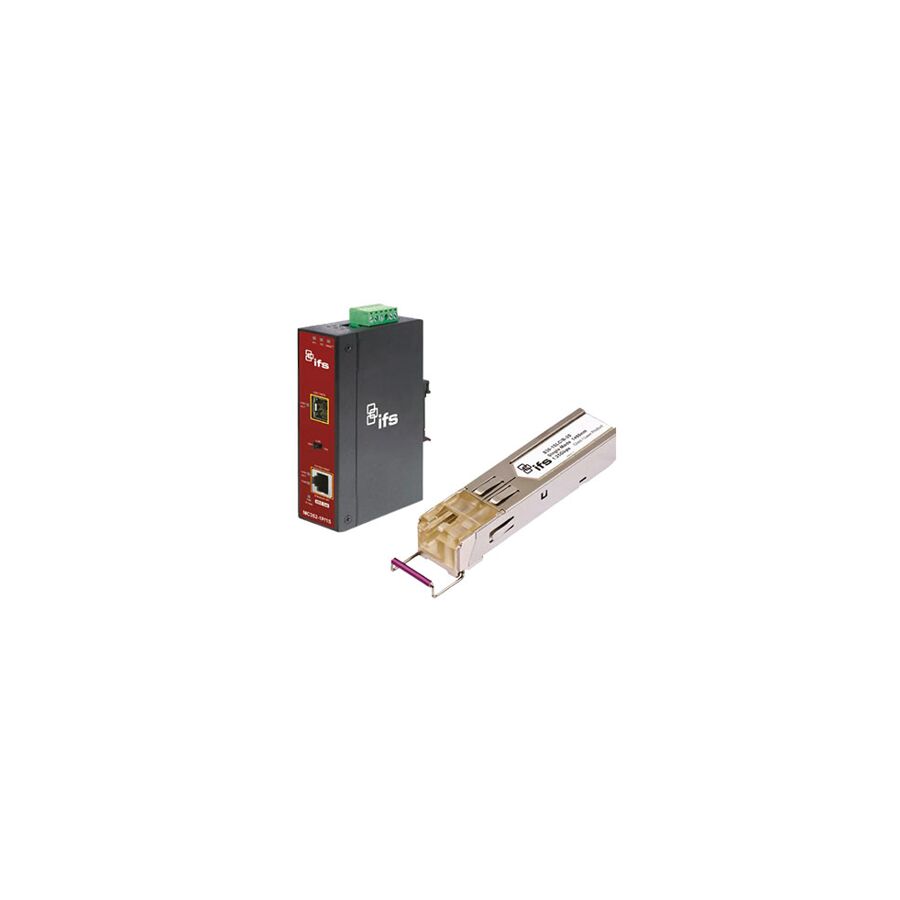
Correct kit selection depends on both transmission distance and fibre type. A typical converter kit consists of a media converter chassis and a Small Form-factor Pluggable (SFP) transceiver module. The optical characteristics of the SFP must match the installed fibre infrastructure.
For short to medium distances, generally up to 550 metres, multimode fibre configurations using OM3 or OM4 fibre are common. These systems utilise cost-effective VCSEL laser technology operating at 850nm and are well suited to campus networks and large commercial buildings. For long-distance applications typical of Australian resource, transport, and utility sectors, single-mode fibre kits are required. Operating at 1310nm or 1550nm, single-mode converters support transmission distances from several kilometres to well beyond 80 kilometres. A mismatch between SFP type and fibre installed will result in excessive dispersion or complete link failure, making correct specification essential.
A defining feature of professional-grade converter kits is Link Fault Pass-Through (LFP). In low-quality converters, a failure on one side of the link may not be communicated to the other. For example, if the copper Ethernet cable is unplugged at the remote end, the fibre link may remain active, causing the central switch to believe the connection is still operational.
With LFP enabled, the converter continuously monitors both copper and fibre interfaces. If one side drops, the converter forces the corresponding port on the opposite side to drop as well. This fault propagation allows managed switches to detect failures immediately, trigger redundancy mechanisms such as Spanning Tree Protocol, or alert administrators through SNMP monitoring. In large industrial networks, this feature is essential for maintaining visibility and reducing fault resolution time.
Ethernet to fiber converters are rarely installed in climate-controlled server rooms. In many applications, the remote converter is located in field cabinets, ceiling voids, or outdoor enclosures exposed to dust, vibration, and temperature variation. As a result, physical mounting and power quality are critical considerations.
Schnap Electric Products supplies industrial DIN-rail mounting solutions, regulated DC power supplies, and protective enclosures designed specifically for networking and control equipment. Most media converters operate on 12V or 24V DC, making a stable and filtered power source essential. A Schnap Electric Products DIN-rail power supply delivers clean, regulated voltage, protecting the converter from surges and fluctuations common in industrial grids. Housing the converter within a properly ventilated enclosure also ensures fibre patch leads are strain-relieved and protected from accidental damage.
In many surveillance and access-control applications, the remote device requires both data and power. Advanced Ethernet to fiber converter kits incorporate Power over Ethernet (PoE) functionality. These converters act as Power Sourcing Equipment, injecting 48V DC in accordance with IEEE 802.3af or 802.3at standards into the copper Ethernet port while maintaining fibre data transmission.
This capability eliminates the need for a separate power circuit at the remote device, simplifying installation and reducing infrastructure costs. PoE-enabled converters are particularly valuable for pole-mounted cameras, remote sensors, and outdoor access points where running mains power is impractical.
The market contains a wide range of low-cost, unbranded media converters that suffer from poor thermal design, capacitor degradation, and premature laser failure. In security, control, or monitoring networks, a failed converter represents a complete loss of communication at that endpoint.
For this reason, professional system integrators procure Ethernet to fiber converter kits through specialised electrical wholesalers with dedicated data and industrial networking expertise. These suppliers verify RCM compliance, electromagnetic compatibility, and suitability for Australian environmental conditions. They also stock compatible fibre patch cords, SFP modules, and Schnap Electric Products mounting accessories, ensuring the entire link is engineered as a coherent, reliable system rather than a collection of mismatched components.
The Ethernet to fiber converter kit is the essential bridge that extends modern networking beyond the physical limits of copper cabling. It delivers the distance, noise immunity, and electrical isolation required for robust industrial and commercial communication systems. By understanding the principles of optical–electrical conversion, selecting the correct single-mode or multimode configuration, leveraging features such as Link Fault Pass-Through, and securing the installation with infrastructure from suppliers like Schnap Electric Products, Australian industry professionals can deploy networks that are scalable, resilient, and uncompromising in reliability. In the equation of connectivity, the converter is not merely an adapter, it is a force multiplier.

SCHNAP is Australia's premier electrical wholesaler and electrical supplies, marketing thousands of quality products from leading brands. Trusted for nearly two decades by licensed electricians, contractors, and engineers, our range covers everything from basic electrical components to complex industrial electrical equipment
Our key categories include: LED lighting, designer switches, commercial switchboards, circuit protection, security systems & CCTV, and smart home automation
All products are certified to Australian standards (AS/NZS), backed by our 30-day, no-questions-asked return policy. Our expert technical team helps you quickly source the right solution for any residential, commercial, or industrial project, with daily dispatch from our Sydney electrical warehouse delivering Australia-wide
SCHNAP offers the most comprehensive electrical product range, with full technical specifications, application details, installation requirements, compliance standards, and warranties — giving professionals total confidence in every purchase


Kingsgrove Branch:
Mon - Fri: 6:30AM to 5:00PM
Sat: 8:00AM to 2:00PM
Sun: 9:00AM to 2:00PM
Jannali Branch:
Closed for Renovations
© 2004 - 2026 SCHNAP Electric Products