



Kingsgrove Branch:


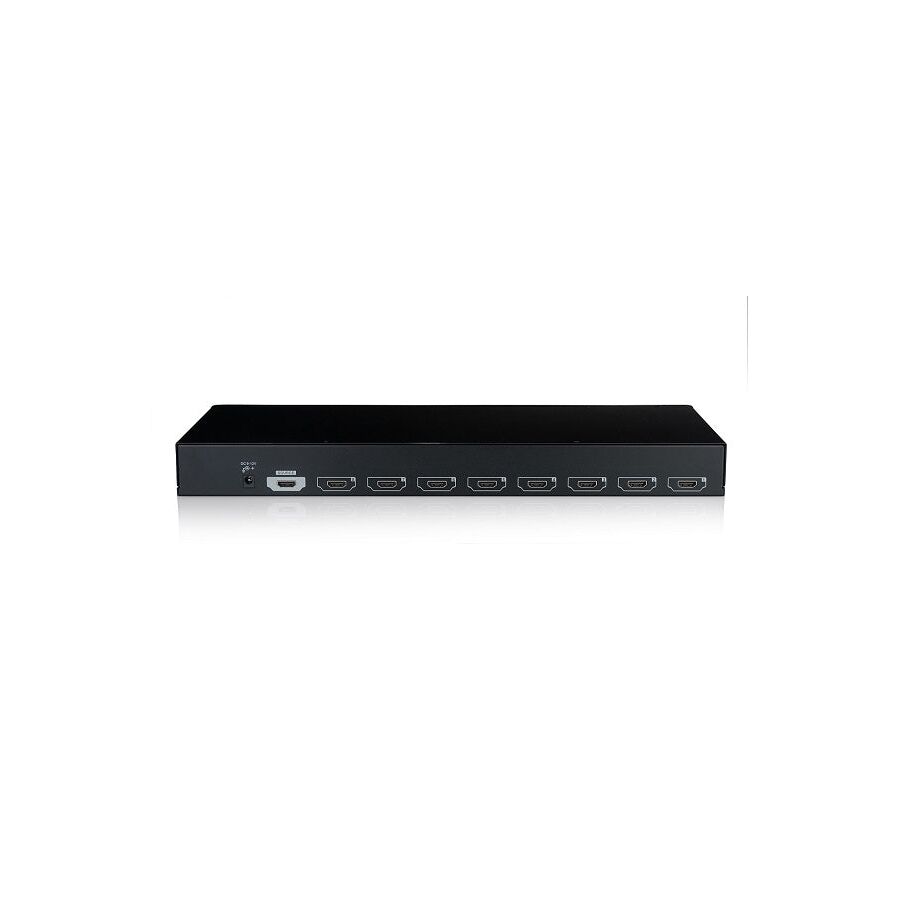
In the modern Australian commercial audiovisual environment, the expectation of multi-screen presentation is no longer optional. Retail stores rely on synchronised promotional displays, hospitality venues require identical live content across dozens of screens, and corporate or industrial environments demand consistent visual information for operational clarity. Achieving this outcome requires more than simply duplicating a cable run. Digital video distribution operates within strict electrical and timing tolerances, and any compromise at the distribution point can undermine the entire system. The professional solution to this requirement is the HD Video Splitter, technically classified as an active Distribution Amplifier.
Unlike consumer adapters, a professional HD video splitter is engineered to accept a single digital source and deliver multiple identical outputs while maintaining signal integrity, timing accuracy, and content protection compliance. It ensures that every connected display receives a mathematically identical signal, regardless of cable length variations or display capabilities. In commercial systems designed for continuous operation, this device becomes a foundational element of reliability.
The most important distinction to understand is the difference between active distribution and passive splitting. In the digital domain, passive splitting is fundamentally incompatible with HDMI signalling. HDMI relies on high-frequency differential data streams that are extremely sensitive to impedance changes. Attempting to divide this signal with a simple Y-cable results in voltage collapse, timing errors, and immediate handshake failure.
An HD video splitter operates as an active regeneration point. Internally, it receives the incoming TMDS signal, buffers it, equalises voltage levels, and re-clocks the data stream before transmitting it to each output port. This regeneration restores signal edge definition and eliminates jitter introduced by cable capacitance. As a result, the signal arriving at the final display remains stable and error-free, even in multi-screen configurations operating at high resolutions.
HDMI video transmission depends on Transition Minimized Differential Signaling. At higher resolutions, especially 4K, the data rate increases dramatically, making the signal more vulnerable to attenuation and timing skew. Without re-clocking, even minor inconsistencies between output paths can cause pixel errors or complete signal loss.
Professional HD video splitters include dedicated re-clocking circuitry for each output channel. This process realigns the data stream with a clean reference clock, effectively resetting the signal before it enters the next cable run. This capability is critical in commercial installations where cable lengths cannot always be perfectly matched or where displays are distributed across large physical areas.
Extended Display Identification Data is one of the most common sources of instability in multi-screen systems. Each display communicates its supported resolutions, refresh rates, and audio formats to the source device. When multiple displays with different capabilities are connected, the source may default to the lowest common resolution or repeatedly renegotiate, causing flicker or black screens.
A professional HD video splitter includes an EDID management engine that allows the installer to control how the handshake is handled. The splitter can copy the EDID from a designated display, use a predefined EDID profile, or intelligently merge capabilities to maintain system stability. This function ensures that all displays receive a compatible signal while preserving maximum resolution where possible. Proper EDID control is essential in venues where legacy screens coexist with newer 4K panels.
Commercial video content is protected by High-bandwidth Digital Content Protection. When protected material is detected, the splitter must authenticate itself as a legitimate repeater, decrypt the incoming stream, and re-encrypt it separately for each connected display. This process requires sufficient processing power and a valid pool of encryption keys.
Professional HD video splitters support HDCP 1.4 and HDCP 2.2, enabling the distribution of modern 4K content without interruption. Inferior devices often fail during simultaneous authentication, resulting in error messages or intermittent image loss. In regulated commercial environments, reliable HDCP handling is not optional; it is a contractual necessity.
Not all HD video splitters are equal in terms of bandwidth capability. Devices limited to HDMI 1.4 can support only 10.2 Gbps, which restricts output to 4K at 30 Hz or lower. For smooth motion, digital signage, and HDR content, HDMI 2.0 support with full 18 Gbps throughput is required.
An underspecified splitter becomes a bottleneck in the signal chain, forcing the entire system to operate below the capability of the source and displays. Professional integrators must confirm support for 4K 60 Hz, appropriate chroma subsampling, and HDR metadata to ensure long-term usability. Selecting the correct splitter at the design stage prevents costly retrofits later.
The performance of an HD video splitter is closely tied to the quality of the surrounding infrastructure. HDMI cables, power supplies, and mounting hardware all influence system stability. This is where the ecosystem provided by Schnap Electric Products plays an important role.
High-speed HDMI leads engineered for commercial use maintain impedance control and shielding integrity, which is essential for sustaining high data rates. Proper cable management and strain relief prevent mechanical stress on HDMI ports, a common cause of intermittent faults in rack-mounted equipment. Additionally, surge-protected power distribution ensures that voltage fluctuations do not damage sensitive processing components within the splitter.
HD video splitters are active electronic devices designed for continuous operation. In commercial racks or ceiling cavities, heat management is critical. Units should be mounted with adequate airflow and should never be buried under cable bundles or insulation.
Professional installations also prioritise accessibility. A splitter that requires periodic power cycling or firmware updates must be reachable without dismantling displays or infrastructure. Proper mounting hardware and structured cabling practices reduce maintenance costs and improve system uptime.
Consumer-grade splitters are often marketed as “4K compatible” but are designed for intermittent home use. In commercial environments, these devices frequently overheat, lock up, or fail under 24/7 duty cycles. The cost of a single service call often exceeds the price difference between consumer and professional hardware.
Commercial AV contractors mitigate this risk by sourcing equipment through specialised electrical wholesaler. These suppliers ensure RCM compliance, local warranty support, and compatibility with Australian electrical standards. Access to matching accessories and tested cabling further reduces deployment risk.
The HD video splitter is a critical control point in any multi-screen AV system. It performs the complex tasks of signal regeneration, timing control, resolution negotiation, and content protection, allowing a single source to be distributed reliably across a venue. By understanding the physics of digital signal distribution, prioritising EDID and HDCP management, and supporting installations with high-quality infrastructure from manufacturers like Schnap Electric Products, Australian professionals can deliver multi-display systems that are stable, scalable, and built for continuous operation. In commercial audiovisual design, distribution quality defines visual credibility.

SCHNAP is Australia's premier electrical wholesaler and electrical supplies, marketing thousands of quality products from leading brands. Trusted for nearly two decades by licensed electricians, contractors, and engineers, our range covers everything from basic electrical components to complex industrial electrical equipment
Our key categories include: LED lighting, designer switches, commercial switchboards, circuit protection, security systems & CCTV, and smart home automation
All products are certified to Australian standards (AS/NZS), backed by our 30-day, no-questions-asked return policy. Our expert technical team helps you quickly source the right solution for any residential, commercial, or industrial project, with daily dispatch from our Sydney electrical warehouse delivering Australia-wide
SCHNAP offers the most comprehensive electrical product range, with full technical specifications, application details, installation requirements, compliance standards, and warranties — giving professionals total confidence in every purchase


Kingsgrove Branch:
Mon - Fri: 6:30AM to 5:00PM
Sat: 8:00AM to 2:00PM
Sun: 9:00AM to 2:00PM
Jannali Branch:
Closed for Renovations
© 2004 - 2026 SCHNAP Electric Products