



Kingsgrove Branch:


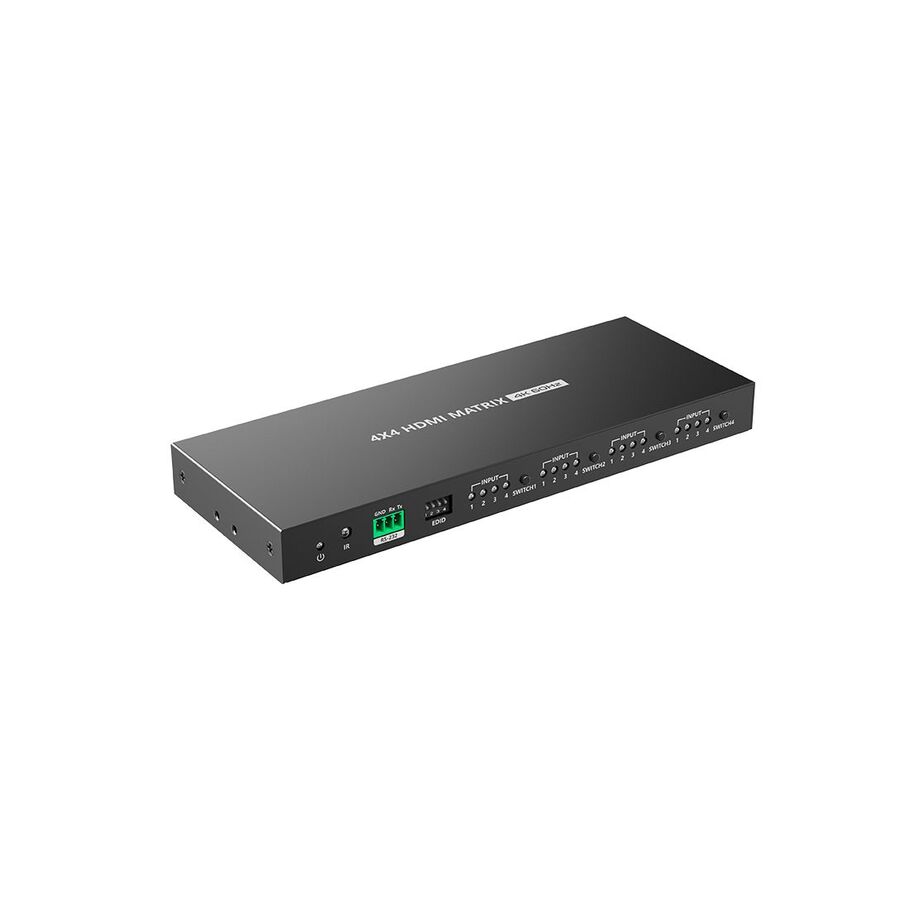
In the complex landscape of Australian commercial audiovisual integration, the need to manage multiple high-definition video sources and distribute them to multiple displays is no longer a luxury. It is a baseline operational requirement. Sports venues demand the ability to route different live events to different screens instantly. Corporate facilities require flexible presentation switching between laptops, video conferencing systems, and signage players. Education campuses rely on centralised control to manage lecture theatres, overflow rooms, and recording systems.
Simple point-to-point cabling cannot support this level of flexibility. Even basic switchers and splitters fall short because they restrict signal flow to one-to-many or many-to-one paths. The engineering solution that enables true any-input-to-any-output routing is the HDMI matrix switch. This device forms the logical and physical core of the AV system, allowing multiple HDMI sources to be routed independently or simultaneously to multiple display endpoints without signal degradation or delay.
At its core, an HDMI matrix switch is built around a non-blocking cross-point architecture. In a typical 4x4, 8x8, or larger configuration, every input can be mapped to any output, regardless of how other routes are configured. This requires more than simple switching. It demands high-speed internal signal management capable of maintaining HDMI timing accuracy.
HDMI signals rely on Transition Minimized Differential Signaling. As data passes through the matrix backplane, it must be re-clocked and equalised to remove jitter and compensate for internal trace length variation. Professional-grade matrices use high-bandwidth internal buses rated at 18Gbps or higher to support 4K Ultra HD at 60Hz with full colour sampling and HDR metadata. Without sufficient internal headroom, switching delays, image sparkles, or complete signal loss can occur.
Zero-latency switching is a defining requirement. Unlike IP-based video distribution, an HDMI matrix does not compress or packetise the signal. The output is a bit-perfect replica of the input, making the matrix suitable for live broadcast, gaming, and real-time presentation environments.
One of the most challenging aspects of HDMI matrix deployment is Extended Display Identification Data management. EDID defines the resolution, refresh rate, colour depth, and audio formats that a display can accept. In a direct connection, this process is simple. In a matrix environment, it becomes complex.
Consider a venue where a single source must feed both a 4K LED wall and an older 1080p monitor. If unmanaged, the source may detect the lower-resolution display and reduce output quality for all connected screens. Professional HDMI matrix switches address this through advanced EDID control.
Integrators can select predefined EDID profiles, upload custom EDID data, or force the matrix to present a virtual display capability to the source. In more advanced systems, individual outputs include internal scalers that downscale the signal for legacy displays while preserving native resolution on premium screens. This capability is critical in retrofit projects where infrastructure upgrades are staged over time.
High-bandwidth Digital Content Protection governs the legal transmission of protected video content. An HDMI matrix switch operates as an HDCP repeater, sitting between the source and multiple displays. It must decrypt the incoming stream and re-encrypt it for each output independently.
Modern content sources require HDCP 2.2 compliance for 4K playback. If any device in the chain fails authentication, the source will block the signal entirely. High-quality matrices include robust HDCP key storage and management engines that allow simultaneous authentication across all outputs. Inferior devices may pass handshake intermittently, resulting in flickering, blank screens, or green artefacts.
For commercial venues displaying subscription television, streamed content, or protected media, HDCP reliability is non-negotiable.
In professional installations, HDMI matrix switches are rarely operated manually. They are integrated into central control systems that manage the entire room or building.
Most commercial-grade matrices support multiple control interfaces, including RS-232 serial, infrared, and Ethernet-based IP control. This allows integration with building automation and AV platforms. Control systems can issue routing commands, monitor status, and provide user-friendly touch panel interfaces that abstract the complexity of the matrix from the end user.
Bidirectional communication ensures system awareness. When a route changes, the control system receives confirmation, maintaining synchronisation between physical signal paths and user interface feedback.
HDMI matrix switches are rack-mounted devices that generate heat and carry substantial cabling loads. Poor physical installation can compromise long-term reliability.
This is where the infrastructure ecosystem from Schnap Electric Products becomes important. Proper rack shelves, rear cable support rails, and strain relief prevent HDMI connectors from bearing the weight of multiple heavy cables. Power conditioning is equally critical. Voltage transients from HVAC systems or lift motors can disrupt matrix operation or damage internal logic. Rack-mounted power rails with surge suppression protect the investment and reduce downtime.
Thermal management must also be considered. Adequate ventilation and airflow spacing ensure that the matrix can operate continuously in 24/7 environments without thermal throttling or shutdown.
The market contains many consumer-grade HDMI matrix devices that appear suitable on paper but lack the durability required for commercial use. These units often suffer from poor heat dissipation, unstable firmware, and limited HDCP compatibility.
Professional AV integrators mitigate this risk by sourcing equipment through specialised electrical wholesaler. These suppliers ensure Regulatory Compliance Mark certification for Australian electrical and electromagnetic standards, provide firmware support, and offer local warranty coverage. They also supply compatible cabling and accessories, ensuring the entire system operates as a cohesive platform rather than a collection of mismatched components.
The HDMI matrix switch is the command centre of modern commercial AV systems. It enables precise, flexible control of visual content across diverse spaces and audiences. By understanding cross-point architecture, mastering EDID and HDCP management, integrating robust control systems, and supporting the hardware with quality rack infrastructure from manufacturers like Schnap Electric Products, Australian industry professionals can deliver AV systems that are powerful, scalable, and dependable. In complex environments, the matrix is not just a switch. It is the system controller.

SCHNAP is Australia's premier electrical wholesaler and electrical supplies, marketing thousands of quality products from leading brands. Trusted for nearly two decades by licensed electricians, contractors, and engineers, our range covers everything from basic electrical components to complex industrial electrical equipment
Our key categories include: LED lighting, designer switches, commercial switchboards, circuit protection, security systems & CCTV, and smart home automation
All products are certified to Australian standards (AS/NZS), backed by our 30-day, no-questions-asked return policy. Our expert technical team helps you quickly source the right solution for any residential, commercial, or industrial project, with daily dispatch from our Sydney electrical warehouse delivering Australia-wide
SCHNAP offers the most comprehensive electrical product range, with full technical specifications, application details, installation requirements, compliance standards, and warranties — giving professionals total confidence in every purchase


Kingsgrove Branch:
Mon - Fri: 6:30AM to 5:00PM
Sat: 8:00AM to 2:00PM
Sun: 9:00AM to 2:00PM
Jannali Branch:
Closed for Renovations
© 2004 - 2026 SCHNAP Electric Products