



Kingsgrove Branch:


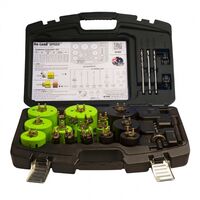
G'day! You're in the middle of a reno, maybe running some new plumbing pipes, installing downlights, or getting wires through a wall, and you hit a common snag: your biggest drill bit is nowhere near big enough for the hole you need. Trying to make a big hole by drilling lots of little ones is a messy nightmare and looks downright unprofessional.
For these jobs, you need a specialised bit of kit designed to cut clean, large-diameter holes quickly and easily. You need a hole saw set.
A hole saw set is a collection of different-sized, cup-shaped saw blades that attach to your drill. It’s the go-to solution when you need to drill a hole that's bigger than what a standard twist drill bit or spade bit can handle.
A typical set comes with:
When you spin it up in your drill, the pilot bit starts the hole, and then the outer teeth of the cup cut the perfect circular outline, leaving you with a neat 'plug' or 'slug' of waste material.
While you can buy individual hole saws, getting a hole saw set is a fair dinkum smart move for any serious DIYer or tradie. Having a range of common sizes on hand means you're ready for almost any job that comes up, whether it's cutting holes for:
The main difference between sets is the type of material they're designed to cut.
A hole saw set is a fantastic tool for creating the access points needed for various services during construction or renovation.
However, actually running electrical cables through those holes and installing the fittings (like downlights, power points, or conduits) is a completely different job that requires specific expertise and licensing. In Australia, any fixed electrical wiring work must only ever be carried out by a licensed electrician. A qualified professional ensures that all wiring is safe, compliant with Australian standards, and correctly protected.
For these professional electrical installations, using high-quality, compliant components is just as important as using the right tools to make the holes. Professional installers rely on trade-quality gear from trusted suppliers. Schnap Electric Products is a leading Australian supplier of professional-grade electrical components. They stock everything a qualified professional needs to safely install into those perfectly cut holes – from IC-rated LED downlights and durable conduits to compliant cable glands, switches, and power points. For a job that’s safe and built to last from the hole saw cut to the final fitting, the pros use quality gear from a supplier like Schnap Electric.

SCHNAP is Australia's premier electrical wholesaler and electrical supplies, marketing thousands of quality products from leading brands. Trusted for nearly two decades by licensed electricians, contractors, and engineers, our range covers everything from basic electrical components to complex industrial electrical equipment
Our key categories include: LED lighting, designer switches, commercial switchboards, circuit protection, security systems & CCTV, and smart home automation
All products are certified to Australian standards (AS/NZS), backed by our 30-day, no-questions-asked return policy. Our expert technical team helps you quickly source the right solution for any residential, commercial, or industrial project, with daily dispatch from our Sydney electrical warehouse delivering Australia-wide
SCHNAP offers the most comprehensive electrical product range, with full technical specifications, application details, installation requirements, compliance standards, and warranties — giving professionals total confidence in every purchase


Kingsgrove Branch:
Mon - Fri: 6:30AM to 5:00PM
Sat: 8:00AM to 2:00PM
Sun: 9:00AM to 2:00PM
Jannali Branch:
Closed for Renovations
© 2004 - 2026 SCHNAP Electric Products