



Kingsgrove Branch:


In Australian heavy industry, network reliability is not a convenience. It is a prerequisite for safe and continuous operation. From iron ore processing plants in the Pilbara to refrigerated logistics centres, water treatment facilities, and rail signalling corridors, modern operations depend on real-time data exchange between machines. As Industrial Internet of Things systems merge with traditional Operational Technology, the volume and speed of data at the network edge have increased dramatically. Legacy 10/100 Mbps networks are no longer capable of supporting modern automation, video inspection, and diagnostics.
Deploying standard office networking hardware in these environments is a fundamental engineering mistake. Commercial switches are designed for air-conditioned server rooms, not dust-laden cabinets, vibration-prone machinery, or extreme temperature swings. The industrial gigabit network switch exists specifically to bridge this gap. It delivers high-bandwidth Ethernet performance while withstanding mechanical stress, electrical noise, and thermal extremes commonly found on Australian industrial sites.
One of the most critical differences between industrial and commercial switches is the cooling strategy. In industrial environments, active cooling fans are a liability. Dust, metallic particles, and airborne contaminants are drawn into the device, leading to blocked airflow, electrical shorts, and premature failure.
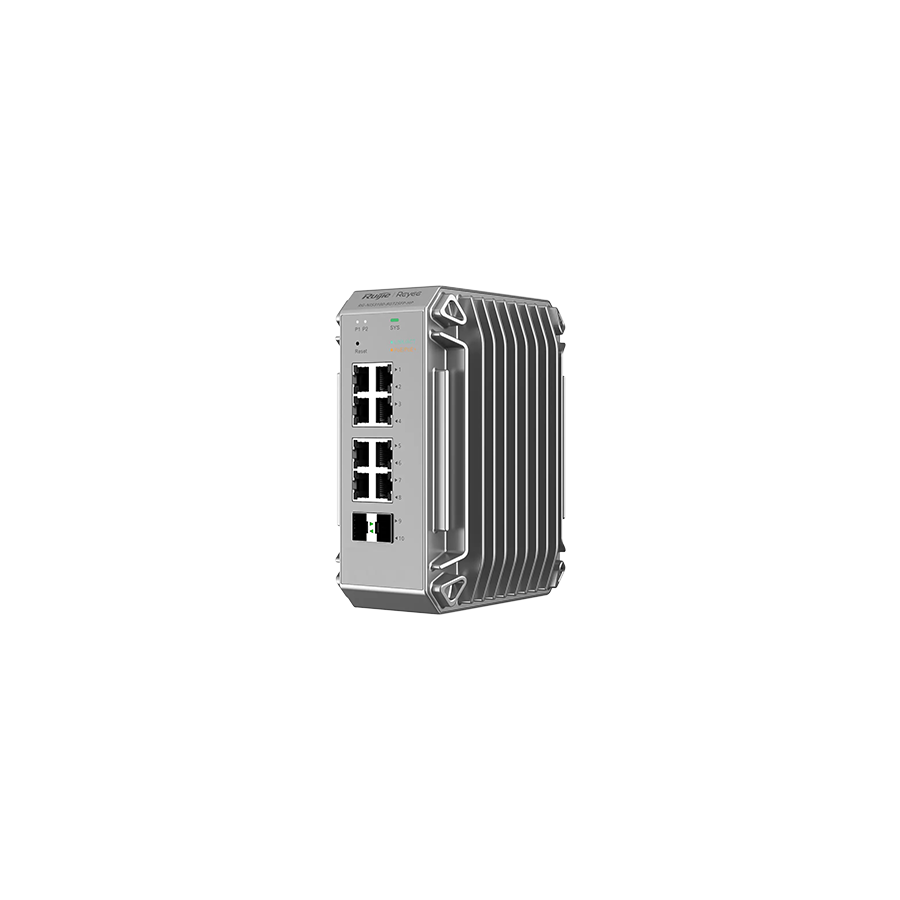
Industrial gigabit switches use fanless thermal architecture. Heat generated by the internal processor, switching fabric, and power circuitry is transferred directly into a heavy-duty metal chassis. The enclosure itself acts as a heat sink, dissipating thermal energy through passive convection. This design allows continuous operation across extreme temperature ranges, often from minus forty degrees to plus seventy-five degrees Celsius. In remote roadside cabinets, mining control rooms, or outdoor enclosures, this wide operating range ensures the network remains stable during peak heat events and overnight cold cycles.
Industrial control systems rarely rely on a single power source. Network components must align with this philosophy. Unlike office switches powered by a single AC adaptor, industrial switches are designed for direct connection to DC control power.
High-grade industrial gigabit switches feature dual redundant power inputs. If the primary DC supply fails, the switch instantly transfers to the secondary input without dropping packets or resetting the device. This capability is essential in process control environments where even brief communication loss can trigger alarms, shutdowns, or safety interlocks. Input voltage ranges are typically broad, allowing operation from common industrial supplies such as 12V, 24V, or 48V DC. This flexibility supports integration with battery systems, uninterruptible power supplies, and redundant control transformers.
Industrial networks are frequently installed in environments subject to constant vibration and shock. Mining conveyors, rail infrastructure, mobile plant, and heavy machinery all introduce mechanical stress that can loosen connectors and damage delicate components.
Industrial gigabit network switches are engineered to withstand high shock and vibration ratings. Ethernet ports feature robust retention mechanisms, and internal components are secured to prevent movement. The preferred mounting method is DIN-rail installation. This allows the switch to be locked securely alongside PLCs, relays, and power supplies within the control cabinet. Metal DIN-rail clips provide long-term mechanical stability, even in applications where vibration is continuous.
In office networks, physical loops are avoided due to the risk of broadcast storms. In industrial automation, loops are deliberately engineered to increase resilience.
Industrial switches support fast redundancy protocols designed for deterministic recovery. Devices can be connected in ring or line topologies that automatically reconfigure when a fault occurs. If a cable is damaged or a switch fails, traffic is rerouted in milliseconds, often faster than a controller scan cycle. This rapid self-healing behaviour ensures that communication between controllers, sensors, and operator interfaces continues uninterrupted, even after physical damage to the network infrastructure.
Factories, mines, and transport systems generate significant electromagnetic interference. Variable speed drives, high-current motors, welding equipment, and switching devices can inject noise into data cabling and power lines.
Industrial gigabit switches are designed with enhanced electromagnetic immunity. Internal circuit boards are often conformally coated to protect against moisture and conductive dust. Metal housings provide shielding, and proper earthing paths allow noise to be safely dissipated. Effective grounding is essential to maintaining signal integrity and preventing erratic network behaviour in electrically noisy environments.
The switch itself is only one part of the system. The surrounding infrastructure determines whether it can operate reliably over time. Maintaining cabinet ingress protection ratings, managing cable strain, and ensuring correct earthing are all critical factors.
This is where industrial installation accessories from Schnap Electric Products are commonly specified. Heavy-duty cable glands protect Ethernet and power cables as they enter the enclosure. Slotted wiring duct and ferrules ensure secure, low-resistance power connections. Proper cable management reduces stress on terminals and maintains airflow within the cabinet, extending the service life of all installed equipment.
Not all products marketed as industrial networking hardware meet true industrial standards. Some devices are simply commercial switches housed in metal enclosures, lacking proper isolation, coating, or certification.
For Australian deployments, compliance with local electrical and regulatory requirements is essential. Procuring industrial gigabit switches through reputable wholesalers ensures access to genuine hardened equipment with verified performance ratings and regulatory approval. These suppliers also provide compatible power supplies, earthing accessories, and enclosure hardware to support compliant installations from end to end.
The industrial gigabit network switch is a cornerstone of modern automation and Industry 4.0 systems. It enables high-speed data exchange in environments that destroy conventional networking hardware. Through fanless cooling, redundant DC power, vibration-resistant construction, and rapid network recovery, it delivers the resilience required for Australian industrial operations. When combined with robust physical infrastructure and compliant installation practices, it forms a network backbone that matches the durability of the machinery it supports. In industrial networking, uptime is not measured in convenience. It is measured in operational survival.

SCHNAP is Australia's premier electrical wholesaler and electrical supplies, marketing thousands of quality products from leading brands. Trusted for nearly two decades by licensed electricians, contractors, and engineers, our range covers everything from basic electrical components to complex industrial electrical equipment
Our key categories include: LED lighting, designer switches, commercial switchboards, circuit protection, security systems & CCTV, and smart home automation
All products are certified to Australian standards (AS/NZS), backed by our 30-day, no-questions-asked return policy. Our expert technical team helps you quickly source the right solution for any residential, commercial, or industrial project, with daily dispatch from our Sydney electrical warehouse delivering Australia-wide
SCHNAP offers the most comprehensive electrical product range, with full technical specifications, application details, installation requirements, compliance standards, and warranties — giving professionals total confidence in every purchase


Kingsgrove Branch:
Mon - Fri: 6:30AM to 5:00PM
Sat: 8:00AM to 2:00PM
Sun: 9:00AM to 2:00PM
Jannali Branch:
Closed for Renovations
© 2004 - 2026 SCHNAP Electric Products