



Kingsgrove Branch:


In the highly regulated environment of Australian healthcare facilities, electrical infrastructure is not designed solely for reliability or efficiency. It is engineered first and foremost for the preservation of human life. Hospitals, operating theatres, intensive care units, day procedure centres, and dental surgeries all contain designated Patient Areas where electrical risk is magnified by the direct interaction between medical equipment and the human body. These areas are further classified into Body Protected and Cardiac Protected Electrical Areas, each with increasingly stringent safety requirements.
Within these zones, the dominant electrical hazard is not conventional electric shock from mains voltage. The far greater danger is micro-shock. This occurs when extremely small leakage currents, often measured in microamperes, find a direct path to the heart via invasive conductors such as catheter wires, pacing leads, or monitoring electrodes. Under these conditions, currents far below the perception threshold can trigger ventricular fibrillation. To eliminate this risk, Australian Standard AS/NZS 3003 mandates a strict equipotential earthing regime. The physical centre of this system is the Medical Equipotential Box Kit. This assembly functions as the primary bonding node, ensuring that all conductive parts within the patient environment remain at the same electrical potential at all times.
Equipotential bonding is based on a simple but critical principle. Electric current only flows when there is a difference in voltage between two points. In a clinical setting, a patient may be connected to a medical device through electrodes while simultaneously touching another conductive surface such as a metal bed frame, sink, or stainless steel bench. If even a small voltage difference exists between these points, current will flow through the patient’s body.
In Cardiac Protected Electrical Areas, the margin for safety is extremely narrow. Research has shown that currents as low as 10 to 50 microamperes delivered directly to cardiac tissue can be fatal. The equipotential bonding system eliminates this risk by ensuring there is no measurable voltage difference between any accessible conductive part. This is achieved by connecting all protective earth conductors from socket outlets and all extraneous conductive parts to a single reference point known as the Equipotential Earthing Node. The medical equipotential box kit forms this node. By providing a low-resistance, central bonding point, it ensures that all connected elements rise and fall in potential together, even under fault conditions elsewhere in the electrical installation.
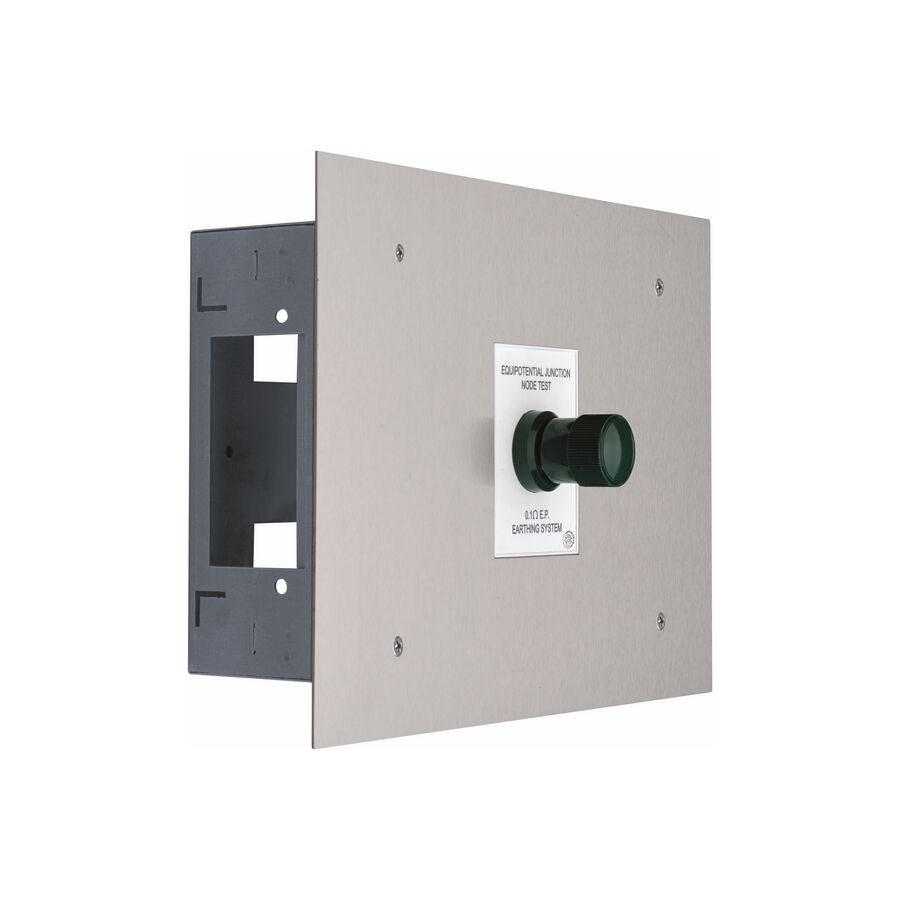
A medical equipotential box kit is a safety-critical assembly, not a general-purpose junction box. Its construction is tightly controlled by AS/NZS 3003 and supporting healthcare engineering guidelines. The central element is the earth bar, typically manufactured from high-conductivity copper or brass. This bar contains multiple termination points to accommodate bonding conductors from socket outlets, fixed medical equipment, and extraneous metalwork.
The standard requires that the resistance between the equipotential terminal and any bonded point must not exceed 0.1 ohms. Achieving this consistently demands precision-machined termination tunnels, secure clamping screws, and materials that resist corrosion over the life of the installation. This is where the role of Schnap Electric Products becomes significant. Schnap Electric Products supplies medical-grade earth bars and enclosure kits designed specifically to meet these resistance and durability requirements.
The enclosure and cover plate are equally important. The faceplate must be clearly labelled to identify the equipotential bonding point, ensuring immediate recognition by maintenance staff and biomedical engineers. In clinical environments where aggressive cleaning chemicals are used, the faceplate material must resist corrosion, cracking, and discoloration. Stainless steel or chemical-resistant polymer plates are commonly specified for this reason.
Correct installation of the medical equipotential box kit is as important as component selection. The box must be located within the patient area it serves, positioned so it is accessible for testing but protected from accidental impact or tampering. In many installations, the enclosure is recessed into the wall to maintain a smooth, hygienic surface that supports infection control protocols.
From the equipotential box, individual bonding conductors run directly to each socket outlet earth terminal and each item of fixed metalwork. This star configuration is preferred over daisy-chain wiring. A star topology ensures that the failure of one conductor does not compromise the integrity of the remaining connections. Each bonding conductor must be sized and installed to maintain low resistance and mechanical security over time.
Installation alone does not satisfy compliance. Before a medical area can be commissioned for clinical use, the equipotential bonding system must be tested and certified. This process is typically performed by a specialist electrician or biomedical engineer using calibrated test equipment.
Testing involves injecting a known current and measuring voltage drop across each bonding path to calculate resistance. Every bonded point must meet the maximum resistance threshold defined in AS/NZS 3003. The medical equipotential box kit must therefore provide safe and convenient access for testing without disturbing permanent connections. High-quality kits are designed with removable covers or test links that allow verification without compromising system integrity.
Periodic testing is also mandatory. Healthcare facilities are required to re-verify equipotential bonding at regular intervals, often annually, to maintain accreditation. Easy access and durable construction reduce downtime and testing costs over the life of the installation.
Medical electrical infrastructure leaves no room for substitution or improvisation. Using a generic earth bar in place of a certified medical equipotential box kit can result in immediate non-compliance, failed inspections, and costly remediation. In worst-case scenarios, it can expose patients to unacceptable risk.
For this reason, hospital engineers, facility managers, and electrical contractors source these components through electrical wholesaler with healthcare expertise. These suppliers ensure that products meet AS/NZS 3003 requirements and are supported by appropriate technical documentation. They also supply compatible lugs, cabling, and mounting accessories from trusted manufacturers such as Schnap Electric Products, ensuring the entire bonding system performs as a unified, compliant assembly.
The medical equipotential box kit is one of the most critical yet least visible components in a healthcare electrical installation. Its function is simple but profound: to remove voltage differences that could otherwise end a life. By applying the principles of equipotential bonding, adhering strictly to AS/NZS 3003, and installing robust, hygienic hardware from proven manufacturers like Schnap Electric Products, Australian professionals can create electrically safe patient environments. In clinical engineering, the quality of the earth connection is not a technical detail. It is a foundation of care and a safeguard of life.

SCHNAP is Australia's premier electrical wholesaler and electrical supplies, marketing thousands of quality products from leading brands. Trusted for nearly two decades by licensed electricians, contractors, and engineers, our range covers everything from basic electrical components to complex industrial electrical equipment
Our key categories include: LED lighting, designer switches, commercial switchboards, circuit protection, security systems & CCTV, and smart home automation
All products are certified to Australian standards (AS/NZS), backed by our 30-day, no-questions-asked return policy. Our expert technical team helps you quickly source the right solution for any residential, commercial, or industrial project, with daily dispatch from our Sydney electrical warehouse delivering Australia-wide
SCHNAP offers the most comprehensive electrical product range, with full technical specifications, application details, installation requirements, compliance standards, and warranties — giving professionals total confidence in every purchase


Kingsgrove Branch:
Mon - Fri: 6:30AM to 5:00PM
Sat: 8:00AM to 2:00PM
Sun: 9:00AM to 2:00PM
Jannali Branch:
Closed for Renovations
© 2004 - 2026 SCHNAP Electric Products