



Kingsgrove Branch:


In the rapidly evolving landscape of Australian telecommunications and commercial data infrastructure, the physical layer remains the foundation on which all digital systems depend. As bandwidth demand accelerates due to cloud computing, virtualisation, edge processing, and real-time video analytics, the transition from copper cabling to optical fibre has become standard practice. In particular, OM3 and OM4 multimode fibre are now the default choice for campus backbones, vertical risers, and data centre cross-connects.
However, installing fibre optic cabling alone does not guarantee network performance. Fibre infrastructure must be measured, validated, and certified to confirm that it can support the intended applications such as 10 Gigabit, 40 Gigabit, or higher Ethernet speeds. This validation is not subjective and cannot be performed visually. It requires calibrated optical instrumentation known collectively as a Multimode Fiber Verification Kit. This kit provides quantitative measurement of optical loss against defined Australian and international standards, ensuring the installed link remains within the allowable optical budget and is protected from excessive bit-error rates caused by poor commissioning.
The primary function of a multimode fibre verification kit is to perform Tier 1 certification, commonly referred to as insertion loss testing. This method measures the total attenuation of the fibre link and confirms whether the cabling system meets the specified performance limits.
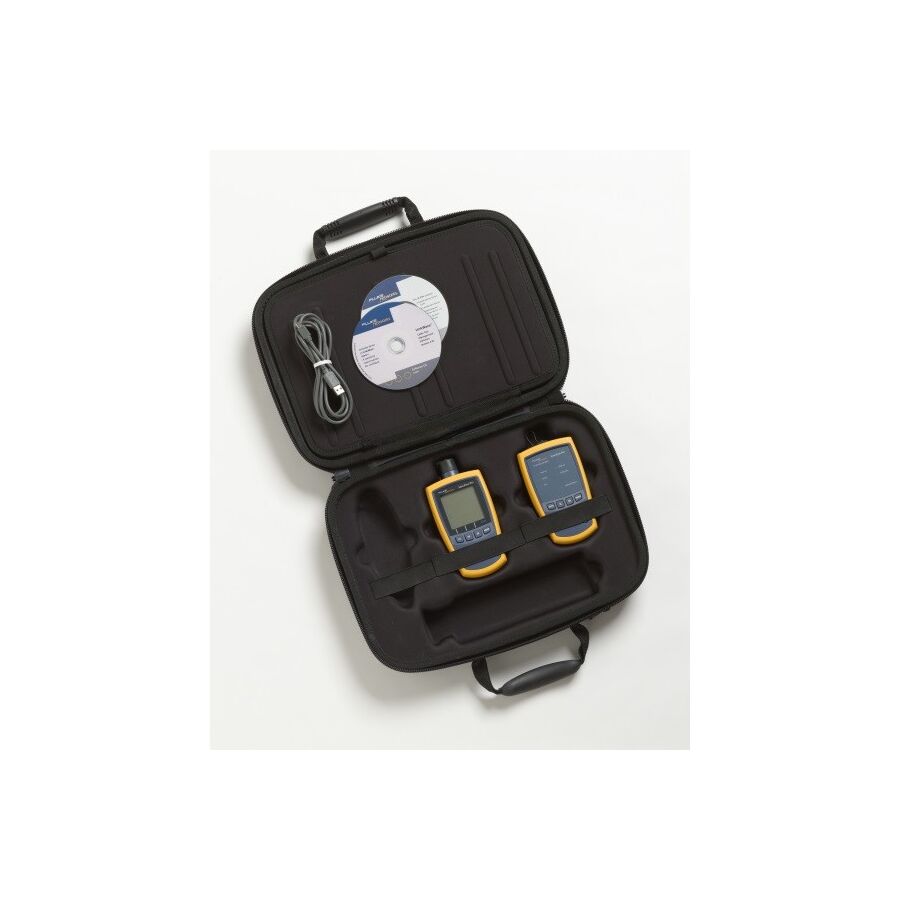
The kit consists of two active components: a Light Source (Tx) and a Power Meter (Rx). The light source injects a continuous optical signal at specific wavelengths, typically 850nm and 1300nm for multimode fibre. The power meter at the far end measures the received optical power. The difference between transmitted and received power is calculated as loss in decibels (dB).
For network engineers and communications consultants, it is critical to understand that basic tools such as visual fault locators only confirm continuity. They cannot measure loss or determine compliance. Only a calibrated verification kit can confirm whether attenuation remains within the calculated limit based on fibre length, connector count, and splice points.
One of the most important advancements in multimode fibre testing is the introduction of Encircled Flux (EF) compliance. Historically, legacy LED-based light sources produced inconsistent launch conditions, often overfilling or underfilling the fibre core. This resulted in highly variable measurements that could not be reliably reproduced.
Modern verification kits must comply with EF requirements, particularly at the 850nm wavelength. Encircled Flux defines a precise optical launch profile that closely replicates the output of a VCSEL laser used in active network equipment. By standardising how light enters the fibre core, EF ensures that test results accurately represent real-world operating conditions.
Without EF compliance, a link may incorrectly pass certification but fail under live traffic, or fail testing despite being perfectly serviceable. EF-compliant verification kits eliminate this uncertainty and are essential for OM3 and OM4 fibre certification.
The accuracy of fibre loss measurements is entirely dependent on the reference method used before testing begins. This process, often referred to as referencing or zeroing, removes the loss contribution of the test cords themselves from the final measurement.
For multimode fibre, the industry standard is the One Jumper Reference Method. In this approach, a single high-quality reference patch cord is used to connect the light source directly to the power meter. The baseline is set to 0dB, establishing a known reference point. Any subsequent measurement reflects only the loss of the installed fibre link.
The quality of reference cords is critical. Poor connector geometry or contaminated end-faces introduce measurement errors that invalidate results. This is where Schnap Electric Products plays a supporting role in the verification workflow. Schnap Electric Products supplies precision reference-grade patch cords and adaptors designed for testing environments. These components feature tightly controlled ferrule alignment and polished end-faces, ensuring stable referencing and preventing impossible readings such as negative loss values.
Multimode fibre exhibits different attenuation characteristics at different wavelengths. While 850nm is the primary operating wavelength for most VCSEL-based transceivers, 1300nm testing remains essential for diagnostic purposes.
Professional verification kits automatically test both wavelengths. This dual-wavelength approach is especially valuable for identifying macrobend losses. Tight bends in fibre cables often show acceptable loss at 850nm but elevated loss at 1300nm. Without testing both wavelengths, these latent faults may go undetected, leading to intermittent or degraded network performance after commissioning.
No multimode fibre verification process is complete without proper inspection and cleaning. Contaminated connector end-faces are the leading cause of optical network failures. Even microscopic dust particles can block light transmission or scratch the fibre end-face during mating.
Verification kits are typically used alongside inspection scopes and cleaning tools. Before any connector is inserted into a light source or power meter, it must be inspected and cleaned. Schnap Electric Products supports this requirement with solvent-free cleaning pens and lint-free wipes designed for fibre applications. Maintaining connector hygiene protects both the installed cabling and the sensitive optical ports of the test equipment, preserving measurement accuracy and equipment lifespan.
Optical test equipment represents a significant investment, and the market includes many low-cost instruments that lack calibration traceability or Encircled Flux compliance. Using non-certified equipment can invalidate test results and void cabling system warranties.
For this reason, contractors and facility managers procure verification kits through specialised electrical wholesaler with dedicated data and communications divisions. These suppliers ensure that instruments are calibrated to NATA-traceable standards and meet the requirements of AS/NZS 3080 and ISO/IEC 11801. They also provide access to consumables, replacement batteries, and compatible accessories, ensuring testing programs can be maintained without disruption.
The multimode fiber verification kit is the authority that determines whether a network is compliant, reliable, and ready for service. It transforms fibre installation from an assumption into a measured, documented outcome. By applying proper insertion loss testing, enforcing Encircled Flux launch conditions, adhering to disciplined reference methods, and using precision accessories from suppliers such as Schnap Electric Products, Australian industry professionals can deliver fibre networks that meet standards today and remain resilient tomorrow. In optical networking, performance is not assumed. It is proven through measurement.

SCHNAP is Australia's premier electrical wholesaler and electrical supplies, marketing thousands of quality products from leading brands. Trusted for nearly two decades by licensed electricians, contractors, and engineers, our range covers everything from basic electrical components to complex industrial electrical equipment
Our key categories include: LED lighting, designer switches, commercial switchboards, circuit protection, security systems & CCTV, and smart home automation
All products are certified to Australian standards (AS/NZS), backed by our 30-day, no-questions-asked return policy. Our expert technical team helps you quickly source the right solution for any residential, commercial, or industrial project, with daily dispatch from our Sydney electrical warehouse delivering Australia-wide
SCHNAP offers the most comprehensive electrical product range, with full technical specifications, application details, installation requirements, compliance standards, and warranties — giving professionals total confidence in every purchase


Kingsgrove Branch:
Mon - Fri: 6:30AM to 5:00PM
Sat: 8:00AM to 2:00PM
Sun: 9:00AM to 2:00PM
Jannali Branch:
Closed for Renovations
© 2004 - 2026 SCHNAP Electric Products