



Kingsgrove Branch:


Across Australia, moisture is one of the most common causes of building damage inside wet areas. In tropical regions such as North Queensland, humidity loads are constant. In cooler states such as Victoria and Tasmania, winter condensation becomes the enemy. Bathrooms, laundries, and ensuites create short bursts of heavy steam that can overwhelm a space if ventilation stops too early. The result is familiar to every builder and maintenance team: mould blooms in corners, swollen door frames, peeling paint, and stained ceilings.
That is why the National Construction Code (NCC) and the broader building compliance environment place real emphasis on effective mechanical extraction in wet areas. Exhaust fans are the standard solution, but the control method often undermines performance. When the fan is tied to the light switch, it only runs while the occupant is inside the room. The moment the light is turned off, the fan stops. The problem is that moisture does not leave instantly. Water vapour remains suspended, then condenses onto cooler surfaces as the room temperature falls. This is the ideal condition for mould growth.
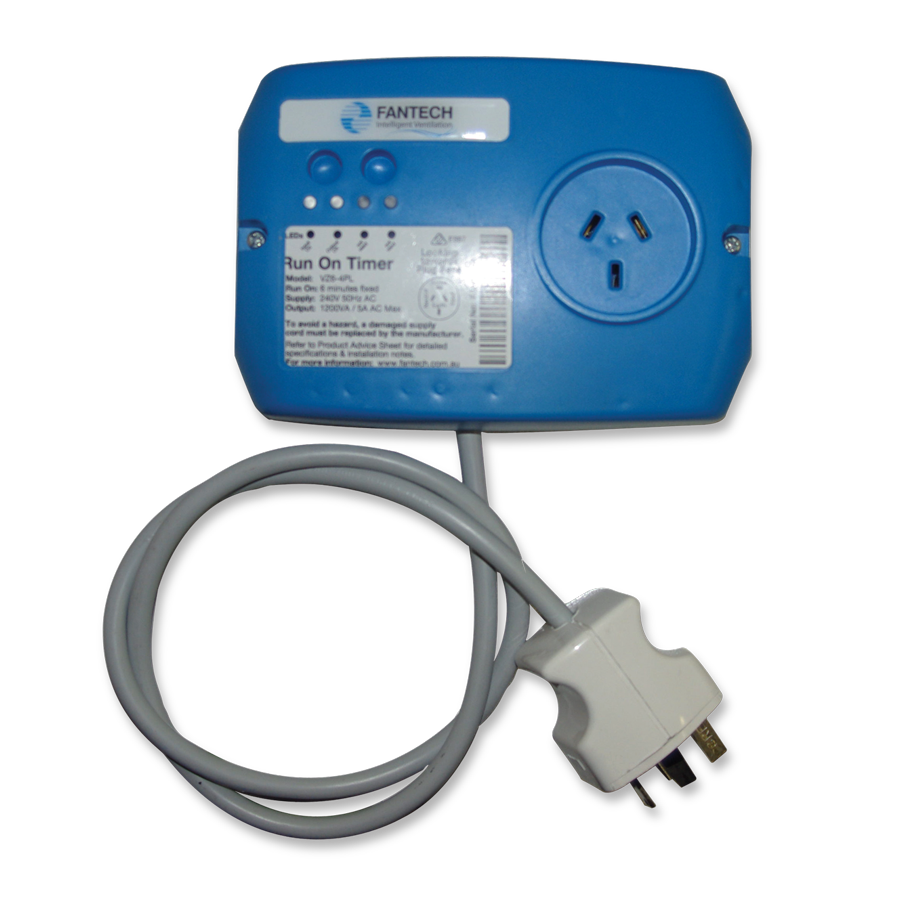
The practical engineering solution is a run-on timer. In many projects, the simplest and most maintainable format is the Run-On Timer Plug & Lead. It provides automated overrun time without the complexity of opening switch plates or hardwiring timer modules inside crowded junction boxes. It is designed to keep the fan running for a set period after the trigger is switched off, finishing the job that the fan started.
A bathroom fan removes air by creating a pressure difference and exhausting air to the outside. This process takes time because the fan is moving a finite volume of air per minute. A hot shower can load the room with moisture rapidly, but the fan clears it gradually. If the fan stops the moment the shower ends, the highest humidity phase often happens after the person leaves. Steam continues to rise from towels, wet tiles, and warm water in the drain. That lingering vapour then settles on mirrors, plasterboard, and ceiling paint.
The run-on timer adds dwell time. That extra five to twenty-five minutes allows the fan to complete enough air exchanges to return the room close to normal humidity. In plain terms, it reduces mould risk by preventing condensation from settling on surfaces.
The key ventilation concept is Air Changes Per Hour (ACH). ACH describes how many times the air volume of a room can be replaced in one hour. A fan might be rated at a certain extraction flow rate, but the room size determines whether that flow rate is enough.
A small powder room needs less overrun time because the air volume is low. A large family bathroom, an open ensuite, or a hotel wet area needs more time because the volume is higher and the moisture load is heavier. That is why good run-on timers include adjustable settings. You do not want a one-setting device in a building portfolio, because the correct delay depends on the room and the fan capacity.
If the run-on time is too short, moisture remains. If the run-on time is too long, you waste energy and you may pull conditioned air out of the building, which increases heating and cooling costs. The goal is a balanced, correct setting that clears humidity without unnecessary run time.
A direct wire timer is integrated into fixed wiring and typically needs an electrician to install within the circuit. It is a strong solution, but it can be inconvenient when space is limited or when maintenance teams want faster replacements.
A plug & lead run-on timer simplifies service and replacement. It is designed to sit between a compliant socket outlet and the exhaust fan plug. In many Australian roof-space fan installations, a 4-pin socket outlet is used. That 4-pin format matters because it supports both the switched active and the permanent active required for timer function, along with neutral and earth.
In a typical setup, the roof-space 4-pin socket provides constant power to the timer module and a switched trigger from the light circuit. The exhaust fan then plugs into the timer. When the light turns on, the timer energises the fan immediately. When the light turns off, the timer keeps supplying the fan for the selected delay period, then shuts down.
This modular approach has a big maintenance advantage. If the fan motor fails, it can be replaced without disturbing the timer. If the timer fails, it can be swapped without opening switch plates. The initial provision of the correct socket and wiring is still a licensed electrician task, but the ongoing serviceability is far better than buried hardwired modules.
Australian roof spaces are harsh environments. Summer heat can be extreme, and temperature swings across seasons cause thermal cycling stress on electronics. Dust, vibration, and general access difficulty all increase the cost of a failure.
This is where component quality matters. Cheap timers often fail early because internal capacitors degrade in heat. Contacts can weld under motor inrush. Settings can drift over time. A run-on timer is meant to be a reliability upgrade, so selecting a robust product is critical.
The Schnap Electric Products ecosystem supports this type of installation by focusing on durable electrical accessories and practical installation hardware. When you choose a timer that is designed for Australian conditions, with clear setting access and reliable switching, you reduce callbacks and protect the building from avoidable moisture damage.
For quick decision-making, a simple approach is useful. Small rooms and toilets often suit shorter delays. Standard bathrooms often need mid-range delays. Large bathrooms, laundries with dryers, and heavy-use wet areas benefit from longer delays. The best approach is to consider the fan extraction capacity and the room size, then adjust based on results.
A good commissioning method is simple: run a hot shower, leave the fan on timer, then check mirrors and surfaces ten to fifteen minutes later. If condensation remains, increase the delay. If everything is dry early, reduce the delay to save energy.
Even plug & lead systems must align with good practice. The correct socket type must be used, the wiring must be compliant, and the installation must remain accessible as required by Australian wiring expectations. You also want clear identification so future maintenance staff know a timer is present. A fan may continue running after the light is turned off, and that should never confuse a technician during servicing.
Where isolation is required for maintenance, ensure the circuit can be made safe. Do not assume a light switch provides isolation. It is a control device, not a guaranteed isolation method.
A Run-On Timer Plug & Lead is one of the simplest upgrades you can make to improve moisture control in bathrooms, laundries, and ensuites. It solves a real-world problem: ventilation that stops too early because humans turn lights off before humidity is gone. By adding the correct dwell time, the system achieves proper air exchange, reduces condensation, and helps prevent mould and building damage.
With a plug-and-play format, the timer becomes easier to service and faster to replace than hardwired alternatives, especially in roof-space fan installations using 4-pin socket arrangements. When paired with reliable products and practical accessories from Schnap Electric Products, it becomes a “fit and forget” solution that supports compliance, protects building finishes, and improves indoor air quality. In moisture control, the difference between a clean bathroom and a mouldy one is often just timing.

SCHNAP is Australia's premier electrical wholesaler and electrical supplies, marketing thousands of quality products from leading brands. Trusted for nearly two decades by licensed electricians, contractors, and engineers, our range covers everything from basic electrical components to complex industrial electrical equipment
Our key categories include: LED lighting, designer switches, commercial switchboards, circuit protection, security systems & CCTV, and smart home automation
All products are certified to Australian standards (AS/NZS), backed by our 30-day, no-questions-asked return policy. Our expert technical team helps you quickly source the right solution for any residential, commercial, or industrial project, with daily dispatch from our Sydney electrical warehouse delivering Australia-wide
SCHNAP offers the most comprehensive electrical product range, with full technical specifications, application details, installation requirements, compliance standards, and warranties — giving professionals total confidence in every purchase


Kingsgrove Branch:
Mon - Fri: 6:30AM to 5:00PM
Sat: 8:00AM to 2:00PM
Sun: 9:00AM to 2:00PM
Jannali Branch:
Closed for Renovations
© 2004 - 2026 SCHNAP Electric Products