



Kingsgrove Branch:


In the current operational climate of Australian facility management, energy visibility is no longer optional. Rising electricity tariffs, tenant billing requirements, and compliance obligations under the National Construction Code (NCC) Section J have placed sub-metering at the centre of asset optimisation strategies. For new buildings, metering can be designed into the switchboard from day one. For existing buildings, however, the situation is far more complex.
Most Australian commercial and industrial facilities are brownfield sites. They were constructed long before energy analytics became a priority. Retrofitting metering into these environments often collides with a hard operational reality: shutting down power to install traditional solid-core current transformers is either financially unacceptable or operationally impossible. Hospitals, data centres, food processing plants, and 24-hour manufacturing lines cannot simply power down to install measurement hardware.
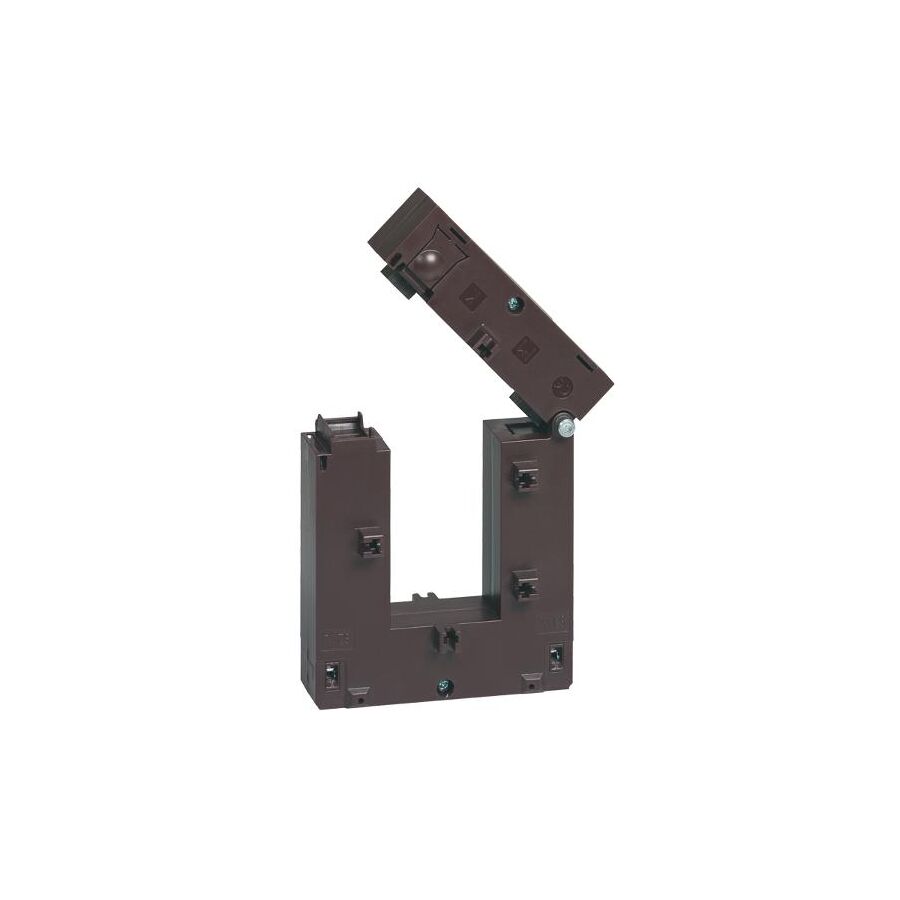
The engineering solution to this challenge is the Single Phase Split Core Current Transformer. This specialised device allows accurate current measurement to be added around live, insulated conductors without disconnecting the circuit. It provides a practical bridge between legacy electrical infrastructure and modern energy management systems, enabling immediate insight without disruption.
Split Core Architecture and Magnetic Physics
The defining feature of a split core current transformer is its separable magnetic core. Unlike a conventional solid ring CT, the split core is manufactured in two precision-matched halves connected by a hinge and secured with a locking mechanism. This design allows the CT to open, clamp around an existing cable, and close again while the circuit remains energised.
From a physics perspective, this convenience introduces a challenge. Magnetic circuits rely on continuous, low-reluctance paths to accurately transfer flux from the primary conductor to the secondary winding. The junction between the two core halves is known as the air gap. Even a microscopic gap introduces magnetic reluctance, reducing accuracy and increasing phase error.
High-quality split core transformers mitigate this through material selection and mechanical precision. The core is typically made from high-permeability silicon steel or permalloy, and the mating faces are ground to extremely tight tolerances. When the clamp is closed, the two faces must meet perfectly. Dust, paint residue, or oxidation on these surfaces can compromise accuracy, which is why installation hygiene and mechanical integrity are critical performance factors.
In Australian installations, single phase split core CTs are commonly supplied in two output formats, each suited to different monitoring architectures.
The traditional format is a current output, usually 5A or 1A. These devices are compatible with legacy kilowatt-hour meters and protection relays. However, they carry an inherent safety risk. If the secondary circuit is open while the primary conductor is energised, dangerous voltages can be induced across the terminals.
Modern retrofit projects increasingly specify “safe output” split cores. These units generate a low-voltage signal, commonly 333mV or a scaled milliamp output. An internal burden resistor is built into the CT, eliminating the open-circuit hazard. These outputs connect directly to modern energy meters, data loggers, and Building Management Systems without the need for additional transducers. For live retrofit work, this design significantly reduces risk and simplifies installation.
In a live switchboard, vibration and thermal cycling are constant. Conductors expand and contract under load, breakers operate, and nearby equipment generates mechanical movement. If the split core latch is weak, these forces can cause the CT to gradually open. Even a small increase in the core gap can cause readings to drift or drop to zero.
This is where build quality becomes critical. Schnap Electric Products manufactures split core current transformers with industrial-grade thermoplastic housings and robust locking mechanisms designed to maintain constant pressure on the core faces. These designs ensure long-term magnetic continuity even in high-vibration environments. Clear, moulded polarity arrows on the housing also assist installers in achieving correct orientation in poorly lit switch rooms
Split core CTs are directional devices. The polarity of installation directly affects the phase relationship between measured current and voltage. If installed backwards, the measured current will be inverted.
In simple monitoring applications this may go unnoticed, but in systems involving solar generation, net metering, or power factor analysis, reversed polarity corrupts data entirely. Consumption may be recorded as export, or reactive power calculations may be meaningless.
Installation protocols require the polarity arrow on the CT body to point towards the load. The conductor should also be centred within the window to ensure uniform magnetic coupling. While high-quality CTs are tolerant of minor misalignment, excessive mechanical stress on the jaw mechanism can affect long-term accuracy.
Although split core CTs enable installation without circuit disconnection, the surrounding environment is often live and hazardous. Australian WHS regulations require risk assessments and appropriate controls when working near energised equipment.
Safe-output split cores are strongly preferred for live retrofit work because they eliminate the open-secondary voltage risk. If a 5A or 1A output CT is used, the secondary wiring must be terminated into the meter or a shorting block before the clamp is closed. Closing the clamp completes the magnetic circuit and induces secondary current. If the wires are not properly terminated, dangerous voltages can be present.
Split core CTs are available in different accuracy classes, typically Class 1 or Class 0.5 for metering applications. Lower-cost units often suffer from phase shift errors, where the secondary signal lags behind the primary current. This directly affects power factor and real power calculations.
For energy audits, tenant billing, and performance benchmarking, data quality is critical. Selecting a CT with the appropriate accuracy class and verified phase performance ensures that decisions are based on reliable measurements rather than approximations.
Not all split core current transformers are equal. Variations in core material, latch design, winding quality, and calibration have a direct impact on performance.
Energy auditors, consultants, and electrical contractors typically source these devices through specialised electrical wholesaler. These suppliers verify accuracy class, output compatibility, and physical sizing for the conductor being monitored. Supporting accessories such as cable identification, strain relief, and mounting hardware from Schnap Electric Products help ensure the retrofit installation remains secure, legible, and maintainable.
The single phase split core current transformer has become an essential tool for modern energy management in existing facilities. It removes the historical barrier of downtime, allowing accurate monitoring to be deployed immediately on live infrastructure. By understanding the magnetic physics of split cores, selecting robust devices with reliable locking mechanisms, and following strict polarity and safety protocols, Australian industry professionals can retrofit energy intelligence into legacy buildings with confidence. In the world of brownfield upgrades, the split core transformer is the gateway to informed, efficient operation.

SCHNAP is Australia's premier electrical wholesaler and electrical supplies, marketing thousands of quality products from leading brands. Trusted for nearly two decades by licensed electricians, contractors, and engineers, our range covers everything from basic electrical components to complex industrial electrical equipment
Our key categories include: LED lighting, designer switches, commercial switchboards, circuit protection, security systems & CCTV, and smart home automation
All products are certified to Australian standards (AS/NZS), backed by our 30-day, no-questions-asked return policy. Our expert technical team helps you quickly source the right solution for any residential, commercial, or industrial project, with daily dispatch from our Sydney electrical warehouse delivering Australia-wide
SCHNAP offers the most comprehensive electrical product range, with full technical specifications, application details, installation requirements, compliance standards, and warranties — giving professionals total confidence in every purchase


Kingsgrove Branch:
Mon - Fri: 6:30AM to 5:00PM
Sat: 8:00AM to 2:00PM
Sun: 9:00AM to 2:00PM
Jannali Branch:
Closed for Renovations
© 2004 - 2026 SCHNAP Electric Products