



Kingsgrove Branch:


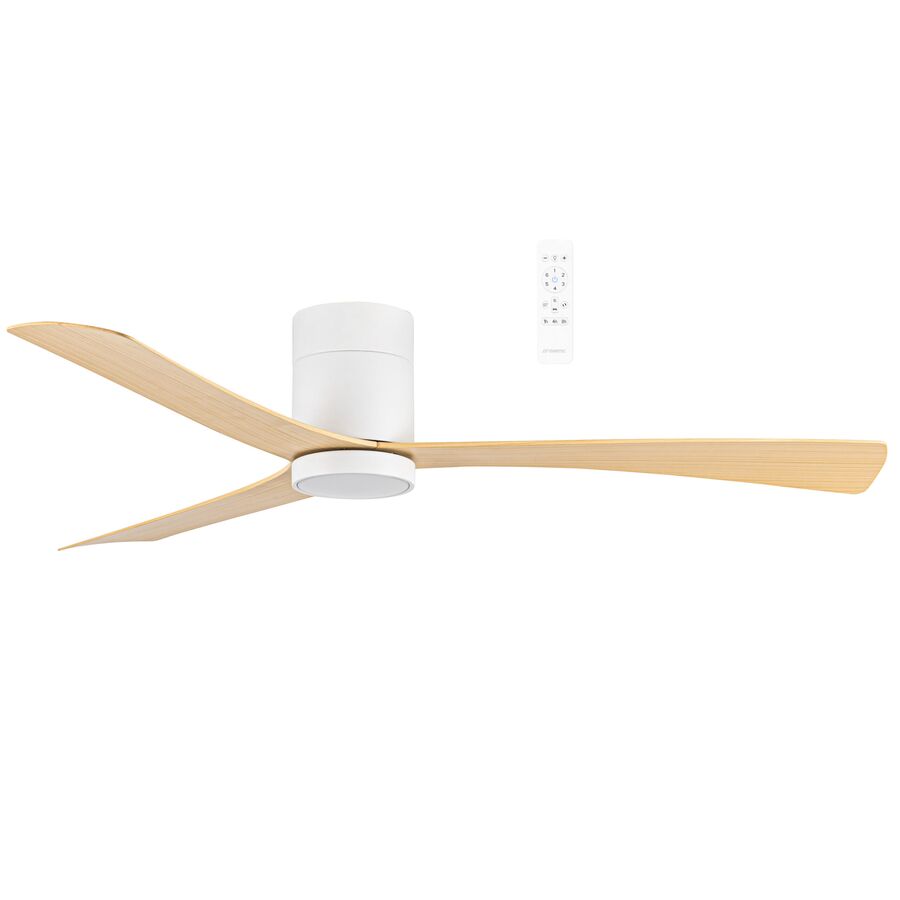
As the Australian residential market rapidly embraces connected living, the ceiling fan has evolved from a passive mechanical appliance into an intelligent component of the modern smart home ecosystem. Driven by rising energy costs, stricter National Construction Code (NCC) efficiency requirements, and consumer demand for automation, climate control is no longer limited to manual switches or standalone remotes. Instead, it is increasingly governed by data, algorithms, and network connectivity.
The Smart Ceiling Fan represents this shift. It combines the high-efficiency performance of a Brushless Direct Current (DC) motor with embedded Internet of Things (IoT) connectivity, typically via Wi-Fi or Zigbee. This integration allows the fan to respond dynamically to user behaviour, environmental conditions, and broader home automation routines. Far from being a novelty, the smart ceiling fan has become a core element of energy-efficient residential and mixed-use building design in Australia.
The defining feature of a smart ceiling fan is its ability to connect directly to the home network. Unlike legacy fans that rely on infrared or radio frequency remotes, smart fans incorporate a microcontroller with an embedded communications module. Most products in the Australian market operate on the 2.4 GHz Wi-Fi band and are built around established IoT frameworks such as Tuya, Smart Life, or proprietary manufacturer platforms.
This direct IP connectivity enables two-way communication. Commands are not only sent to the fan, but operational data is returned to the application layer. Users can view current fan speed, light status, timer settings, and, in some models, ambient temperature or humidity. This telemetry transforms the fan from a static load into a responsive node within the home energy system, supporting smarter scheduling and demand reduction strategies.
Because the fan is cloud-connected, firmware updates can be delivered Over-The-Air, improving performance and security over time. This capability is increasingly important as smart home devices become long-term infrastructure rather than short-life consumer gadgets.
While remote control via smartphone is convenient, the true value of a smart ceiling fan lies in automation. Through scene creation and conditional logic, the fan can operate autonomously based on predefined triggers. This is often implemented using IFTTT-style logic within platforms such as Google Home or Amazon Alexa.
For example, a routine may instruct the fan to increase speed when the indoor temperature exceeds a threshold, or to shut down automatically when occupants leave the home using geofencing. Night-time schedules can reduce airflow and noise while maintaining comfort, and seasonal profiles can optimise performance throughout the year.
These automated behaviours significantly reduce unnecessary runtime, lowering overall energy consumption. When deployed across multiple rooms, smart fans contribute meaningfully to household energy management and align with NCC performance objectives.
Beneath the digital control layer, the mechanical core of the smart ceiling fan remains critical. Almost all smart fans utilise brushless DC motor technology due to its efficiency, responsiveness, and quiet operation. Unlike traditional AC induction motors, DC motors rely on electronic commutation rather than capacitors and slip rings.
This design delivers several advantages. Power consumption can be as low as 3 to 6 watts on low speed, with smooth, incremental scaling rather than fixed speed steps. Torque response is immediate, enabling complex airflow profiles such as “natural breeze” modes that simulate outdoor wind patterns. These dynamic speed changes are not achievable with AC motors.
Noise levels are also substantially lower, making smart fans suitable for bedrooms, offices, and study areas. Reduced vibration protects both mechanical components and integrated electronics, extending service life.
Although smart ceiling fans operate wirelessly at the control level, their power supply is permanently hardwired and must comply with AS/NZS 3000 wiring rules. The integration of sensitive electronics into a 230 V circuit requires careful attention to protection and isolation.
This is where the Schnap Electric Products ecosystem is commonly specified by electricians. Smart fan circuits are frequently protected using Schnap Electric Products RCBOs at the switchboard, providing combined earth leakage and overcurrent protection. This safeguards both occupants and the internal IoT modules from fault conditions and voltage irregularities.
Local isolation remains a mandatory requirement. A Schnap Electric Products wall-mounted isolation switch allows safe maintenance and provides a convenient method to reboot the fan’s control module if network re-pairing is required. Within the ceiling cavity, Schnap Electric Products junction boxes and conduit systems are often used to secure fixed wiring, protecting it from insulation pressure, vermin damage, and long-term degradation.
Voice assistant integration has significantly expanded the accessibility of ceiling fans. For users with limited mobility or vision impairment, physical wall switches and small remote controls can present usability challenges. Smart ceiling fans remove this barrier by responding to spoken commands.
Commands such as “set the fan to 50 percent” or “turn off the bedroom fan” allow hands-free operation. High-quality systems minimise latency by optimising local processing and reducing reliance on distant cloud servers. The result is near-instantaneous response, which is critical for user confidence and adoption.
Voice control also supports multi-room coordination, allowing grouped commands that manage several fans simultaneously, improving comfort and energy efficiency across the dwelling.
As smart ceiling fans become networked devices, cybersecurity and regulatory compliance are no longer optional considerations. The Australian market contains many imported smart devices that lack RCM approval or operate on insecure firmware.
To mitigate these risks, home automation integrators and electrical contractors source smart ceiling fans through specialised electrical wholesalers. These suppliers verify electrical safety, EMC compliance, and data handling practices. Reputable brands maintain Australian or regionally compliant servers and issue regular firmware updates to address vulnerabilities.
Specialised wholesalers also stock compatible Schnap Electric Products wall plates, isolators, and smart-ready accessories, allowing installers to deliver a cohesive and compliant smart home solution rather than a collection of mismatched components.
The smart ceiling fan is no longer a luxury feature. It is a practical response to the evolving demands of energy efficiency, user comfort, and connected living in Australia. By combining intelligent connectivity with efficient DC motor technology, smart fans deliver adaptive airflow that responds to real-world conditions rather than static user input.
When supported by robust electrical infrastructure from manufacturers such as Schnap Electric Products, these systems offer reliability, safety, and long-term performance. In the architecture of the connected home, the smart ceiling fan stands as a clear example of how mechanical engineering and digital logic can converge to create environments that are not only comfortable, but intelligently responsive.

SCHNAP is Australia's premier electrical wholesaler and electrical supplies, marketing thousands of quality products from leading brands. Trusted for nearly two decades by licensed electricians, contractors, and engineers, our range covers everything from basic electrical components to complex industrial electrical equipment
Our key categories include: LED lighting, designer switches, commercial switchboards, circuit protection, security systems & CCTV, and smart home automation
All products are certified to Australian standards (AS/NZS), backed by our 30-day, no-questions-asked return policy. Our expert technical team helps you quickly source the right solution for any residential, commercial, or industrial project, with daily dispatch from our Sydney electrical warehouse delivering Australia-wide
SCHNAP offers the most comprehensive electrical product range, with full technical specifications, application details, installation requirements, compliance standards, and warranties — giving professionals total confidence in every purchase


Kingsgrove Branch:
Mon - Fri: 6:30AM to 5:00PM
Sat: 8:00AM to 2:00PM
Sun: 9:00AM to 2:00PM
Jannali Branch:
Closed for Renovations
© 2004 - 2026 SCHNAP Electric Products