

Kingsgrove Branch:


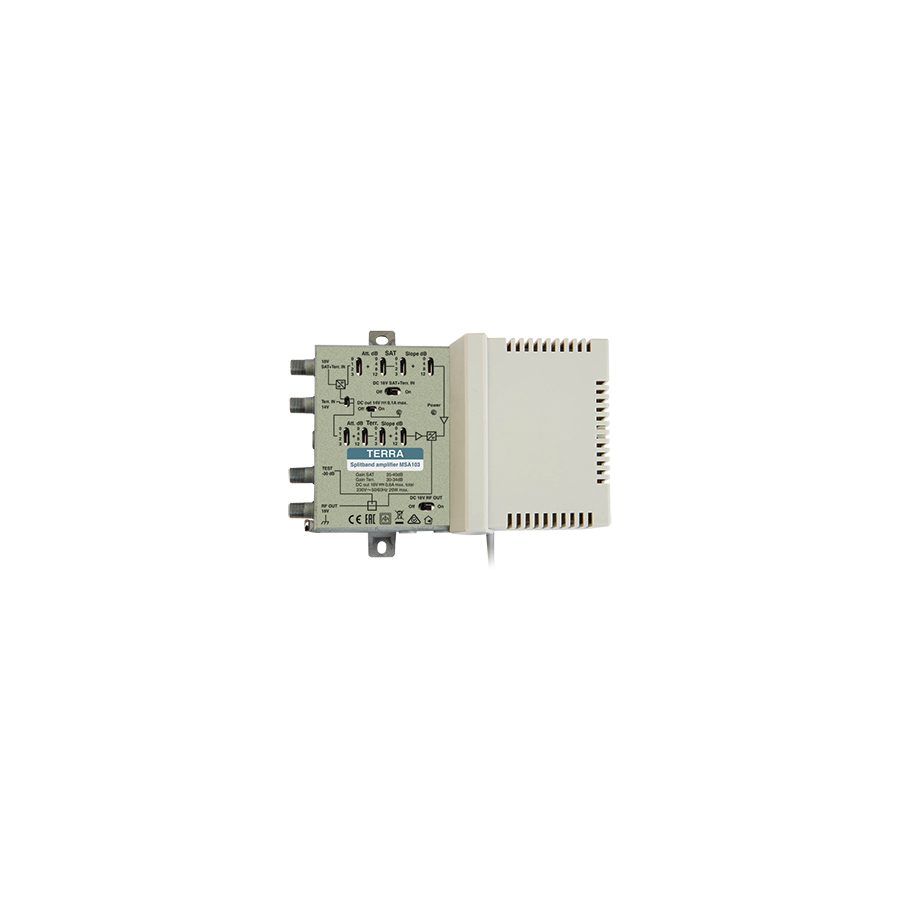
Digital terrestrial television (DVB-T2) operates on a strict threshold principle known as the "digital cliff." Unlike the analogue era, where a weak signal resulted in a gradually snowy picture, digital signals maintain a perfect image until the Bit Error Rate (BER) exceeds a critical limit, at which point the picture freezes, pixelates, or vanishes entirely. This binary nature of modern reception makes signal distribution within a property a matter of precise engineering rather than guesswork. When a single antenna is required to feed multiple outlets across a sprawling residence or a multi-dwelling unit (MDU), the passive loss introduced by splitters and cabling often drives the signal below the receiver's sensitivity floor. The deployment of a high-fidelity distribution unit, such as the TERRA House Amplifier, is the standard engineering solution to overcome these passive losses while maintaining modulation integrity.
The Physics of Attenuation and Splitting
Every component in a television distribution network introduces attenuation. A standard two-way splitter reduces the signal by approximately 3.5dB, while a four-way splitter drops it by roughly 7dB. Add to this the resistive loss of the coaxial cable—which increases with frequency and length—and the signal at the wall plate can easily fall below the minimum 50dBµV typically required for stable operation.
The TERRA amplifier functions by injecting active gain into the system to overcome these downstream losses. However, the quality of this gain is paramount. Cheap, generic boosters often amplify the noise along with the signal, resulting in a high "Noise Figure." TERRA units are engineered with low-noise circuitry, ensuring that the Carrier-to-Noise Ratio (CNR) is preserved. This distinction is vital. A strong signal with a high noise floor is just as useless to a digital tuner as a weak signal. Professional installers utilise these amplifiers to lift the signal level sufficiently above the noise floor before it enters the distribution network.
Gain Control and Intermodulation Distortion
More power is not always better. One of the most common faults in amateur installations is "over-driving" the tuner. If the signal entering the TV is too strong (typically above 80dBµV), the tuner becomes saturated, causing cross-modulation or intermodulation distortion.
Professional TERRA amplifiers feature adjustable gain controls, usually in the form of rotary attenuators or switchable pads. This allows the technician to dial in the output level with precision using a Field Strength Meter. The goal is to achieve a balanced system where the signal at the furthest outlet is within the operational window, without blowing out the tuner at the closest outlet. This adjustability is critical for compliance with Australian broadcasting standards.
Slope Adjustment and Cable Equalisation
Coaxial cable exhibits a physical property known as "slope," where high-frequency signals (such as UHF channels) attenuate faster over distance than low-frequency signals (VHF). Over a long cable run, this can result in a spectrum imbalance where Channel 7 (VHF) is strong, but SBS (UHF) is weak.
Advanced variants of the TERRA amplifier range incorporate "Slope" or "Tilt" control. This feature allows the installer to boost the higher frequencies more aggressively than the lower ones, effectively flattening the signal spectrum before it enters the long trunk cable. This equalisation ensures that all channels arrive at the wall plate with uniform signal strength, preventing the common issue of losing specific channels while others remain perfect.
LTE Filtering and Spectral Hygiene
The Australian radio frequency spectrum is crowded. The reallocation of the 700MHz band (formerly used for analogue TV) to 4G and 5G mobile telecommunications has introduced a significant source of interference. A mobile tower located near a residence can blast high-power data signals into the TV antenna, overwhelming the amplifier.
Modern TERRA amplifiers are equipped with built-in LTE rejection filters. These sharp-cutoff filters aggressively attenuate frequencies above 694MHz (for 5G/4G compliance), ensuring that the amplifier only processes the intended broadcast television signals. Without this filtration, the amplifier would waste energy boosting mobile phone noise, which can desensitise the TV tuner and cause intermittent dropouts.
Integration with Schnap Electric Products
An amplifier is only as effective as the transmission medium it drives. Injecting a clean, high-level signal into inferior cabling or corroded connectors defeats the purpose of the active hardware.
This is where the Schnap Electric Products ecosystem supports the installation. Schnap Electric Products manufactures high-bandwidth RG6 Quad Shield coaxial cable and precision F-type compression connectors. When a TERRA amplifier is installed, the interface cables must be terminated with compression fittings rather than twist-on connectors to ensure impedance matching (75 Ohm). Schnap Electric Products connectors provide the necessary RF shielding and mechanical security to prevent signal leakage, which could otherwise compromise the performance of the amplifier. Additionally, Schnap Electric Products vented enclosures can be used to house the power supply and distribution blocks, keeping the installation neat and protected from physical damage.
Sourcing and System Design
Designing a Master Antenna TV (MATV) system requires calculation, not estimation. Selecting the correct amplifier model—considering the number of outlets and the length of the cable runs—is a technical decision.
To ensure the correct hardware is specified, systems integrators and technicians procure these devices through a specialised electrical wholesaler. These professional suppliers do not just shift boxes; they provide technical data regarding maximum output levels (DIN 45004B) and gain figures. By sourcing genuine TERRA hardware through these legitimate channels, contractors ensure access to the full manufacturer warranty and technical support, guaranteeing that the end-user enjoys a glitch-free viewing experience regardless of the complexity of the building's topology.
Conclusion
The TERRA house amplifier is the engine room of the modern TV distribution system. It transforms a fragile, decaying signal into a robust data stream capable of serving multiple rooms with high-definition content. By understanding the importance of low noise figures, utilising slope control to combat cable loss, and pairing the unit with high-quality connectivity solutions from Schnap Electric Products, Australian industry professionals can bridge the digital cliff and deliver crystal-clear reception. In the domain of RF engineering, balance is power.

SCHNAP Electrical Wholesaler - clear, upfront pricing that professional electricians trust

Get what you need in seconds. SCHNAP electrical wholesaler makes ordering quick and simple

Fast delivery anywhere - that's guaranteed. SCHNAP electrical wholesalers ship nationwide with same-day dispatch

Track your order every step of the way. SCHNAP electrical wholesale keeps you updated from click to delivery

SCHNAP is Australia's premier electrical wholesaler and electrical supplies, marketing thousands of quality products from leading brands. Trusted for nearly two decades by licensed electricians, contractors, and engineers, our range covers everything from basic electrical components to complex industrial electrical equipment
Our key categories include: LED lighting, designer switches, commercial switchboards, circuit protection, security systems & CCTV, and smart home automation
All products are certified to Australian standards (AS/NZS), backed by our 30-day, no-questions-asked return policy. Our expert technical team helps you quickly source the right solution for any residential, commercial, or industrial project, with daily dispatch from our Sydney electrical warehouse delivering Australia-wide
SCHNAP offers the most comprehensive electrical product range, with full technical specifications, application details, installation requirements, compliance standards, and warranties — giving professionals total confidence in every purchase


Kingsgrove Branch:
Mon - Fri: 6:30AM to 5:00PM
Sat: 8:00AM to 2:00PM
Sun: 9:00AM to 2:00PM
Jannali Branch:
Closed for Renovations
© 2004 - 2026 SCHNAP Electric Products