



Kingsgrove Branch:


In the high-density environment of Australian commercial and industrial switchboards, space efficiency is no longer a convenience. It is a design requirement. As building owners respond to the National Construction Code, NABERS, and Green Star energy performance obligations, accurate three-phase energy monitoring has become standard practice rather than a specialist upgrade. Main Switchboards and Distribution Boards are now expected to provide reliable data for load profiling, demand management, tenant sub-metering, and energy optimisation.
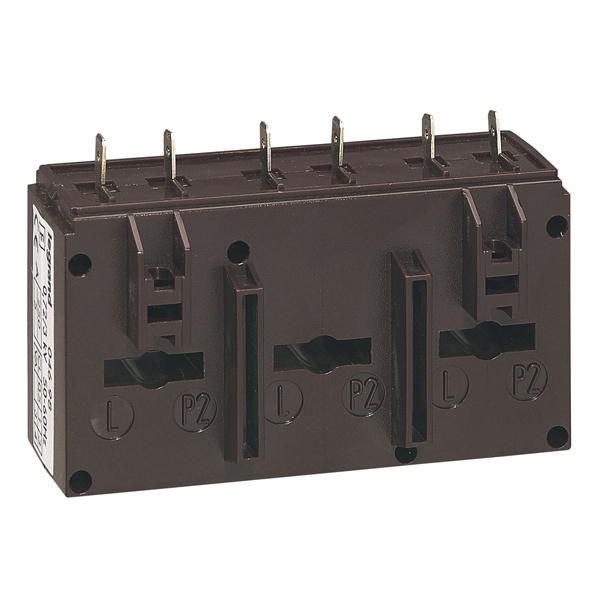
Traditionally, monitoring a three-phase circuit required three separate single-phase current transformers, one installed on each active conductor. While technically effective, this approach consumes valuable busbar space, increases wiring complexity, and introduces a higher risk of installation errors such as incorrect polarity or phase cross-connection. The engineering solution that addresses these limitations is the Three Phase Current Transformer. Commonly known as a block CT or 3-in-1 CT, this device integrates three independent magnetic cores into a single moulded housing. The result is a compact, mechanically stable, and electrically consistent metering solution that aligns with modern switchboard design principles.
Block-Type CT Architecture and Mechanical Design
The defining characteristic of a three phase current transformer is its physical alignment with standard breaker geometry. Modern block CTs are engineered to match the pole pitch of Moulded Case Circuit Breakers used in 250A, 400A, and larger chassis sizes. Each phase window is positioned to align directly with the active conductors L1, L2, and L3, whether these are solid copper busbars or insulated cables.
This alignment delivers immediate benefits on site. Instead of installing, spacing, and securing three individual CTs, the installer mounts a single rigid unit. This reduces labour time and ensures uniform spacing between phases. Mechanical rigidity is particularly important in high fault-level environments. During short-circuit events, busbars experience extreme electromagnetic forces. A unified block CT is far less likely to twist, rotate, or creep under these forces compared to multiple independent devices. This stability helps maintain insulation clearances and mechanical integrity in accordance with AS/NZS 3000 and switchboard assembly standards.
Like all instrument transformers, three phase CTs are governed by AS 60044 requirements. Selecting the correct accuracy class is essential for meaningful data.
For basic monitoring applications such as motor status indication or approximate load balancing, Class 1 accuracy is generally sufficient. However, in commercial buildings where energy data feeds billing systems, NABERS assessments, or sustainability reporting, higher precision is required. Class 0.5 or Class 0.5S current transformers are typically specified. The “S” designation indicates superior accuracy at low current levels, often down to 1 percent of rated current. This is critical in office buildings, schools, and healthcare facilities where occupancy and load vary significantly throughout the day.
A key advantage of the block CT is internal vector consistency. The polarity of each phase is fixed during manufacture, ensuring correct P1–P2 and S1–S2 orientation. This significantly reduces the risk of phase rotation errors that can occur when wiring three individual CTs. Correct vector alignment is essential for accurate three-phase power calculations, including true power, reactive power, and power factor.
The three phase current transformer sits at the interface between high-current power conductors and sensitive metering electronics. Secure mounting and controlled wiring are essential.
This is where the support ecosystem provided by Schnap Electric Products becomes relevant. Schnap Electric Products supplies block-type CTs designed for both busbar and cable installations. For busbar systems, integrated clamp mechanisms secure the CT directly to the copper bars, preventing vibration and movement over time. For cable-fed circuits, DIN-rail adaptors allow the CT to be mounted neatly above or adjacent to the breaker, maintaining clean cable routing and service access.
Secondary terminals are another critical detail. Professional-grade CTs provide clearly marked, shrouded terminals with optional sealing points. This allows tamper-evident seals to be applied where metering data is used for billing or compliance reporting, supporting regulatory and contractual requirements.
One of the most common technical errors in current transformer installations is incorrect burden calculation. The burden represents the total load imposed on the CT secondary circuit, including the meter input impedance and the resistance of the secondary wiring.
In three-phase systems, this calculation must consider all three secondary circuits. Long cable runs between the CT and the energy meter can introduce significant resistance, especially when small conductor sizes are used. If the burden exceeds the CT’s rated capacity, the transformer core may saturate. Saturation causes waveform distortion, leading to under-reading and unreliable data, particularly at high load.
Engineers must therefore calculate total secondary VA demand and select an appropriate CT rating such as 2.5VA, 5VA, or 10VA. Many block CTs use a star-connected secondary reference, simplifying wiring but requiring careful attention to loop impedance and return paths. Proper design at this stage ensures long-term accuracy and prevents costly troubleshooting after commissioning.
Current transformers present a unique safety hazard. If a CT secondary circuit is open-circuited while current flows in the primary, extremely high voltages can be induced across the secondary terminals. This poses a serious risk to personnel and equipment.
To mitigate this risk, professional installations incorporate test blocks or shorting links. These devices allow all three CT secondaries to be safely shorted before meters are disconnected for testing or replacement. In block CT systems, the advantage is clear. All three phases can be isolated or shorted simultaneously, reducing procedural complexity and improving safety during maintenance.
Three phase CT specifications vary widely. Ratios, window sizes, mounting options, and accuracy classes must be matched precisely to the application. A lighting distribution board may require a 160/5 CT, while a main incomer may demand a 630/5 or higher ratio with a larger window aperture.
To avoid costly errors, project engineers and switchboard manufacturers typically source these components through specialised electrical wholesalers. These suppliers verify compatibility between breaker frame sizes and CT geometry, confirm accuracy class requirements, and coordinate delivery with switchboard production schedules. Supporting components such as shorting blocks, wiring looms, and compatible mounting hardware from Schnap Electric Products ensure a complete, compliant metering solution.
The three phase current transformer represents a mature and efficient approach to polyphase energy monitoring. By combining three independent measurement cores into a single, mechanically stable device, it reduces installation time, saves space, and improves measurement consistency. When correctly specified for accuracy class, burden capacity, and mounting configuration, it provides the reliable data foundation demanded by modern energy management systems.
By integrating block-type CTs with robust switchboard hardware from manufacturers such as Schnap Electric Products, Australian industry professionals can deliver compact, safe, and data-rich electrical assemblies. In three-phase power systems, accuracy is achieved not through complexity, but through intelligent integration.

SCHNAP is Australia's premier electrical wholesaler and electrical supplies, marketing thousands of quality products from leading brands. Trusted for nearly two decades by licensed electricians, contractors, and engineers, our range covers everything from basic electrical components to complex industrial electrical equipment
Our key categories include: LED lighting, designer switches, commercial switchboards, circuit protection, security systems & CCTV, and smart home automation
All products are certified to Australian standards (AS/NZS), backed by our 30-day, no-questions-asked return policy. Our expert technical team helps you quickly source the right solution for any residential, commercial, or industrial project, with daily dispatch from our Sydney electrical warehouse delivering Australia-wide
SCHNAP offers the most comprehensive electrical product range, with full technical specifications, application details, installation requirements, compliance standards, and warranties — giving professionals total confidence in every purchase


Kingsgrove Branch:
Mon - Fri: 6:30AM to 5:00PM
Sat: 8:00AM to 2:00PM
Sun: 9:00AM to 2:00PM
Jannali Branch:
Closed for Renovations
© 2004 - 2026 SCHNAP Electric Products