



Kingsgrove Branch:


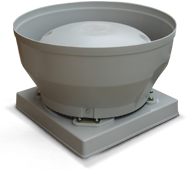
In Australian residential and commercial building design, mechanical ventilation is not simply an amenity. It is a regulated engineering system governed by the National Construction Code and Australian Standard AS 1668.2, which define how air must be removed from sanitary compartments, kitchens, and enclosed spaces. As buildings become denser and more airtight, natural ventilation is often insufficient or impossible. Windowless bathrooms, internal laundries, plant rooms, and commercial food preparation areas all rely on forced extraction to maintain hygiene, manage moisture, and control odours.
The vertical exhaust fan is the industry standard solution where air must be drawn vertically through duct risers and expelled safely above the roof line. Unlike basic ceiling-mounted axial fans, which are effective only for short, low-resistance duct runs, vertical exhaust fans are engineered to overcome significant static pressure and deliver reliable upward discharge. This makes them essential in multi-storey apartments, commercial facilities, and any application where horizontal discharge would risk recirculation or regulatory non-compliance.
The defining technical challenge of vertical ventilation is static pressure. Static pressure is created by gravity, duct wall friction, changes in duct diameter, and fittings such as bends or dampers. In vertical systems, the fan must generate enough pressure to lift a column of air upwards while maintaining sufficient velocity at the discharge point.
Standard axial fans move large volumes of air but generate very little pressure. When connected to long vertical ducting, they stall, resulting in poor extraction and condensation forming inside the duct. Vertical exhaust fans avoid this limitation by using centrifugal or mixed-flow impellers. These impellers accelerate air radially, converting rotational energy into pressure rather than relying solely on airflow volume.
The result is consistent extraction even with tall risers and complex duct layouts. Just as importantly, vertical discharge ensures that exhaust air is expelled upward at high velocity. This prevents short-circuiting, where stale air is blown across the roof surface and drawn back into nearby fresh air intakes or open windows. By projecting the exhaust plume upward, the air is rapidly diluted by ambient wind conditions, reducing odour nuisance and ensuring compliance with building and environmental regulations.
Because vertical exhaust fans are roof-mounted, they must be designed to survive Australia’s extreme climate. UV exposure, high temperatures, wind loading, and heavy rain all place stress on materials and fixings.
Professional units use UV-stabilised polymers or marine-grade aluminium cowls to resist degradation and corrosion. The external housing is shaped to shed water even when the fan is not operating. Integrated backdraft dampers, often butterfly or gravity-assisted designs, prevent rain, dust, and vermin from entering the duct when the fan is off. These dampers are a critical component. If they fail or stick closed, ventilation performance drops to zero.
The roof penetration itself must be sealed correctly. Flashing systems are selected to match the roof profile and fixed securely to prevent capillary water ingress. In high-wind regions, additional mechanical fixing is required to ensure the fan remains attached to the roof structure during storm events.
Modern vertical exhaust fans increasingly utilise electronically commutated motors. EC motors combine the efficiency of DC operation with precise electronic control. They allow the fan speed to be adjusted continuously via control signals rather than operating at a fixed speed.
This capability enables demand-based ventilation. Instead of running continuously at full speed, the fan output can be matched to actual conditions, such as humidity levels in a bathroom or occupancy in a commercial space. This reduces energy consumption, lowers noise levels, and extends bearing life. However, EC motors require proper electrical integration and protection to ensure reliability in rooftop environments.
Roof-mounted fans are classified as remote motors. Australian electrical standards require that maintenance personnel can safely isolate the fan without shutting down unrelated circuits. This is particularly important for residential apartments and commercial buildings where multiple systems may share supply circuits.
This is where integration with the Schnap Electric Products ecosystem becomes critical. Weatherproof lockable isolators installed adjacent to the fan provide a local means of disconnection. These isolators are rated to withstand UV exposure, rain, and heat, ensuring long-term safety. Local isolation allows technicians to service the fan, clean impellers, or inspect dampers without accessing internal switchboards or disrupting other services.
Inside the building, vertical exhaust fans are often paired with run-on timers. These devices keep the fan operating for a set period after the light is switched off, ensuring residual moisture is fully evacuated from the duct riser. Without this purge cycle, condensation can form inside the vertical duct and eventually drip back into the room below.
Noise control is a major consideration, particularly in residential applications where the fan may be located above sleeping areas. One advantage of roof-mounted vertical exhaust fans is that the primary noise source is outside the habitable envelope.
However, vibration can still transmit through the roof structure if not properly isolated. Professional installations use neoprene or rubber isolation mounts between the fan base and the roof flashing. Flexible duct connections between the ceiling grille and the fan further reduce vibration transmission and minimise turbulence noise.
Correct duct sizing is also essential. Undersized ducting increases air velocity and noise, while oversized ducting reduces extraction effectiveness. Balanced design ensures quiet operation without sacrificing performance.
In cyclone-prone regions of Australia, roof-mounted equipment must be mechanically secured to withstand extreme wind loads. Vertical exhaust fans installed in these areas require additional fixings that anchor the unit through the roof sheeting into the underlying battens or structure.
Manufacturers provide region-specific installation guidelines that must be followed to maintain warranty and compliance. Failure to secure the fan correctly can result in detachment during storms, posing a serious safety hazard.
Not all roof cowls marketed as exhaust fans provide true vertical discharge performance. Decorative or passive cowls may look similar but lack the impeller design and motor power required for effective extraction.
Professional vertical exhaust fans are supplied with performance curves that detail airflow versus static pressure. These curves allow designers and installers to verify that the fan will meet the calculated requirements of the duct system. Using verified data is essential for compliance with AS 1668.2 and for avoiding costly rectification works.
Quality ventilation outcomes depend on quality components. Inferior fans often suffer from water ingress, bearing failure, or insufficient pressure capability. These issues lead to poor indoor air quality and expensive remedial work.
Mechanical contractors and electricians source vertical exhaust fans through specialised electrical wholesaler who understand local standards and application requirements. Access to compatible flashing kits, duct accessories, isolators, and control modules ensures the entire system operates as a cohesive, compliant solution.
The vertical exhaust fan is a critical component in modern Australian building ventilation. It enables reliable extraction where gravity, duct resistance, and regulatory requirements would defeat simpler systems. By applying centrifugal pressure principles, ensuring robust weatherproof construction, integrating compliant electrical isolation, and supporting the system with quality infrastructure from suppliers such as Schnap Electric Products, professionals can deliver ventilation solutions that protect occupant health and building integrity. In engineered airflow, effective extraction is achieved by moving air decisively upward, away from the structure, and safely into the atmosphere.

SCHNAP is Australia's premier electrical wholesaler and electrical supplies, marketing thousands of quality products from leading brands. Trusted for nearly two decades by licensed electricians, contractors, and engineers, our range covers everything from basic electrical components to complex industrial electrical equipment
Our key categories include: LED lighting, designer switches, commercial switchboards, circuit protection, security systems & CCTV, and smart home automation
All products are certified to Australian standards (AS/NZS), backed by our 30-day, no-questions-asked return policy. Our expert technical team helps you quickly source the right solution for any residential, commercial, or industrial project, with daily dispatch from our Sydney electrical warehouse delivering Australia-wide
SCHNAP offers the most comprehensive electrical product range, with full technical specifications, application details, installation requirements, compliance standards, and warranties — giving professionals total confidence in every purchase


Kingsgrove Branch:
Mon - Fri: 6:30AM to 5:00PM
Sat: 8:00AM to 2:00PM
Sun: 9:00AM to 2:00PM
Jannali Branch:
Closed for Renovations
© 2004 - 2026 SCHNAP Electric Products