



Kingsgrove Branch:


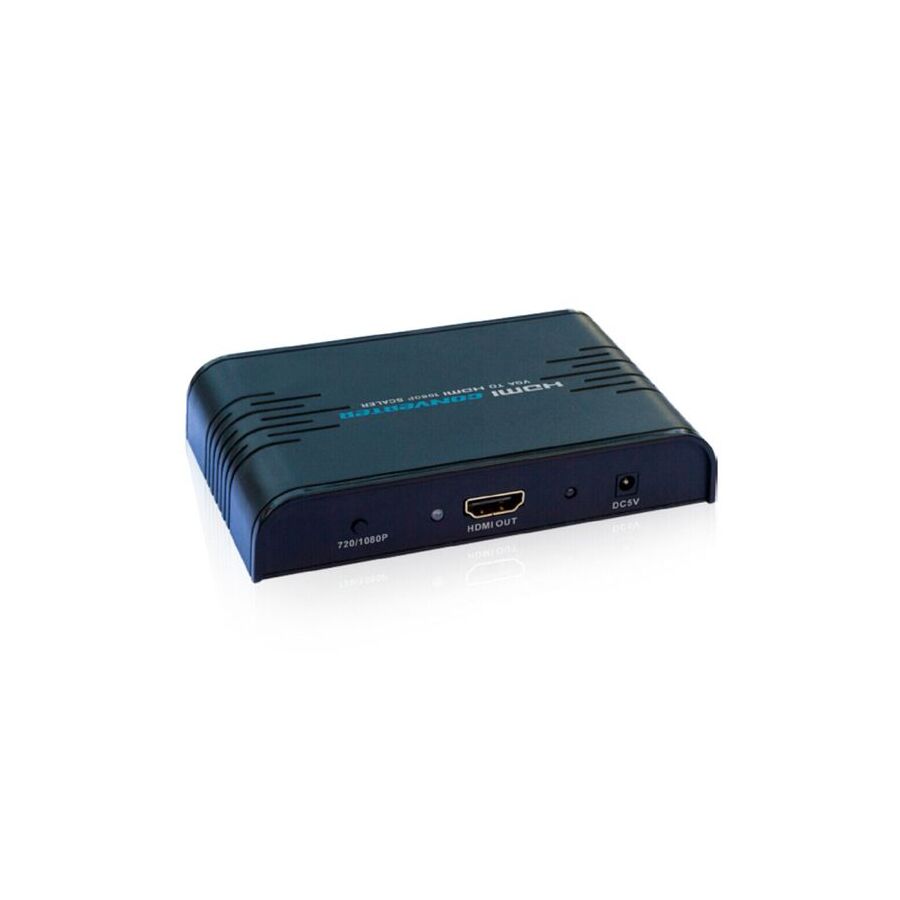
In the rapidly evolving Australian audiovisual landscape, a persistent challenge exists at the intersection of legacy infrastructure and modern display technology. While contemporary commercial environments have standardised on HDMI for video distribution, a significant portion of critical backend equipment remains dependent on the Video Graphics Array standard. Industrial control systems, building management interfaces, medical imaging consoles, legacy servers, and security Digital Video Recorders often output only VGA. At the same time, modern flat-panel displays, LED walls, and projectors increasingly omit analog inputs altogether.
For system integrators, replacing functional legacy equipment is rarely economical or operationally practical. The engineering requirement is not replacement, but translation. This is where the VGA to HDMI upscaler becomes indispensable. Unlike a passive adaptor, this device is an active signal processor that converts analog video into digital form, scales the image to a modern resolution, embeds audio where required, and delivers a stable HDMI output compatible with today’s displays.
The first task of a VGA to HDMI upscaler is signal type conversion. VGA is an analog standard that transmits Red, Green, and Blue colour channels as continuous voltage levels, accompanied by horizontal and vertical synchronisation pulses. HDMI, by contrast, is a fully digital protocol that transmits binary data using Transition Minimized Differential Signaling.
To bridge this gap, the upscaler relies on a high-performance Analog-to-Digital Converter. The ADC samples the incoming voltage waveform thousands of times per second, converting each sample into digital values. The precision of this process determines image quality. Insufficient sampling resolution results in colour banding, shimmering edges, or unstable images. Professional upscalers are designed to lock onto a wide range of VESA standard timings and stabilise sync signals before conversion, ensuring consistent digitisation even from aging or electrically noisy VGA sources.
Conversion alone does not solve the problem. Most VGA sources output resolutions such as 800×600, 1024×768, or 1280×1024. When displayed on a 1920×1080 or 4K screen without proper processing, these images appear soft and poorly defined.
The scaler engine inside a VGA to HDMI upscaler performs mathematical interpolation to expand the original pixel grid. Using algorithms such as bilinear or bicubic scaling, the device generates additional pixels based on surrounding data, effectively reconstructing the image to match the native resolution of the display. This process significantly improves readability, particularly for text-heavy interfaces like industrial HMIs or legacy server dashboards. For control rooms and technical environments, clarity is not aesthetic. It is operationally critical.
Another challenge lies in aspect ratio mismatch. VGA systems were largely designed around a 4:3 format, while modern displays use a 16:9 widescreen layout. Without proper handling, images are stretched horizontally, distorting graphics and undermining usability.
Professional VGA to HDMI upscalers provide aspect ratio control options. Integrators can maintain the original 4:3 geometry by adding pillar-box bars to the sides of the widescreen output. This preserves the intended proportions of diagrams, schematics, and user interfaces. In applications such as medical imaging, engineering visualisation, or security monitoring, geometric accuracy is essential and cannot be compromised for screen fill.
VGA carries video only. HDMI expects both video and audio in a single stream. To achieve full compatibility, the upscaler must embed audio into the HDMI output.
Most professional units include an analogue audio input, typically via a 3.5 mm stereo jack. The device digitises this signal and synchronises it with the processed video stream. Because video scaling introduces processing delay, audio must be time-aligned to avoid lip-sync errors. High-quality upscalers manage this internally, ensuring audio remains locked to the video even during dynamic resolution changes.
Latency is often overlooked in conversion devices. Consumer-grade converters may introduce several frames of delay, which is unacceptable in interactive environments. Cursor movement, touchscreen interaction, or live monitoring becomes sluggish and frustrating.
Professional VGA to HDMI upscalers are designed for low-latency operation, typically adding no more than one to two frames of delay. This makes them suitable for real-time applications such as control rooms, surveillance systems, and live presentation environments where responsiveness is critical.
As active devices, VGA to HDMI upscalers require external power. Depending on the model, this may be supplied via USB or a dedicated DC adaptor. Stable power delivery is essential, as voltage fluctuations can destabilise the scaler chip and cause intermittent signal loss.
This is where the broader infrastructure ecosystem from Schnap Electric Products becomes relevant. High-quality HDMI leads are required to carry the upscaled digital signal without introducing handshake failures or sparkles. Surge-protected power distribution helps shield sensitive electronics from electrical noise, particularly in industrial environments where motors, lifts, and heavy machinery share the same supply. Proper mounting accessories ensure the upscaler is secured behind displays or within racks, preventing mechanical strain on legacy VGA ports.
The market is saturated with low-cost VGA converters that lack proper scaling engines, introduce excessive latency, or fail electromagnetic compatibility requirements. These devices may work temporarily but often degrade under continuous operation.
Professional AV integrators mitigate this risk by sourcing equipment through specialised electrical wholesaler. These suppliers ensure products meet Australian regulatory standards and are suited to long-term commercial deployment. They also provide access to compatible cabling, mounting hardware, and test equipment, allowing installations to be completed to a professional standard rather than improvised on site.
The VGA to HDMI upscaler is a critical enabler of continuity in modern AV systems. It allows organisations to preserve the value of reliable legacy equipment while embracing modern display technology. By understanding analog-to-digital conversion physics, prioritising high-quality scaling, managing aspect ratios correctly, and supporting installations with robust infrastructure from manufacturers like Schnap Electric Products, Australian industry professionals can deliver seamless, high-definition integration across generations of technology. In commercial AV, intelligent adaptation is often more valuable than replacement.

SCHNAP is Australia's premier electrical wholesaler and electrical supplies, marketing thousands of quality products from leading brands. Trusted for nearly two decades by licensed electricians, contractors, and engineers, our range covers everything from basic electrical components to complex industrial electrical equipment
Our key categories include: LED lighting, designer switches, commercial switchboards, circuit protection, security systems & CCTV, and smart home automation
All products are certified to Australian standards (AS/NZS), backed by our 30-day, no-questions-asked return policy. Our expert technical team helps you quickly source the right solution for any residential, commercial, or industrial project, with daily dispatch from our Sydney electrical warehouse delivering Australia-wide
SCHNAP offers the most comprehensive electrical product range, with full technical specifications, application details, installation requirements, compliance standards, and warranties — giving professionals total confidence in every purchase


Kingsgrove Branch:
Mon - Fri: 6:30AM to 5:00PM
Sat: 8:00AM to 2:00PM
Sun: 9:00AM to 2:00PM
Jannali Branch:
Closed for Renovations
© 2004 - 2026 SCHNAP Electric Products