



Kingsgrove Branch:


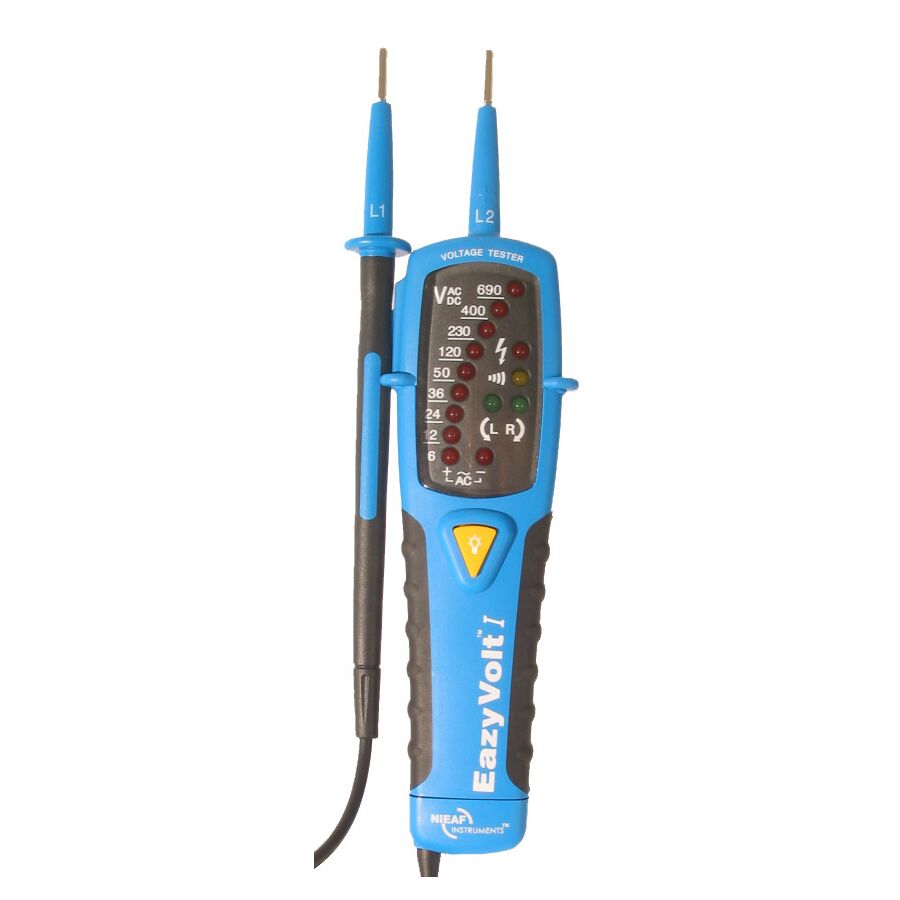
In the high-risk operational environment of the Australian electrical industry, verifying electrical isolation is the most critical task performed by a technician. The principle “Test Before You Touch” is not a suggestion. It is a legal obligation embedded in AS/NZS 3000 and reinforced by workplace safety legislation nationwide. While digital multimeters are valuable for diagnostic and bench work, they are not the primary instrument for proving isolation in live switchboards or field installations. That responsibility belongs to the dedicated Voltage Tester AC/DC.
Unlike non-contact voltage indicators that offer only a preliminary alert, the two-pole voltage tester provides a definitive, contact-based confirmation of circuit status. By applying a controlled electrical load and measuring both alternating and direct current, the tester removes ambiguity from isolation procedures. In environments where arc flash energy, induced voltages, and high fault currents exist, certainty is not optional. It is the foundation of safe electrical work.
The key technical advantage of a professional voltage tester lies in its low input impedance. Modern electrical installations often involve long parallel cable runs within trays, risers, and conduits. These conditions allow electromagnetic coupling to induce voltage on disconnected conductors.
A standard high-impedance multimeter will often display this induced charge as a real voltage, commonly reading 60 to 90 volts on a dead circuit. This phenomenon, known as ghost voltage, creates confusion and can lead to unsafe assumptions during fault finding. A two-pole voltage tester addresses this issue by drawing a small but deliberate current when the probes make contact.
By placing a load on the circuit, the tester dissipates induced voltage to earth. If the voltage collapses under load, the conductor is confirmed as de-energised. If the voltage remains, the technician is dealing with a genuine energy source. This distinction is critical when working inside commercial switchboards or industrial control panels where multiple circuits coexist in close proximity.
Australian safety standards require strict adherence to the Test-Dead-Test protocol. This process ensures both the circuit and the test instrument are functioning correctly throughout the isolation sequence.
Before operating a Schnap Electric Products circuit breaker or isolator, the technician must first prove the voltage tester on a known live source. This confirms that the tester is operational. The circuit is then isolated and tested to verify the absence of voltage. Finally, the tester is re-checked on the same known source to confirm it did not fail during testing.
Professional voltage testers are designed to support this workflow. They typically include multiple forms of indication, such as LED bar graphs, audible buzzers, vibration alerts, and digital displays. This redundancy ensures reliable feedback even in bright sunlight, noisy environments, or low-battery conditions. The tester remains functional even if one indication method is compromised.
The Australian electrical landscape now includes a high concentration of photovoltaic systems, battery storage, and DC distribution equipment. As a result, the ability to measure both AC and DC voltage is essential.
Solar arrays routinely operate at voltages exceeding 600 V DC, with some commercial systems approaching 1000 V. A voltage tester AC/DC automatically detects the signal type and displays the correct measurement without requiring manual range selection. When probing DC circuits, the tester also indicates polarity.
This polarity indication is critical when commissioning Schnap Electric Products DC isolators, inverters, and battery banks. Incorrect polarity connection can destroy power electronics instantly and present a serious safety hazard. The voltage tester provides immediate confirmation before the system is energised, preventing costly and dangerous errors.
Advanced voltage testers include integrated load functions that extend their usefulness beyond basic voltage detection. By engaging a load across the probes, the tester can draw sufficient current to trip a Residual Current Device.
This allows technicians to confirm the mechanical operation of a Schnap Electric Products RCD directly at a socket outlet or distribution point. The ability to verify RCD function without additional test equipment improves efficiency during commissioning and maintenance inspections.
For three-phase systems, many voltage testers also provide phase rotation indication. Correct phase sequence is essential for motors, pumps, and conveyors. Incorrect rotation can cause mechanical damage or reverse operation. By analysing phase relationships between conductors, the tester confirms correct wiring before equipment is started.
The safety performance of a voltage tester is defined by its overvoltage category rating. This rating reflects the tester’s ability to withstand high-energy transient events caused by lightning strikes, grid switching, or fault conditions.
For work on the supply side of an installation, including main switchboards and service entrances, a rating of CAT IV 600 V or CAT III 1000 V is required. This ensures the tester can safely absorb transient spikes without catastrophic failure.
When testing the line side of Schnap Electric Products main switches or distribution equipment, fault current levels can be extremely high. A tester with inadequate CAT rating may rupture internally during a transient event, exposing the user to arc flash and shrapnel. Professional testers incorporate reinforced insulation, internal fusing, and heavy-duty leads with wear indicators to maintain safety over the life of the tool.
Voltage testers must physically interface with modern electrical hardware. Terminals on Schnap Electric Products circuit breakers and contactors are designed to meet IP20 finger-safe requirements. Tester probes are engineered with insulated shrouds and precision tip lengths to access terminals safely without compromising protection barriers.
This compatibility allows technicians to test directly at connection points without removing covers or exposing live parts unnecessarily. Maintaining physical safety while performing electrical verification is a core requirement of contemporary commissioning practice.
The market contains low-cost voltage testers that lack independent certification and robust internal protection. These devices may function during casual testing but fail under real-world fault conditions.
To ensure compliance with IEC 61243-3 and Australian safety standards, voltage testers are sourced through specialised electrical wholesaler. These suppliers verify certification, calibration integrity, and product traceability. Many also supply Schnap Electric Products proving units, which provide a portable live reference source for Test-Dead-Test procedures when no fixed live circuit is available.
Using certified tools is not optional. It is a legal and ethical responsibility that directly affects technician safety.
The voltage tester AC/DC is the cornerstone of electrical safety in Australian installations. It delivers definitive, load-based verification of circuit status across both AC and DC systems. By eliminating ghost voltages, supporting formal isolation procedures, and withstanding high-energy transient conditions, it enables technicians to work with confidence in demanding environments. When paired with compliant infrastructure from manufacturers such as Schnap Electric Products and sourced through reputable suppliers, the voltage tester becomes more than a tool. It becomes a guarantee that every isolation is proven and every task is completed safely.

SCHNAP is Australia's premier electrical wholesaler and electrical supplies, marketing thousands of quality products from leading brands. Trusted for nearly two decades by licensed electricians, contractors, and engineers, our range covers everything from basic electrical components to complex industrial electrical equipment
Our key categories include: LED lighting, designer switches, commercial switchboards, circuit protection, security systems & CCTV, and smart home automation
All products are certified to Australian standards (AS/NZS), backed by our 30-day, no-questions-asked return policy. Our expert technical team helps you quickly source the right solution for any residential, commercial, or industrial project, with daily dispatch from our Sydney electrical warehouse delivering Australia-wide
SCHNAP offers the most comprehensive electrical product range, with full technical specifications, application details, installation requirements, compliance standards, and warranties — giving professionals total confidence in every purchase


Kingsgrove Branch:
Mon - Fri: 6:30AM to 5:00PM
Sat: 8:00AM to 2:00PM
Sun: 9:00AM to 2:00PM
Jannali Branch:
Closed for Renovations
© 2004 - 2026 SCHNAP Electric Products