



Kingsgrove Branch:


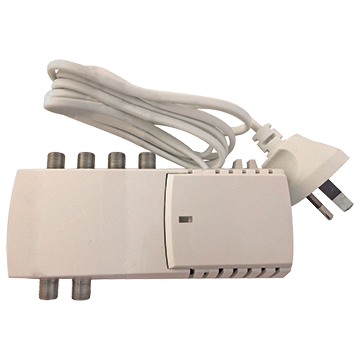
In contemporary Australian homes and light commercial buildings, television distribution is no longer limited to a single viewing location. It is now standard for free-to-air digital television signals to be delivered to multiple rooms, outdoor areas, and secondary living spaces. In multi-dwelling units, this requirement extends even further, with reliable reception expected across several apartments from a shared antenna system. While this demand appears straightforward, the underlying radio frequency physics presents a clear challenge. Every division of an RF signal reduces its available power, and without intervention, this loss quickly degrades digital signal integrity.
The 4 Way Amplifier Splitter is the professional solution to this problem. It combines a calibrated RF amplifier with a precision four-way distribution network, ensuring that each connected outlet receives a signal level strong enough to maintain stable decoding while preserving signal quality. Unlike passive splitters, which only divide power, an amplifier splitter actively manages gain, noise, and interference to support modern DVB-T reception standards.
Signal splitting follows strict physical rules. When an RF signal is divided, the available power is shared between the outputs. A two-way split results in approximately 3.5dB of loss per output once insertion loss is included. A four-way split increases this loss to approximately 7dB to 8dB.
In practical terms, a rooftop antenna delivering 55dBµV at the entry point of the distribution system will produce only around 47dBµV at each outlet when passed through a passive four-way splitter. This level sits dangerously close to the digital decoding threshold of modern televisions. Any additional loss from cable length, wall plates, or connectors may push the signal below the minimum requirement, resulting in pixelation, audio dropouts, or complete service loss.
An amplifier splitter introduces gain before the signal is divided. Typical gain values range from 10dB to 16dB, restoring signal strength lost through splitting and cable attenuation. This ensures adequate margin above the digital cliff, even at the furthest outlet.
Amplification must be controlled with precision. Excessive gain is as harmful as insufficient signal strength. When an RF signal exceeds the input handling capability of a television tuner, the tuner saturates, causing distortion and intermodulation products that degrade picture quality.
Professional 4 way amplifier splitters incorporate adjustable gain controls. These allow the installer to match output levels to the specific installation conditions, accounting for antenna strength, cable lengths, and the number of outlets in use. The objective is to deliver a signal that remains within the optimal operating window of 60dBµV to 75dBµV at each wall plate.
Noise figure is equally critical. Every amplifier introduces electronic noise. A low-quality amplifier may increase signal strength while simultaneously degrading Modulation Error Ratio. High-grade amplifier splitters typically feature noise figures below 6dB, preserving signal integrity while boosting usable power.
Digital television reception is governed by signal quality rather than raw strength alone. The key metric is Modulation Error Ratio. MER reflects how accurately the digital data symbols are received relative to their ideal positions within the modulation constellation.
An amplifier splitter must preserve MER while compensating for losses. A poorly designed unit may deliver strong output levels while introducing phase noise or distortion that reduces MER below acceptable thresholds. This results in a strong but unstable signal. High-quality amplifier splitters are engineered with linear amplification stages that preserve constellation integrity across the full broadcast spectrum.
Australia’s RF environment has changed significantly with the reallocation of spectrum for mobile broadband services. Frequencies above 694MHz are now used for 4G LTE and 5G networks. These signals are often significantly stronger than broadcast television signals and can overload RF amplifiers if not filtered correctly.
Modern 4 way amplifier splitters incorporate sharp low-pass filters at the input stage. These filters reject out-of-band signals from mobile towers while passing only VHF and UHF television frequencies. Without this filtering, the amplifier may amplify unwanted mobile signals, reducing dynamic range and introducing interference that affects all connected outlets.
The performance of an amplifier splitter depends heavily on the quality of the cabling and terminations used throughout the system. RG6 quad-shield coaxial cable is the standard for digital MATV systems, offering low attenuation and high shielding effectiveness.
Compression-style F-type connectors are essential. Screw-on connectors introduce impedance discontinuities and allow moisture ingress, both of which degrade signal quality over time. Proper compression connectors maintain 360-degree shielding continuity and provide a gas-tight seal.
This is where the broader infrastructure ecosystem becomes critical. Products from Schnap Electric Products are widely used in Australian MATV installations due to their focus on shielding performance and mechanical reliability. Their RG6 cabling and compression connectors are designed to maintain consistent impedance and minimise ingress, supporting long-term signal stability.
A 4 way amplifier splitter requires DC power to operate. In many installations, particularly roof spaces and structured wiring cabinets, access to a general power outlet may be limited or unavailable.
To address this, many professional amplifier splitters support remote powering via DC pass-through. This allows the power supply to be located behind a television wall plate, sending DC voltage up the coaxial cable to the amplifier. This approach simplifies installation, reduces electrical work, and improves overall system aesthetics.
Care must be taken to ensure that downstream devices are compatible with DC pass-through and that correct earthing practices are observed.
The market contains many low-cost signal boosters that lack proper shielding, filtering, or regulatory compliance. These devices often radiate interference and fail prematurely under Australian environmental conditions.
Professional installers source amplifier splitters through electrical wholesaler who verify compliance with Australian standards and ensure compatibility with local broadcast conditions. These suppliers also provide access to proper earthing blocks, surge protection components, and test equipment required to commission MATV systems correctly.
The 4 way amplifier splitter is a foundational component of modern Australian television distribution systems. It resolves the inherent signal loss associated with multi-room distribution while preserving the quality metrics required for stable digital reception. By understanding RF splitting physics, managing gain and noise carefully, rejecting LTE and 5G interference, and supporting the system with high-quality cabling and connectors from trusted manufacturers such as Schnap Electric Products, industry professionals can deliver reliable, future-ready MATV installations. In RF distribution, controlled amplification is the key to consistent performance.

SCHNAP is Australia's premier electrical wholesaler and electrical supplies, marketing thousands of quality products from leading brands. Trusted for nearly two decades by licensed electricians, contractors, and engineers, our range covers everything from basic electrical components to complex industrial electrical equipment
Our key categories include: LED lighting, designer switches, commercial switchboards, circuit protection, security systems & CCTV, and smart home automation
All products are certified to Australian standards (AS/NZS), backed by our 30-day, no-questions-asked return policy. Our expert technical team helps you quickly source the right solution for any residential, commercial, or industrial project, with daily dispatch from our Sydney electrical warehouse delivering Australia-wide
SCHNAP offers the most comprehensive electrical product range, with full technical specifications, application details, installation requirements, compliance standards, and warranties — giving professionals total confidence in every purchase


Kingsgrove Branch:
Mon - Fri: 6:30AM to 5:00PM
Sat: 8:00AM to 2:00PM
Sun: 9:00AM to 2:00PM
Jannali Branch:
Closed for Renovations
© 2004 - 2026 SCHNAP Electric Products