

Kingsgrove Branch:


Send us a photo and our team will help identify it.

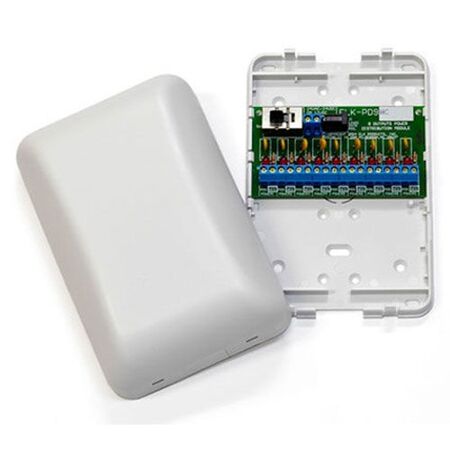
Eight camera positions on the plan, eight 12V plug packs queued up next to them — that's the default a lot of installers fall into on a multi-camera retail or warehouse job, right up until the power board runs out of GPOs and the client asks why there's a nest of wall warts behind the counter. There's a cleaner way to run a bank of cameras off a single power source, and picking the right piece of gear for it comes down to how many devices you're feeding and at what voltage.
Running a separate plug pack per camera works fine for a two or three camera resi job. Past that, it starts costing you time and reliability. Every plug pack is another point of failure, another GPO you need free near the camera run, and another thing to troubleshoot when a client calls to say one camera's gone dark. Centralising the power — one PSU feeding a distribution module or splitter, with individual fused outputs running out to each camera — means one supply to size properly, one place to check when something trips, and a much tidier enclosure at the head end.
Before locking in the distribution setup, it's worth confirming how many outputs the recorder actually needs — the channel count on the NVR is usually what determines how many camera outputs your distribution board has to carry, so it's a good idea to size the recorder side of the job first.
There are three ways to go about this, and the right one depends mostly on device count and how much you value being able to isolate a single camera without killing the whole bank.
A basic splitter takes one 12V input and breaks it into multiple unfused outputs. It's cheap and fine for two or three low-draw devices, but there's no individual protection — a fault on one camera can pull the whole splitter down, and you've got no way to isolate it without unplugging everything to find the culprit.
A DIN-rail distribution module is the more common choice on a proper install. Each output is individually fused, so a shorted camera cable trips its own fuse rather than taking the rest of the bank offline. Most come in 8-way, 9-way or 10-way configurations, and some support mixed voltage outputs on the same board, which matters if you've got a mix of 12VDC cameras and 24VAC devices on the same job.
A high-output PSU with built-in fused outputs combines the supply and the distribution in one enclosure — useful when you want fewer boxes in the cabinet and enough headroom for a larger install with battery backup thrown in.
[!] Fuse ratings matter more than they get credit for. A distribution module rated for 1A per output won't cover a PTZ camera or a heated dome drawing closer to 2A — check the current draw on the datasheet for every device on the run, not just the standard fixed cameras, before you lock in which module to use.
Take the eight-camera retail job as the working example. Standard fixed IR cameras typically draw somewhere in the 200-400mA range at 12V, so eight cameras land you around 2-3.2A total — well within what an 8-way module can handle, provided the input PSU itself is sized with some headroom rather than run flat out. As a general rule, add 20-30% headroom to your total calculated draw when picking the input PSU, since inrush current on power-up and any IR illuminators kicking in at night will push the momentary draw higher than the steady-state number.
| Camera Count | Typical Total Draw @ 12V | Suggested Module |
|---|---|---|
| Up to 8 | ~2-3A | 8-way DIN-rail module |
| Up to 10 | ~3-4A | 10-way selectable module |
| 10+ or mixed devices with backup | Varies — check datasheets | High-output fused PSU with battery backup |
If the job includes battery backup — common on jobs where the client wants recording to keep running through a power outage — a wall-mount PSU with fused outputs and built-in battery charging saves you adding a separate UPS into the cabinet. Once you've settled on the module and worked out how many outputs you actually need, that same channel count feeds back into confirming the NVR sizing, so it's worth double-checking the two against each other before ordering.
Related Reading
Sizing the module to today's camera count, not tomorrow's. An 8-way module feeding exactly 8 cameras leaves nothing spare for the client who asks for two more cameras six months later. Going up one size on the module rarely costs much more and saves a return visit.
Ignoring PTZ and heated housing draw. A distribution board sized around standard fixed camera draw can get caught out the moment a PTZ dome or heated external housing goes on the same run — those devices commonly pull well above what a fixed camera draws, and undersizing here trips fuses on cold mornings.
Mixing voltages without checking the module supports it. Not every distribution module handles 12VDC and 24VAC outputs on the same board — running a mixed-voltage system through a single-voltage module means either bodging in a second supply or frying a device.
Skipping the input PSU headroom calculation. Sizing the PSU to exactly match calculated draw, with nothing spare, is how installs end up tripping intermittently — usually blamed on the cameras rather than the power budget that caused it.
Daisy-chaining cameras off a single fused output. It's tempting to save an output by running two cameras off one fuse point, but that defeats the point of individual fusing — one faulty camera takes both down, and troubleshooting gets harder, not easier.
how many cameras can I run off one 8-way distribution module?
Up to eight devices, one per output, provided the combined draw stays within the module's total input rating and each individual output's fuse rating covers that device's current draw — check both numbers, not just the port count.
can I mix 12VDC cameras and a 24VAC gate motor on the same distribution board?
Only if the module is specifically rated for selectable or mixed voltage outputs — a 10-way selectable 12VDC/24VAC module handles that combination, whereas a fixed-voltage board doesn't.
what happens if one camera's cable shorts out on a distribution board?
On a properly fused distribution module, only that camera's output fuse trips — the rest of the cameras on the board keep running. This is the main reason to avoid unfused splitters on anything beyond a couple of devices.
do I need a licence to wire a CCTV power distribution board in NSW?
Extra-low voltage CCTV wiring itself typically sits outside standard electrical licensing requirements, but if the install involves connecting to mains for the PSU or working within a switchboard, that part of the job does require a licensed electrician. Check current NSW Fair Trading requirements if you're unsure where the line sits for a specific job.
how do I know if my distribution module is overloaded?
A module with per-output LED status indicators makes this easy to spot at a glance — a dark LED usually means that output's fuse has tripped, which is a quicker diagnostic than pulling cameras offline one at a time to test.
what's the point of battery backup on a CCTV power distribution setup?
It keeps cameras and the recorder running through short mains outages, which matters most for clients who need continuous footage regardless of power interruptions. A wall-mount PSU with fused outputs and built-in battery backup covers this without needing a separate UPS in the cabinet.
Access control installs on the same site raise a related but separate sizing question — choosing an access control PSU comes down to door count and battery-backup needs rather than camera count, so it's worth treating as its own decision rather than an extension of the CCTV power budget.
Related Reading
Trade pricing and same-day dispatch from Kingsgrove NSW on the full range of distribution modules and multi-output PSUs below.
Browse the full security power supplies range at Schnap for trade pricing and same-day dispatch from Kingsgrove NSW.

SCHNAP Electrical Wholesaler - clear, upfront pricing that professional electricians trust

Get what you need in seconds. SCHNAP electrical wholesaler makes ordering quick and simple

Fast delivery anywhere - that's guaranteed. SCHNAP electrical wholesalers ship nationwide with same-day dispatch

Track your order every step of the way. SCHNAP electrical wholesale keeps you updated from click to delivery

SCHNAP is Australia's premier electrical wholesaler and electrical supplies, marketing thousands of quality products from leading brands. Trusted for nearly two decades by licensed electricians, contractors, and engineers, our range covers everything from basic electrical components to complex industrial electrical equipment
Our key categories include: LED lighting, designer switches, commercial switchboards, circuit protection, security systems & CCTV, and smart home automation
All products are certified to Australian standards (AS/NZS), backed by our 30-day, no-questions-asked return policy. Our expert technical team helps you quickly source the right solution for any residential, commercial, or industrial project, with daily dispatch from our Sydney electrical warehouse delivering Australia-wide
SCHNAP offers the most comprehensive electrical product range, with full technical specifications, application details, installation requirements, compliance standards, and warranties — giving professionals total confidence in every purchase


Kingsgrove Branch:
Opening hours:
Mon - Fri: 6:30 AM to 5 PM
Saturday: 8:00 AM to 2:00 PM
Sunday: 9:00 AM to 2:00 PM
Closed on public holidays
Jannali Branch:
Closed for Renovations
© 2004 - 2026 SCHNAP Electric Products