

Kingsgrove Branch:


Send us a photo and our team will help identify it.

A retail fitout lands on your desk: eight cameras across a warehouse and loading dock, all tied back to one NVR in the site office, with camera runs ranging from 15 to 60 metres. Before you can quote the cable, you need to know which power supply actually covers that load without tripping a fuse or starving the camera furthest from the rack. Get the amp rating wrong and you're back on site swapping units after the client's already signed off. If you haven't locked in your camera or channel count yet, it's worth starting with our guide to sizing an NVR by channel count before you spec the PSU around it.
Most installers start by adding up camera draw and stop there — but that only gets you part way. The NVR itself pulls current too, and so does anything else sharing the rail, like an IR illuminator on a long-range camera. As a general rule, tally every device that'll draw from the one supply, add headroom rather than sizing to the exact total, and factor in voltage drop on the longest run separately.
Cable run length matters more than most installers expect. A camera rated at 500mA close to the PSU behaves very differently to the same camera on the end of a 60-metre run, where voltage drop eats into what actually reaches the lens. In practice, runs over 30-40 metres are where undersized PSUs start showing symptoms on site — flickering IR, intermittent dropouts — well before the total current draw looks like it should be a problem on paper.
| Camera Count | Typical PSU Size | Notes |
|---|---|---|
| 1-2 cameras | 1.5A plug pack | Fine for short runs under 20m |
| 3-4 cameras | 2.5A-5A | Step up if any run exceeds 30m |
| 5-8 cameras | 8A wall-mount or rack | Multi-fused output recommended |
| 9+ cameras | 24A multi-output | Individually fused outputs matter at this scale |
Most analogue and IP CCTV cameras run on 12V DC, which covers the bulk of standard installs. Some systems — particularly ones standardised around alarm-grade battery-backed gear — are built around a 13.8V float voltage instead, which keeps the battery topped up without overcharging it. It's worth checking what the rest of the system expects before you order, rather than assuming every job is a straight 12V swap.
[!] Voltage drop and compliance: Long cable runs at low DC voltage are more susceptible to voltage drop than mains-voltage circuits. As a general rule, AS/NZS 3000 wiring principles around voltage drop still apply in spirit even on extra-low-voltage security runs — if a camera sits right at the edge of its rated voltage, drop on a long run can push it out of spec before the current draw itself becomes an issue.
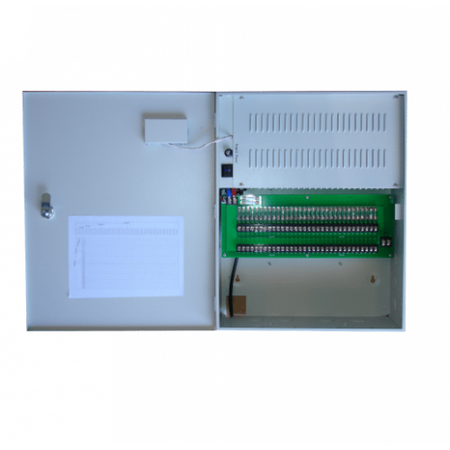
For a one or two-camera job, a compact plug pack does the job without adding anything to the wall. Once you're past four or five cameras, a wall-mount unit with individually fused outputs and an LCD display earns its keep — you can see at a glance which output has tripped instead of chasing a dead camera blind. For cabinet installs feeding a rack alongside other gear, a 1RU rack-mount PSU keeps everything tidy and serviceable from the front panel. On larger sites pushing 20-30+ devices off one supply, a high-output unit with dozens of individually fused outputs and battery backup becomes the practical choice — though once you're at that scale, it's also worth looking at whether a dedicated distribution setup makes more sense than one large PSU carrying everything.
A handful of PSUs in this range carry AC-fail and low-battery outputs — dry contacts that report back to a monitored panel if mains power drops or the backup battery is running low. This matters when the CCTV system is tied into a monitored alarm setup and the client expects to know about an outage before the battery dies, not after. For a standalone CCTV install with no monitoring back-end, it's a feature you're paying for without using — a standard PSU without the reporting outputs does the same job for less.
How many amps do I need for a 4 camera CCTV system?
For four standard cameras with runs under 30 metres, a 5A PSU typically gives enough headroom to cover camera draw plus the NVR. If any run pushes past 40-50 metres, size up rather than relying on the total-current figure alone.
Will a 12V 1.5A power supply run an 8 channel NVR?
Not reliably on its own if it's also feeding cameras off the same rail. A 1.5A plug pack suits one or two low-draw cameras at most — an 8-channel setup with the NVR included needs a multi-amp, multi-output unit.
Do I need a licensed electrician to install security power supplies in NSW?
Extra-low-voltage CCTV wiring itself typically falls outside standard electrical licensing requirements, but any 240V mains connection point for the PSU — including a new GPO — generally does require a licensed electrician. As a general rule, check current NSW Fair Trading requirements for the specific scope of your job before quoting.
Can I run a CCTV power supply off the same circuit as my alarm panel?
You can, but it's worth checking the combined draw doesn't push the circuit close to its rating, particularly if the alarm panel already has its own backup battery load. A wall-mount unit with short-circuit protection adds a layer of safety if you do decide to share the circuit.
What's the difference between a plug-pack and a rack-mount PSU for CCTV?
A plug-pack is a single-output unit suited to one or two cameras with no fusing per output. A rack-mount PSU gives multiple individually fused outputs in a form factor that mounts cleanly alongside your NVR and other cabinet gear.
How many outputs does an 8 amp rack PSU actually give you?
It depends on the specific unit and how the load is split — an 8A rating is the total the supply can deliver across however many outputs it has, not the rating per output. Check the individual output fusing on the datasheet before assuming each port can carry the full 8A on its own.
Trade pricing on the full CCTV power supply range, with same-day dispatch from our Kingsgrove NSW warehouse on in-stock orders.
Find the full cctv power supply range at Schnap -- trade pricing and same-day dispatch from Kingsgrove NSW.

SCHNAP Electrical Wholesaler - clear, upfront pricing that professional electricians trust

Get what you need in seconds. SCHNAP electrical wholesaler makes ordering quick and simple

Fast delivery anywhere - that's guaranteed. SCHNAP electrical wholesalers ship nationwide with same-day dispatch

Track your order every step of the way. SCHNAP electrical wholesale keeps you updated from click to delivery

SCHNAP is Australia's premier electrical wholesaler and electrical supplies, marketing thousands of quality products from leading brands. Trusted for nearly two decades by licensed electricians, contractors, and engineers, our range covers everything from basic electrical components to complex industrial electrical equipment
Our key categories include: LED lighting, designer switches, commercial switchboards, circuit protection, security systems & CCTV, and smart home automation
All products are certified to Australian standards (AS/NZS), backed by our 30-day, no-questions-asked return policy. Our expert technical team helps you quickly source the right solution for any residential, commercial, or industrial project, with daily dispatch from our Sydney electrical warehouse delivering Australia-wide
SCHNAP offers the most comprehensive electrical product range, with full technical specifications, application details, installation requirements, compliance standards, and warranties — giving professionals total confidence in every purchase


Kingsgrove Branch:
Opening hours:
Mon - Fri: 6:30 AM to 5 PM
Saturday: 8:00 AM to 2:00 PM
Sunday: 9:00 AM to 2:00 PM
Closed on public holidays
Jannali Branch:
Closed for Renovations
© 2004 - 2026 SCHNAP Electric Products