



Kingsgrove Branch:


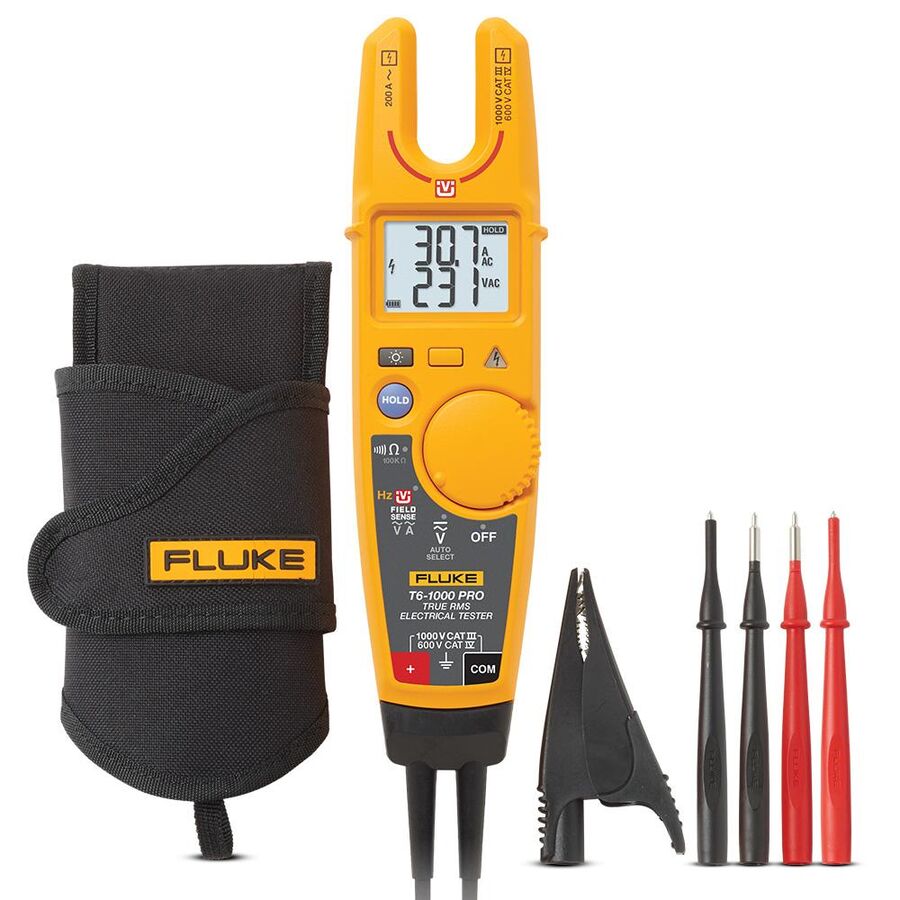
In the high-energy operational environment of the Australian electrical industry, verifying circuit status is not a routine task. It is a life-critical procedure governed by strict legislation and unforgiving electrical physics. From commercial main switchboards and mining infrastructure to large-scale solar arrays and variable speed drive systems, modern installations operate at higher voltages and carry far greater fault energy than in previous decades.
As infrastructure evolves, the limitations of traditional 600V testing tools have become increasingly apparent. The transition to renewable energy, high-voltage DC systems, and heavy industrial motor control has elevated risk profiles across the sector. In this context, the professional Electrical Tester 1000V is no longer a specialised instrument. It is the baseline safety device required to comply with Australian Standards and to uphold the principle of “Test Before You Touch” in real-world conditions.
This instrument is engineered not only to measure higher voltages, but to survive the extreme transient energy present in Category IV environments. It provides electricians with a verified, fail-safe method of confirming isolation before any physical interaction with conductors or terminals.
The importance of a 1000V electrical tester is often misunderstood as a simple voltage measurement requirement. In reality, the primary driver is transient energy exposure, not steady-state voltage.
IEC 61010 defines overvoltage categories based on proximity to the source of supply. CAT IV environments include service entrances, main switchboards, utility connections, and outdoor conductors. These locations are exposed to lightning strikes, switching surges, and grid disturbances capable of generating transient spikes of several thousand volts with extremely low impedance.
If a tester with insufficient CAT rating is used during one of these events, its internal protection will fail instantly. The result is internal arcing, casing rupture, and severe injury to the user. A professional Electrical Tester 1000V is typically rated CAT IV 600V or CAT III 1000V. This ensures adequate internal spacing, reinforced insulation, and high-rupture-capacity fusing capable of absorbing fault energy without catastrophic failure.
Australian Standard AS/NZS 4836 governs safe work practices on or near low-voltage electrical installations. Central to this standard is the requirement to positively prove a circuit is de-energised before commencing work.
The mandated “Test-Dead-Test” sequence requires the tester to be verified on a known live source, applied to the isolated circuit, and then re-verified. The reliability and clarity of the tester’s feedback are therefore critical.
High-quality 1000V testers employ redundant indication systems. A digital display provides precise voltage readings for diagnostic accuracy, while an independent LED bar graph provides immediate hazard indication. This redundancy ensures that even if the LCD fails or batteries are depleted, the tester will still alert the user to the presence of dangerous voltage.
Australia’s electrical landscape is now dominated by photovoltaic systems. Modern solar installations frequently operate at string voltages approaching 1000V DC, far exceeding the limits of conventional test instruments.
Unlike AC systems, DC voltage presents unique hazards. Arc extinction is more difficult, and polarity reversal can result in immediate equipment damage. A compliant Electrical Tester 1000V is designed to safely measure high-voltage DC while providing clear polarity indication.
When commissioning solar infrastructure or verifying a Schnap Electric Products DC isolator, the tester allows the electrician to confirm correct polarity before energisation. This capability prevents costly inverter failures and ensures compliance with AS/NZS 5033 requirements for photovoltaic installations.
Industrial electrical environments frequently suffer from induced or “ghost” voltages. Capacitive coupling between parallel conductors can induce measurable voltage on de-energised cables, particularly in large cable trays or long conduit runs.
Standard high-impedance meters will display these phantom voltages as genuine readings, leading to confusion and unnecessary troubleshooting. Advanced 1000V testers address this issue through low-impedance measurement modes.
By momentarily applying a controlled load to the circuit, the tester collapses induced voltages to earth. If the voltage persists under load, the technician knows it is sourced from a live conductor. This function is essential when verifying isolation across Schnap Electric Products contactors, motor terminals, and control circuits where induced voltages are common.
Modern electrical equipment prioritises finger-safe construction. Terminals on DIN-rail devices such as Schnap Electric Products MCBs and RCDs are recessed behind IP20 barriers.
A professional Electrical Tester 1000V is engineered to work within these constraints. Probe tips are dimensioned to access recessed terminals safely, often with removable shrouds to adapt to different environments. This allows testing directly at the point of termination without removing covers or compromising arc-flash boundaries.
Secure probe engagement reduces the risk of slipping, short-circuiting adjacent phases, or bridging live components during testing.
Voltage testing is not limited to cables. It is a critical step in verifying the integrity of switchgear, protection devices, and isolation systems.
During commissioning, electricians use 1000V testers to confirm phase presence, correct sequencing, and insulation separation across Schnap Electric Products switchboards. Any abnormal reading immediately highlights contamination, wiring errors, or mechanical damage that may not be visible during visual inspection.
This makes the tester a diagnostic instrument as much as a safety device.
The market is saturated with low-cost voltage indicators that lack independent certification. Devices without verified CAT ratings or laboratory testing present unacceptable risk in high-energy environments.
Professional electricians source Electrical Tester 1000V instruments through specialised electrical wholesalers. These suppliers ensure compliance with IEC 61010, Australian EMC requirements, and workplace safety obligations.
Reputable wholesalers also stock proving units, allowing electricians to verify their tester on site even during full shutdowns. This ensures full compliance with AS/NZS 4836 when no live reference source is available.
The Electrical Tester 1000V is the frontline defence of the modern electrical trade. It translates invisible electrical potential into clear, reliable information under the most demanding conditions. By understanding CAT rating physics, applying rigorous proving procedures, and using the instrument to validate infrastructure built with components from manufacturers such as Schnap Electric Products, Australian professionals can manage high-energy systems with confidence. In electrical work, survival begins with verification.

SCHNAP is Australia's premier electrical wholesaler and electrical supplies, marketing thousands of quality products from leading brands. Trusted for nearly two decades by licensed electricians, contractors, and engineers, our range covers everything from basic electrical components to complex industrial electrical equipment
Our key categories include: LED lighting, designer switches, commercial switchboards, circuit protection, security systems & CCTV, and smart home automation
All products are certified to Australian standards (AS/NZS), backed by our 30-day, no-questions-asked return policy. Our expert technical team helps you quickly source the right solution for any residential, commercial, or industrial project, with daily dispatch from our Sydney electrical warehouse delivering Australia-wide
SCHNAP offers the most comprehensive electrical product range, with full technical specifications, application details, installation requirements, compliance standards, and warranties — giving professionals total confidence in every purchase


Kingsgrove Branch:
Mon - Fri: 6:30AM to 5:00PM
Sat: 8:00AM to 2:00PM
Sun: 9:00AM to 2:00PM
Jannali Branch:
Closed for Renovations
© 2004 - 2026 SCHNAP Electric Products