

Kingsgrove Branch:



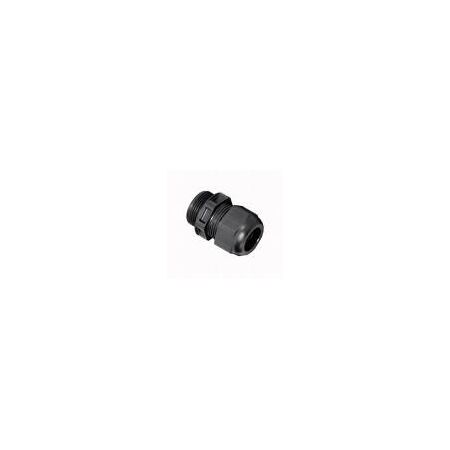
You're feeding a new sub-board outdoors, the cable's sitting around 20mm OD, and there's a box of mixed brass and nylon glands in the van with half the labels rubbed off. Grabbing the first one that looks close enough is how you end up with a gland that's too loose to seal properly, or too tight to thread the cable through without damaging the sheath. Getting the size and material right takes a minute to check properly, and it's the same call made across the Lanx Australis electrical range.
Every cable gland is specified by a clamping range, not a single fixed size — the gland needs to close down onto the cable's outer diameter firmly enough to seal and grip, without crushing the sheath. Measure the cable OD before grabbing a gland, not the conduit or cutout size the cable's passing through. Undersized and the cable won't thread through the gland body; oversized and the seal won't compress properly against the cable, which defeats the point of using a gland at all rather than a plain grommet.
Nylon glands are the general-purpose option — the Lanx nylon range from 12mm through 63mm covers most weatherproof cable entry points on standard enclosures. Brass glands step up where the install is exposed to corrosion — coastal sites, industrial environments, or anywhere salt air or chemical exposure will degrade a plastic gland faster than the job's design life. It's not just a durability upgrade; a brass gland also provides continuity for cable armour or shielding where that's part of the install, which a nylon gland doesn't.
| Gland size | Material | Typical use |
|---|---|---|
| 12mm | Nylon or brass | Small control or data cable entries |
| 20-25mm | Nylon or brass | General sub-board and enclosure feeds |
| 32-40mm | Brass preferred | Heavier feeder cables, industrial enclosures |
| 63mm | Brass | Main incomer and large feeder cables |
Treat this as a starting reference — always confirm against the actual cable OD on the job rather than sizing off the circuit rating alone.
On the outdoor sub-board from the intro, the gland isn't just holding the cable in place — it's maintaining the enclosure's IP rating at every entry point. A gland that's the wrong size, or fitted without the seal compressing properly, opens a path for moisture into the enclosure regardless of how well-rated the enclosure itself is. This matters more on nylon glands, where the seal relies entirely on the gland body compressing evenly; a brass gland with a compression nut generally tolerates a slightly imperfect fit better.
[!] Compliance note
Where an enclosure's IP rating is part of the installation's compliance requirement under AS/NZS 3000, every cable entry — including the gland — needs to maintain that rating, not just the enclosure body itself.
Sizing to the conduit instead of the cable. The gland needs to clamp the cable OD, not fill the conduit or cutout — grabbing a gland to match the hole size rather than the cable is the most common mismatch on site.
Using nylon where brass was needed. A nylon gland that's fine indoors can degrade faster than expected once it's exposed to UV, salt air, or chemical fumes — worth checking the environment before defaulting to nylon out of habit.
Not tightening the compression nut fully. A gland that's the right size but under-tightened won't seal properly — it's an easy step to rush when you're working overhead or in a tight enclosure.
Reusing a gland from a different cable size. Similar to the spare-breaker trap on other jobs, grabbing whatever gland's already in the enclosure from a previous cable run often means it's the wrong clamping range for the new cable.
Forgetting earthing continuity on armoured cable. Where the gland is meant to bond to cable armour or shielding, a gland that's just clamping the sheath without making that connection leaves a compliance gap that's easy to miss on a visual check.
What size cable gland do I need for a 12mm OD cable?
A 12mm nylon cable gland covers a cable OD around that size, though it's worth checking the gland's stated clamping range rather than matching the number directly to the cable diameter.
Can I use a gland that's slightly larger than my cable?
Only within the gland's stated clamping range — outside that range the seal won't compress evenly around the cable, even if the cable physically fits through the opening.
What's the largest cable gland size in the Lanx range?
The range runs up to a 40mm brass cable gland and equivalent nylon sizing, which covers most feeder cable entries on a standard trade job.
Should I use brass or nylon glands outdoors?
Nylon is fine for general outdoor use, but a 32mm brass cable gland is the better pick near coastal or industrial sites where corrosion resistance matters more than upfront cost.
Does the cable gland need to match the enclosure's IP rating?
In practice, yes — an enclosure's IP rating is only as good as its weakest entry point, so the gland needs to be correctly sized and tightened to maintain that rating, not just present.
Do I need a licence to fit cable glands on a switchboard?
Yes — switchboard work is licensed electrical work in NSW, and it's worth confirming current requirements against NSW Fair Trading for the specific scope of work before starting.
Related Reading
These cable glands are trade priced with same-day dispatch on in-stock items from the Kingsgrove NSW warehouse.
Find the full cable gland range at Schnap — trade pricing and same-day dispatch from Kingsgrove NSW.

SCHNAP Electrical Wholesaler - clear, upfront pricing that professional electricians trust

Get what you need in seconds. SCHNAP electrical wholesaler makes ordering quick and simple

Fast delivery anywhere - that's guaranteed. SCHNAP electrical wholesalers ship nationwide with same-day dispatch

Track your order every step of the way. SCHNAP electrical wholesale keeps you updated from click to delivery

SCHNAP is Australia's premier electrical wholesaler and electrical supplies, marketing thousands of quality products from leading brands. Trusted for nearly two decades by licensed electricians, contractors, and engineers, our range covers everything from basic electrical components to complex industrial electrical equipment
Our key categories include: LED lighting, designer switches, commercial switchboards, circuit protection, security systems & CCTV, and smart home automation
All products are certified to Australian standards (AS/NZS), backed by our 30-day, no-questions-asked return policy. Our expert technical team helps you quickly source the right solution for any residential, commercial, or industrial project, with daily dispatch from our Sydney electrical warehouse delivering Australia-wide
SCHNAP offers the most comprehensive electrical product range, with full technical specifications, application details, installation requirements, compliance standards, and warranties — giving professionals total confidence in every purchase


Kingsgrove Branch:
Opening hours:
Mon - Fri: 6:30 AM to 5 PM
Saturday: 8:00 AM to 2:00 PM
Sunday: 9:00 AM to 2:00 PM
Closed on public holidays
Jannali Branch:
Closed for Renovations
© 2004 - 2026 SCHNAP Electric Products