

Kingsgrove Branch:



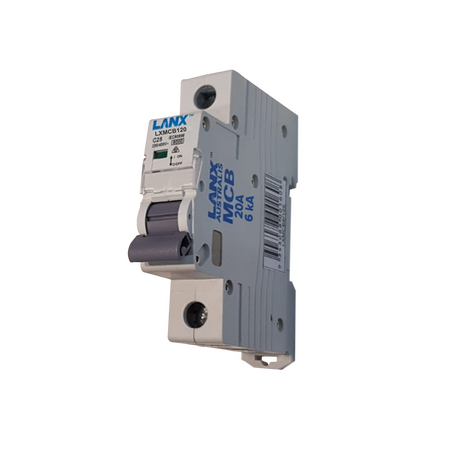
You're back in the switchboard on a kitchen reno, running a new circuit for the dishwasher, and there's a spare 32A breaker already sitting in the board from the old range hood run. It'd save a trip to the van — but that rating was never picked for this load, and swapping it in without checking is exactly how nuisance trips and undersized protection happen. Getting the rating right takes a bit more than grabbing whatever's spare, and it's worth doing properly every time, the same way it's covered across the Lanx Australis electrical range.
An MCB is specified by two things, not one: the amp rating and the trip curve. The amp rating is the obvious part — how much continuous current the breaker will carry before it trips on overload. The curve (almost always C-curve for general power and lighting circuits in a residential or light commercial board) determines how fast it trips on a short-term overcurrent, like a motor starting or an inrush spike. Grab a breaker with the right amps but the wrong curve and you'll either get nuisance tripping on startup loads, or protection that's slower to react than it should be. Every Lanx MCB in this range is C-curve, which covers the vast majority of general circuits — it's the amp rating that changes job to job.
Most general power and lighting circuits in a house run off a single-pole breaker on 230/240V. A lighting circuit typically sits at the lower end — 6A is common where the cable run and fitting load support it. General power circuits, including the dishwasher run from the hook above, commonly land on 20A, which covers a standard GPO circuit wired in 2.5mm² cable under typical run lengths. Heavier single-phase loads — a larger single-element appliance circuit or a higher-draw EV charger — push into 40A or 63A territory, but at that point cable sizing and voltage drop need checking against the actual run, not just the appliance nameplate. Lanx's 1P range covers that whole spread, 6A through to 63A.
| Rating | Poles | Typical circuit |
|---|---|---|
| 6A | 1P | Lighting circuit |
| 20A | 1P | Standard GPO / general power circuit |
| 10A / 32A | 2P | Hot water system, ducted heater |
| 16A / 63A | 3P | Workshop machinery, three-phase equipment |
This is a starting reference, not a substitute for checking cable size and run length against AS/NZS 3000 for the specific job.
Two-pole breakers switch both active conductors on a circuit, which is what a lot of fixed single-phase appliances need rather than a standard 1P/N arrangement — a hot water system or ducted electric heater is a common example. 10A and 32A cover a good spread of these loads, from a smaller instantaneous unit through to a full-size ducted system, but as with single-pole circuits, the rating has to match what the cable run can actually carry, not just the appliance's rated draw.
Three-phase circuits show up most often on workshop equipment, larger compressors, and some EV chargers. Motor loads bring a wrinkle single-phase circuits mostly don't: starting current can spike well above the running current for a short period, and a breaker sized only to the running load will typically nuisance-trip on startup. 16A suits smaller three-phase equipment; 63A covers heavier machinery and main sub-circuits feeding a workshop board. As a general rule, three-phase sizing is worth cross-checking against the equipment's actual starting characteristics rather than the nameplate running current alone.
[!] Compliance note
An MCB on its own protects against overload and short circuit — it doesn't provide earth leakage protection. Where AS/NZS 3000 requires RCD protection for a circuit, that's a separate device (or an RCBO combining both functions), not something an MCB rating alone covers.
Reusing whatever spare breaker is in the board. It's the fastest option on site, but a breaker rated for the old circuit it came from isn't necessarily right for the new one — that's exactly the trap from the dishwasher circuit above.
Matching the breaker to the appliance instead of the cable. A breaker rated higher than what the cable can safely carry defeats the point of the protection — the cable's current-carrying capacity sets the ceiling, not the appliance draw.
Using a single-pole breaker where a double-pole is needed. Some fixed appliances need both actives switched together; a 1P breaker on a circuit that calls for 2P switching leaves one active still live when the circuit's meant to be isolated.
Under-sizing for motor starting current on three-phase loads. Sizing purely to running current on compressor or motor circuits is a common source of nuisance tripping the moment the equipment starts up.
Assuming the MCB has earth leakage covered. As above — an MCB by itself doesn't provide RCD protection, and treating it as if it does is a compliance gap, not just an inconvenience.
What size MCB do I need for a standard GPO circuit?
A 1P 20A C-curve MCB is the common size for a standard general power circuit, though the final rating always depends on the cable size and run length for that specific job.
Can I use a 32A MCB on a circuit wired for 20A?
No — the breaker rating has to match what the cable can safely carry, not be bumped up to whatever's on hand. A 32A breaker on 20A-rated cable removes the protection the cable actually needs.
What's the difference between a C-curve and B-curve MCB?
C-curve breakers, like the 2P 10A C-curve MCB, tolerate a higher short-term inrush before tripping, which suits general power, lighting, and light motor loads. B-curve trips faster on lower overcurrent and is typically reserved for circuits with minimal inrush, which is less common on general trade work.
Do I need a licence to install or replace an MCB in NSW?
Yes — switchboard work is licensed electrical work in NSW, and it's worth confirming current licensing requirements for the specific job against NSW Fair Trading before starting, since scope and exemptions can vary by circuit type.
Does an MCB protect against earth leakage?
No — an MCB covers overload and short circuit only. Earth leakage protection needs a separate RCD, or an RCBO that combines both functions in one device.
What rating three-phase MCB do I need for a workshop machine?
It depends on the machine's running and starting current, but a 3P 16A C-curve MCB is a common starting point for smaller three-phase equipment — always cross-check against the equipment's actual current draw rather than sizing on rating alone.
For more on the full electrical range this sits within, see the Shop section below.
The right rating still comes down to checking cable size and job conditions before ordering — the range below covers the common ratings across single, double, and three-phase.
These MCBs are trade priced with same-day dispatch on in-stock items from the Kingsgrove NSW warehouse.
Find the full circuit breaker rating range at Schnap — trade pricing and same-day dispatch from Kingsgrove NSW.

SCHNAP Electrical Wholesaler - clear, upfront pricing that professional electricians trust

Get what you need in seconds. SCHNAP electrical wholesaler makes ordering quick and simple

Fast delivery anywhere - that's guaranteed. SCHNAP electrical wholesalers ship nationwide with same-day dispatch

Track your order every step of the way. SCHNAP electrical wholesale keeps you updated from click to delivery

SCHNAP is Australia's premier electrical wholesaler and electrical supplies, marketing thousands of quality products from leading brands. Trusted for nearly two decades by licensed electricians, contractors, and engineers, our range covers everything from basic electrical components to complex industrial electrical equipment
Our key categories include: LED lighting, designer switches, commercial switchboards, circuit protection, security systems & CCTV, and smart home automation
All products are certified to Australian standards (AS/NZS), backed by our 30-day, no-questions-asked return policy. Our expert technical team helps you quickly source the right solution for any residential, commercial, or industrial project, with daily dispatch from our Sydney electrical warehouse delivering Australia-wide
SCHNAP offers the most comprehensive electrical product range, with full technical specifications, application details, installation requirements, compliance standards, and warranties — giving professionals total confidence in every purchase


Kingsgrove Branch:
Opening hours:
Mon - Fri: 6:30 AM to 5 PM
Saturday: 8:00 AM to 2:00 PM
Sunday: 9:00 AM to 2:00 PM
Closed on public holidays
Jannali Branch:
Closed for Renovations
© 2004 - 2026 SCHNAP Electric Products