

Kingsgrove Branch:



You’re at the switchboard with a circuit that needs residual-current protection, and the choice comes down to two familiar options: an RCD with separate overcurrent protection, or an RCBO that combines both functions. The difference matters because the devices protect against different faults and affect how the circuit behaves when something goes wrong.
The practical question is not simply rcbo vs rcd as a product comparison. It is whether the circuit needs residual-current protection only, or residual-current protection together with overload and short-circuit protection in the same device. For broader context on the products available in this family, see the LANX electrical range.
The easiest way to separate the two is to look at the protection functions built into each device.
| Device | Residual-current protection | Overload protection | Short-circuit protection |
|---|---|---|---|
| RCD | Yes | No | No |
| RCBO | Yes | Yes | Yes |
An RCD monitors for an imbalance between current flowing out and returning through the circuit. When residual current reaches the device’s operating threshold, it disconnects the circuit. It is therefore focused on residual-current protection rather than protecting the conductors from overload or short circuit.
An RCBO adds overcurrent protection to that residual-current function. In practical terms, it combines the job normally associated with an RCD and an MCB into one protective device. That distinction is the key to understanding the difference between rcd and rcbo.
An RCD is there to detect residual current. That makes it a safety device for faults where current is escaping from its intended path, such as a leakage fault associated with insulation failure or contact with an unintended conductive path.
What it does not do is protect the circuit from every type of overcurrent event. An RCD does not replace an MCB for overload and short-circuit protection. Where those protections are required, the circuit still needs appropriate overcurrent protection alongside the RCD.
Trade point: An RCD and an MCB solve different protection problems. Seeing “RCD protection” on a circuit does not mean the circuit is automatically protected against overload and short circuit.
That distinction is worth keeping clear when checking an existing switchboard or planning a new circuit. The protection arrangement has to be assessed as a complete circuit, not by looking at one device in isolation.
An RCBO combines residual-current protection with overcurrent protection. That means the same device can respond to residual-current faults while also providing protection against overload and short circuit, subject to its specified ratings and characteristics.
This combination can make circuit protection more straightforward where each individual final circuit needs its own residual-current protection. It also means a fault on one protected circuit can be isolated without relying on one shared residual-current device to cover several downstream circuits.
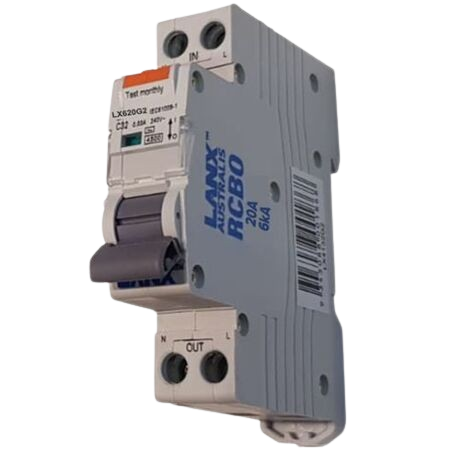
LANX’s current RCBO selection illustrates this integrated approach. The LANX 20A single-pole RCBO, for example, is specified as a 20A 1P RCBO with 30mA Type A detection and 6kA breaking capacity. The exact rating and configuration still need to match the circuit and installation requirements.
The buying decision becomes much easier once the circuit is considered first.
An RCD can make sense where the protection design already includes suitable MCB or other overcurrent protection for the circuit. In that arrangement, the devices have separate jobs: the MCB handles overload and short circuit, while the RCD handles residual current.
The advantage is flexibility in how the switchboard is configured, particularly where an existing board already uses a separate RCD arrangement. The important point is that the complete protection scheme must still provide the required functions for the circuit.
An RCBO is often the more direct choice when the circuit needs both overcurrent and residual-current protection and you want those functions integrated into one device. This can be particularly useful where individual circuit protection is preferred or switchboard space is a consideration.
It also changes fault isolation. With individual RCBO protection, a fault on one circuit can trip that circuit’s protective device rather than necessarily disconnecting several downstream circuits through a shared RCD arrangement.
The right choice depends on more than whether the product says RCD or RCBO. Check the circuit arrangement, conductor protection, rated current, pole configuration, residual-current characteristics, breaking capacity and the requirements that apply to the installation.
For example, choosing a 20A RCBO does not mean the circuit should automatically be protected at 20A. The protective-device rating must be appropriate for the cable, installation conditions and circuit design. For the MCB side of that selection process, the Lanx MCB rating guide covers how current rating and circuit conditions affect breaker selection.
Consider a new final circuit where residual-current protection is required and the board is being configured circuit by circuit. The first question is whether you need both residual-current and overcurrent protection for that circuit.
If the answer is yes, an RCBO provides both functions in one device. You then select the appropriate current rating, poles, residual-current characteristics and breaking capacity for the installation.
If the switchboard already uses a suitable RCD arrangement and separate MCB protection, an RCD may still be the appropriate part of that overall design. The important distinction is that an RCD should not be treated as a replacement for the circuit’s required overcurrent protection.
Selection rule: Start with the protection functions the circuit requires, then select the device configuration and ratings. Do not start with whichever breaker happens to be available in the van or switchboard.
What is the difference between RCD and RCBO?
An RCD provides residual-current protection, while an RCBO combines residual-current protection with overcurrent protection for overload and short circuit. An RCD therefore normally forms part of a protection arrangement that also includes suitable overcurrent protection.
Can an RCD replace an RCBO?
Not as a direct one-for-one substitution. An RCD and RCBO perform different protection functions, so replacing one with the other depends on the complete circuit design and the protection already provided elsewhere.
What type of RCBO suits a 20A single-pole circuit?
A product such as the LANX LX620G2 20A RCBO is specified as a 1P 20A device with 30mA Type A detection and 6kA breaking capacity. The final selection must still match the circuit design and installation requirements.
Does an RCD protect against short circuit?
No. An RCD is intended for residual-current protection. Short-circuit and overload protection requires appropriate overcurrent protection, such as an MCB or the overcurrent function incorporated into an RCBO.
Does replacing an RCBO require a licensed electrician in NSW?
Electrical wiring work in NSW must be carried out by, or under the supervision of, a licensed electrician. Switchboard protection work should therefore be handled within the applicable licensing and compliance requirements for the job.
Is 30mA always the correct RCD or RCBO sensitivity?
No device rating should be selected automatically from a general rule. Residual-current sensitivity must be appropriate to the circuit, equipment and applicable installation requirements. Check the specific job rather than assuming one sensitivity suits every application.
LANX RCBO options are available with trade pricing and same-day dispatch from the Kingsgrove NSW warehouse. Check the individual product specifications before ordering to make sure the configuration matches the circuit.
Need the right rcbo vs rcd for the job? Browse the LANX range at Schnap.

SCHNAP Electrical Wholesaler - clear, upfront pricing that professional electricians trust

Get what you need in seconds. SCHNAP electrical wholesaler makes ordering quick and simple

Fast delivery anywhere - that's guaranteed. SCHNAP electrical wholesalers ship nationwide with same-day dispatch

Track your order every step of the way. SCHNAP electrical wholesale keeps you updated from click to delivery

SCHNAP is Australia's premier electrical wholesaler and electrical supplies, marketing thousands of quality products from leading brands. Trusted for nearly two decades by licensed electricians, contractors, and engineers, our range covers everything from basic electrical components to complex industrial electrical equipment
Our key categories include: LED lighting, designer switches, commercial switchboards, circuit protection, security systems & CCTV, and smart home automation
All products are certified to Australian standards (AS/NZS), backed by our 30-day, no-questions-asked return policy. Our expert technical team helps you quickly source the right solution for any residential, commercial, or industrial project, with daily dispatch from our Sydney electrical warehouse delivering Australia-wide
SCHNAP offers the most comprehensive electrical product range, with full technical specifications, application details, installation requirements, compliance standards, and warranties — giving professionals total confidence in every purchase


Kingsgrove Branch:
Opening hours:
Mon - Fri: 6:30 AM to 5 PM
Saturday: 8:00 AM to 2:00 PM
Sunday: 9:00 AM to 2:00 PM
Closed on public holidays
Jannali Branch:
Closed for Renovations
© 2004 - 2026 SCHNAP Electric Products