

Kingsgrove Branch:



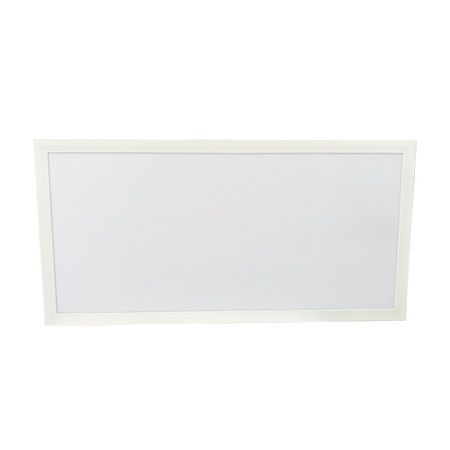
A fitout crew pulls the old fluoro troffers out of a 600x600 T-bar grid, orders what the spec sheet calls an equivalent LED panel, and it lands 4-5mm proud on one edge — enough that it won't sit flush without packing the frame. Getting the dimension right before ordering saves a return trip and a second freight charge.
On a new build, the grid gets designed around the fitting. On a retrofit, it's the other way around — the grid is already up, already carrying ceiling tiles either side of the opening, and the panel has to work with whatever dimension is already there. A panel that's a few millimetres out in either direction either won't drop in cleanly or leaves a visible gap once the tiles go back around it. In an office or retail fitout where the ceiling is on show, that gap is the first thing a site manager notices at handover.
The other complication is that "600x600" as a marketing size and 600x600 as an actual millimetre measurement aren't always the same thing. Most panels sold as 600x600 are manufactured a few millimetres under that — typically around 595x595mm — to allow clearance inside a standard T-bar grid opening. If a spec or a quote lists 600x600 without qualifying the actual panel dimension, it's worth confirming before ordering rather than assuming it'll drop straight in.
Four sizes cover most commercial retrofit jobs. Matching one of these to the existing grid opening is usually faster and cheaper than modifying the grid to fit a non-standard panel.
| Panel Size | Typical Grid Fit | Common Use |
|---|---|---|
| 295 x 595mm | Euro/UK-standard T-bar module | Retrofitting older imported or narrow-module grids |
| 595 x 595mm (marketed as 600x600) | Standard Australian T-bar grid opening | Direct swap for square fluoro troffers |
| 300 x 600mm | Half-module T-bar grid, or single-tube batten replacement | Corridors, smaller offices, plasterboard recesses |
| 300 x 1200mm | Two-module T-bar run, or double-tube batten replacement | Open-plan offices, warehouses, larger commercial spaces |
The 300x1200 size is worth flagging on its own: a panel this length can replace two single-tube fluoro battens laid end to end, which cuts the number of fittings — and the number of driver connections — in half for a long run.
The size on the box only tells half the story — how it's meant to sit in the ceiling matters just as much. Lay-in panels drop into a T-bar grid from below and rest on the grid's flange, which is the most common retrofit scenario. Recessed panels need a plaster or gyprock cut-out sized to the panel's frame, common when there's no existing grid at all. Surface-mount panels sit proud of the ceiling on their own frame, usually specified when the ceiling structure won't take a recessed cut or when the job calls for a retrofit without opening up the plasterboard.
Once the physical size is locked in, the next decision is usually colour temperature. Fixed-CCT panels are set at a single colour temperature from the factory, which is fine when the spec is already settled. Selectable-CCT panels — sometimes called tri-colour or tri-CCT — let the installer switch between warm, neutral and cool white on site via a rocker switch on the driver, which is useful when the fitout spec hasn't fully locked down the colour temperature or when one panel model needs to serve rooms with different lighting requirements. A tri-colour 600x600 panel covers both cases in one SKU rather than stocking three separate fixed-CCT versions.
The same standard sizes also cover more specific compliance needs. Cleanroom and IP65-rated troffers are built in the same 600x600 and equivalent footprints, so a job that needs a washdown-rated or dust-sealed fitting for a lab, food-prep area, or wet commercial space doesn't need a different mounting approach — just a different variant within the same size range.
Assuming "600x600" means exactly 600mm. As covered above, most panels sold under that name are actually closer to 595x595mm. Ordering on the marketing name alone without checking the actual dimension is the single most common cause of a panel not sitting flush.
Reading the SKU code as the dimension. Product codes sometimes carry numbers that look like sizes but aren't a reliable dimension reference on their own — always confirm the actual millimetre measurement in the product description rather than the model number.
Not checking driver housing depth. A panel that fits the grid opening perfectly can still be too deep for the ceiling cavity if there's ducting, cable tray, or a shallow bulkhead directly above. Worth a quick check above the existing tile before ordering, not after the panel's on site.
Ordering a recessed frame for a T-bar retrofit. Recessed and lay-in are not interchangeable — a recessed frame designed for a plasterboard cut-out won't sit correctly in a T-bar grid opening, and vice versa.
Locking in fixed-CCT before the spec is finalised. If a tender document or client brief hasn't confirmed the exact colour temperature yet, ordering fixed-CCT panels early can mean a full re-order later. Selectable-CCT removes that risk for a modest cost difference.
Skipping the T-bar width check on older buildings. Newer commercial fitouts are almost always 24mm T-bar, but a retrofit in an older building is worth a quick measurement rather than an assumption.
Related Reading
Will a 600x600 LED panel actually fit a 595x595 T-bar opening?
Yes, in most cases — panels marketed as 600x600 are typically manufactured at approximately 595x595mm precisely so they clear a standard T-bar grid opening. Worth confirming the actual dimension listed in the product description rather than relying on the marketing name alone.
Can I use a 300x1200 panel in place of two fluoro battens?
Yes — a 300x1200mm panel covers the same run as two single-tube battens end to end, which means one driver and one set of mounting points instead of two.
What size is a standard commercial ceiling panel in Australia?
The most common size in Australian offices and retail fitouts is the 600x600 (actual 595x595mm) panel, sized to suit the standard 24mm T-bar grid module. 300x600 and 300x1200 are the next most common, generally used for corridors, half-module grids, or longer open-plan runs.
Do I need a licence to install an LED panel in an existing ceiling grid?
Yes — connecting an LED panel to mains wiring is licensed electrical work in every Australian state and territory, regardless of whether the fitting is dropping into an existing grid opening or being newly recessed. A licensed electrician needs to carry out or supervise the connection even if the physical fit-up is straightforward.
Can I connect a tri-CCT panel to a standard single-CCT driver circuit?
No — selectable-CCT panels use a driver built specifically for CCT switching, with the selector integrated into that driver. They're not designed to be retrofitted onto a driver built for a fixed-CCT panel.
What's the difference between recessed and surface-mount LED panel frames?
A recessed frame sits inside a plaster or gyprock cut-out so the panel face is flush with the ceiling surface. A surface-mount frame sits on top of the existing ceiling, with the panel and its housing visible below the ceiling line — typically chosen when cutting into the ceiling isn't practical or desired.
For the full range of panels and troffers, including cleanroom and IP65-rated options in the same standard sizes, see the shop section below.
Trade pricing on every size below, dispatched same day from our Kingsgrove NSW warehouse.
Related Reading
Find the full led panel sizes range at Schnap — trade pricing and same-day dispatch from Kingsgrove NSW.

SCHNAP Electrical Wholesaler - clear, upfront pricing that professional electricians trust

Get what you need in seconds. SCHNAP electrical wholesaler makes ordering quick and simple

Fast delivery anywhere - that's guaranteed. SCHNAP electrical wholesalers ship nationwide with same-day dispatch

Track your order every step of the way. SCHNAP electrical wholesale keeps you updated from click to delivery

SCHNAP is Australia's premier electrical wholesaler and electrical supplies, marketing thousands of quality products from leading brands. Trusted for nearly two decades by licensed electricians, contractors, and engineers, our range covers everything from basic electrical components to complex industrial electrical equipment
Our key categories include: LED lighting, designer switches, commercial switchboards, circuit protection, security systems & CCTV, and smart home automation
All products are certified to Australian standards (AS/NZS), backed by our 30-day, no-questions-asked return policy. Our expert technical team helps you quickly source the right solution for any residential, commercial, or industrial project, with daily dispatch from our Sydney electrical warehouse delivering Australia-wide
SCHNAP offers the most comprehensive electrical product range, with full technical specifications, application details, installation requirements, compliance standards, and warranties — giving professionals total confidence in every purchase


Kingsgrove Branch:
Opening hours:
Mon - Fri: 6:30 AM to 5 PM
Saturday: 8:00 AM to 2:00 PM
Sunday: 9:00 AM to 2:00 PM
Closed on public holidays
Jannali Branch:
Closed for Renovations
© 2004 - 2026 SCHNAP Electric Products