

Kingsgrove Branch:


Product help, identification or bulk pricing.
Send us a photo and our team will help identify it.
Large quantities? Send us the details via WhatsApp.
Enter a quantity or some details about your bulk request.
Request via WhatsApp
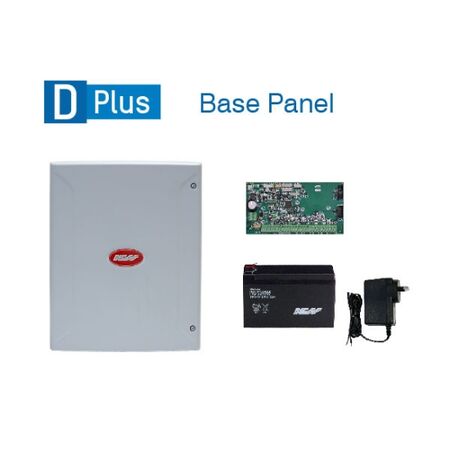
A real estate office fit-out landed on the quote sheet last month — reception, three private offices, a server room, and a storage area out back, eleven points needing coverage on day one. Six weeks later the agency signs a lease on the vacant suite next door and wants it wired in too. If the panel specified maxes out at eight zones, that's a truck roll and a full panel swap, not a quick add-on. Getting zone count right before the quote goes out saves that callback — and it starts with understanding what actually eats into a zone budget beyond the sensor count on the day.
Walk a site and count PIRs and door contacts, and it's tempting to spec a panel that matches that number exactly. In practice, zone budget gets consumed by more than motion sensors and reed switches. Tamper inputs on external sirens, panic buttons at reception, and interface points for future CCTV or access control integration can all draw from the same zone pool depending on how the panel's wired. A client who mentions they're "probably" adding a second tenancy or converting storage into a fourth office isn't giving you a firm number — but it's a signal the panel needs headroom, not just a tally of what's visible today.
As a general rule, it's worth quoting one tier above what today's walkthrough suggests whenever there's any indication of near-term change to the site. The cost difference between an 8-zone and a 16-zone base is usually small next to the labour cost of coming back to swap the panel entirely.
Related Reading
Zone tiers on the shelf generally fall into four practical bands. None of them are exclusive to a particular building type — the deciding factor is how much the site is likely to grow, not just how big it is today.
| Zone Tier | Typical Job Size | Notes |
|---|---|---|
| 8 zone | Small residential, single-tenant office | Fine for a fixed, small point count with no expansion planned |
| 16 zone | Larger home, multi-room office suite | Common middle ground where most quoted jobs land |
| 32 zone (expandable base) | Site with confirmed or likely near-term growth | Same base panel, zones added later without a swap |
| 208 zone | Multi-tenant commercial, warehouse, integrated access control | Different product class entirely, not just a bigger version of a residential panel |
For the real estate office scenario, an 8-zone panel technically covers the eleven points once shared inputs are consolidated — but it leaves nothing for the second suite. An expandable base panel that starts at 8 zones and scales to 32 solves this without a second visit: the enclosure and control board stay the same, additional zone capacity gets added when the second tenancy actually signs. Where the base panel doesn't have enough onboard inputs for a specific expansion, a supervised zone expander PCB adds capacity to select control board families without replacing the panel itself.
This is generally the cheaper path compared to quoting the largest tier "just in case" — the client isn't paying for zone capacity they may never use, and there's a straightforward upgrade path if the growth actually happens.
Not every job has the luxury of chasing cable through open walls. An older tenancy fit-out, a heritage-restricted building, or a client who wants coverage before any construction starts can make a wired zone expansion impractical no matter how good the panel's expansion story is. In that situation, a wireless system built around individually addressable sensors is often the more practical route than trying to force a wired solution through finished walls.
Some jobs outgrow the residential-style tier lineup entirely, even the 32-zone expandable option. A multi-tenant office block, a warehouse with staged access zones, or a site that needs voice reporting and integrated access control isn't just "a bigger version" of a home alarm panel — it calls for a genuinely different product class. If that's the situation on your next quote, sizing a commercial-grade alarm panel walks through when to make that jump and what changes beyond just the zone number.
Sizing to today's sensor count only. A walkthrough shows what's needed right now, not what the client mentioned in passing about future plans. Ask directly about upcoming changes before locking in a tier.
Choosing a non-expandable panel to save a small amount upfront. The saving rarely covers the cost of a return visit and full panel swap once the site grows past its original zone count.
Forgetting that shared inputs eat into the zone budget. Tamper switches, panic buttons, and PA interfaces can consume zones that weren't accounted for when only counting motion sensors and door contacts.
Assuming all panels in a tier report the same way. Zone capacity and notification/dialler capacity aren't always the same spec — check both before assuming a kit covers the monitoring method the client wants.
Trying to force a wired expansion into a site that can't take new cable runs. Heritage buildings and finished-out tenancies are usually better served by a wireless approach than by chasing walls for one or two extra zones.
Can I add zones to an 8-zone panel later, or do I need to swap the whole panel?
It depends on the control board family. Some 8-zone panels are genuinely fixed-capacity, while others accept a supervised zone expander PCB to add capacity without replacing the enclosure or control board. Check the specific panel's expansion support before assuming either way.
How many zones does a typical 3-bedroom house actually need?
As a general rule, most standard 3-bedroom homes land comfortably within 8 zones once entry points, a garage, and one or two internal motion sensors are accounted for — though a client with a large yard, a shed, or a strong preference for zone-by-zone reporting can push that closer to a 16-zone tier.
Do I need a licence to install a security alarm system in NSW?
Yes — installing and servicing security alarm systems in NSW typically requires a security installer licence issued under the relevant state security industry legislation. Licensing requirements can vary between states, so it's worth confirming current requirements for the job's specific location before quoting.
What's the practical difference between an 8-zone panel and an 8-to-32-zone expandable base?
The enclosure and control board are often the same or similar — the difference is in the onboard capacity and expansion header. An 8-zone base panel built for expansion lets you start small and step up in zone blocks as the site grows, rather than starting from a fixed-capacity board with no upgrade path.
Does a higher zone count slow down arming and disarming?
Not directly. Arming speed generally comes down to keypad response and how zones are grouped into areas, not the raw zone count on the panel. A well-configured 32-zone system arms just as quickly as an 8-zone one for the areas actually in use day to day.
For sizing guidance on the CCTV recorder side of a job like this, sizing your NVR channel count covers the same "don't undersize for growth" logic applied to camera channels instead of alarm zones.
Trade pricing across the full zone-tier range, dispatched same day from Kingsgrove NSW.
Find the full alarm panels and kits range at Schnap -- trade pricing and same-day dispatch from Kingsgrove NSW.

SCHNAP Electrical Wholesaler - clear, upfront pricing that professional electricians trust

Get what you need in seconds. SCHNAP electrical wholesaler makes ordering quick and simple

Fast delivery anywhere - that's guaranteed. SCHNAP electrical wholesalers ship nationwide with same-day dispatch

Track your order every step of the way. SCHNAP electrical wholesale keeps you updated from click to delivery

SCHNAP is Australia's premier electrical wholesaler and electrical supplies, marketing thousands of quality products from leading brands. Trusted for nearly two decades by licensed electricians, contractors, and engineers, our range covers everything from basic electrical components to complex industrial electrical equipment
Our key categories include: LED lighting, designer switches, commercial switchboards, circuit protection, security systems & CCTV, and smart home automation
All products are certified to Australian standards (AS/NZS), backed by our 30-day, no-questions-asked return policy. Our expert technical team helps you quickly source the right solution for any residential, commercial, or industrial project, with daily dispatch from our Sydney electrical warehouse delivering Australia-wide
SCHNAP offers the most comprehensive electrical product range, with full technical specifications, application details, installation requirements, compliance standards, and warranties — giving professionals total confidence in every purchase


Kingsgrove Branch:
Opening hours:
Mon - Fri: 6:30 AM to 5 PM
Saturday: 8:00 AM to 2:00 PM
Sunday: 9:00 AM to 2:00 PM
Closed on public holidays
Jannali Branch:
Closed for Renovations
© 2004 - 2026 SCHNAP Electric Products