

Kingsgrove Branch:


Product help, identification or bulk pricing.
Send us a photo and our team will help identify it.
Large quantities? Send us the details via WhatsApp.
Enter a quantity or some details about your bulk request.
Request via WhatsApp
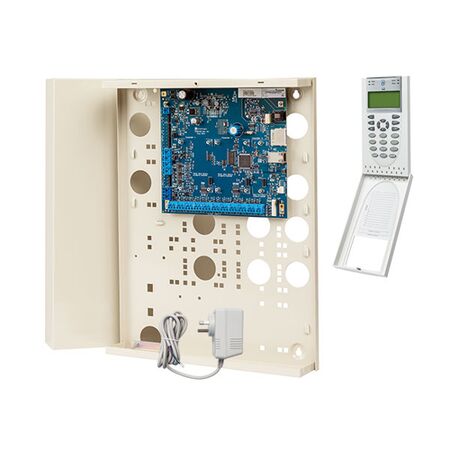
Three tenants sharing one building, one strata manager asking for door access baked into the same system, and a spec sheet that suddenly looks nothing like a house job. That's the point where a straightforward panel swap turns into a real decision about product class -- not just how many zones you actually need, but which tier of panel can actually carry the job.
The brief usually starts simple: fit-out across three floors, a handful of doors, a client who wants "the alarm sorted before the tenants move in." On paper, a residential-grade panel with enough spare zones covers it. Where it starts falling apart is reporting -- three tenancies, one landlord, and everyone wanting their own arm/disarm code and their own event history, not a shared log that lumps every tenant's activity together.
That's usually the first sign the job has moved past residential-class hardware. It's not that the zone count is wrong -- it's that the panel's user management, reporting structure, and expansion path weren't built for multiple stakeholders on one system. Commercial-grade panels like ChallengerPlus are built around exactly that: separate user codes, area partitioning, and reporting that can be split by tenancy rather than treated as one flat site.
It's tempting to treat this purely as a zone-count decision, but the class jump is really about three things: how the panel partitions areas and users, how it reports, and how far it can genuinely expand without a forklift upgrade later. As a general rule, residential panels are built to a ceiling that assumes one household and one reporting path -- commercial panels like ChallengerPlus or M1 Gold are built assuming multiple areas, multiple user tiers, and integration paths that residential hardware typically doesn't offer at all.
| Consideration | Typical Residential Panel | Commercial-Grade (ChallengerPlus / M1 Gold) |
|---|---|---|
| Area partitioning | Usually single-area or basic split | Multiple partitions, tenancy-level separation |
| User/code management | Handful of shared codes | Per-user codes, typically with scheduling and access tiers |
| Reporting | Single event log | Splittable by area, generally suited to multi-tenant reporting |
| Access control path | Rarely native, often needs a separate system | Integration path available, or fully native on integrated panels |
[!] Compliance note: Commercial security installation and monitoring work typically sits under separate security industry licensing on top of your electrical licence -- requirements vary by state, so check with your local security licensing authority before quoting a monitored commercial job.
The strata manager wanting fob access on the front door isn't an edge case -- on multi-tenant commercial jobs it's close to the default ask now. This is where the panel class decision really pays off or bites you later. A ChallengerPlus kit with RAS gives you the partitioning and reporting to run the alarm side properly, but if access control is a day-one requirement rather than a maybe-later addition, an integrated panel like the Tecom Discovery is worth pricing from the start -- it handles alarm and access control natively rather than needing a bolt-on system down the track.
If you're pulling from the alarm panels and kits range with an access control tender attached, it's worth sizing the power side of that integration properly too -- undersized supplies on access-controlled doors are a common callback, and it's a separate calculation from the alarm panel itself.
Related Reading
Sizing by zone count alone. A panel with plenty of spare zones can still be the wrong choice if it can't partition areas or split reporting by tenancy -- zone headroom doesn't fix a single-area design.
Treating access control as a later add-on. Retrofitting access control onto a panel that wasn't speced for it usually means a second system running alongside the first, with none of the integration benefits and double the maintenance calls.
Underestimating RAS and keypad requirements. Multi-tenant sites often need more than one remote arming station -- one per tenancy is common -- and that changes which kit configuration actually fits the job.
Not confirming licensing before quoting. Commercial monitored alarm work commonly falls under security industry licensing separate from an electrical licence -- finding this out mid-job is a bad place to be.
Mixing brands without checking the integration path. Pairing an alarm panel from one range with an access control system from another can work, but it's worth confirming the integration is genuinely supported rather than assumed.
Is ChallengerPlus overkill for a 3-tenant office job?
Not usually -- area partitioning and separate reporting per tenancy are exactly the problem a 3-tenant job creates, and that's what ChallengerPlus is built to handle rather than work around.
What's the practical difference between M1 Gold and ChallengerPlus for a commercial fit-out?
Both sit in the commercial-grade tier -- the right pick generally comes down to expansion needs and which kit configuration (voice dialler, navigator keypad, zone count at install) matches the specific site rather than one being universally "better."
Can I start with a ChallengerPlus panel alone and add the RAS later?
Yes -- the panel and RAS are separable, though pricing the kit together upfront is usually more straightforward than adding a keypad after the initial install is signed off.
Do I need a security licence to install a commercial alarm panel in NSW?
In most states, commercial alarm installation and monitoring work requires a security licence in addition to your electrical licence -- check with your state's security licensing authority before quoting, as requirements and exemptions vary by jurisdiction.
Can a Tecom Discovery panel genuinely replace a separate access control system?
For sites where alarm and access control needs are aligned from the start, an integrated panel typically covers both without needing a second standalone system -- worth confirming door count and reader type against the panel's specs before committing.
Does a commercial alarm panel need its own backup power sizing separate from the building's main supply?
Yes -- commercial panels typically need battery backup sized to the site's reporting and access control load, which is a separate calculation from the building's general power supply.
Trade pricing across the commercial panel range, dispatched same day from Kingsgrove NSW.
Find the full commercial alarm panel range at Schnap -- trade pricing and same-day dispatch from Kingsgrove NSW.

SCHNAP Electrical Wholesaler - clear, upfront pricing that professional electricians trust

Get what you need in seconds. SCHNAP electrical wholesaler makes ordering quick and simple

Fast delivery anywhere - that's guaranteed. SCHNAP electrical wholesalers ship nationwide with same-day dispatch

Track your order every step of the way. SCHNAP electrical wholesale keeps you updated from click to delivery

SCHNAP is Australia's premier electrical wholesaler and electrical supplies, marketing thousands of quality products from leading brands. Trusted for nearly two decades by licensed electricians, contractors, and engineers, our range covers everything from basic electrical components to complex industrial electrical equipment
Our key categories include: LED lighting, designer switches, commercial switchboards, circuit protection, security systems & CCTV, and smart home automation
All products are certified to Australian standards (AS/NZS), backed by our 30-day, no-questions-asked return policy. Our expert technical team helps you quickly source the right solution for any residential, commercial, or industrial project, with daily dispatch from our Sydney electrical warehouse delivering Australia-wide
SCHNAP offers the most comprehensive electrical product range, with full technical specifications, application details, installation requirements, compliance standards, and warranties — giving professionals total confidence in every purchase


Kingsgrove Branch:
Opening hours:
Mon - Fri: 6:30 AM to 5 PM
Saturday: 8:00 AM to 2:00 PM
Sunday: 9:00 AM to 2:00 PM
Closed on public holidays
Jannali Branch:
Closed for Renovations
© 2004 - 2026 SCHNAP Electric Products