

Kingsgrove Branch:



You crack open a switchboard on a routine service call and find a fine film of moisture across the terminals, with the first specks of rust already forming on the DIN rail. A cold night followed by a warm, humid morning is often all it takes to trigger this inside an enclosure. Left unchecked, that condensation eats into contact surfaces, insulation, and eventually reliability.
Condensation forms when the air inside a sealed enclosure cools below its dew point, usually overnight, and moisture that was invisible as vapour turns into liquid on the coldest metal surfaces it can find — often busbars, terminals, and the enclosure walls themselves. Coastal sites and enclosures that see daily temperature swings tend to be the worst affected, since a sealed IP-rated switchboard traps that humid air with nowhere to go. Over time this can lead to tracking across terminals, corroded contacts, and nuisance trips that are hard to diagnose because the evidence dries out before anyone opens the door.
An anti condensation heater breaks this cycle by keeping the internal air a few degrees above ambient, which is usually enough to stay clear of the dew point without needing to heat the enclosure to any specific temperature.
Related Reading: If corrosion inside the switchboard has already made circuit IDs hard to read, it's worth sorting that out at the same time — see Switchboard Labels: Get Your Circuit ID Right First Time.
Enclosure heaters generally fall into three types, and the right one depends more on enclosure size and airflow than on price alone.
| Type | Typical Wattage | Best Suited For | Notes |
|---|---|---|---|
| DIN rail resistive | 10–30W | Small control panels | Compact, low cost, usually paired with a thermostat |
| Natural convection | 30–150W | Small to mid-size switchboards | Silent, no moving parts, needs some free space around the fins |
| Fan-forced | 150–250W | Larger boards, restricted airflow | Circulates heat faster through the enclosure volume |
| High-output panel heater | 350–2000W | Large cabinets, main switchboards | Sized against enclosure volume; may need more than one unit |
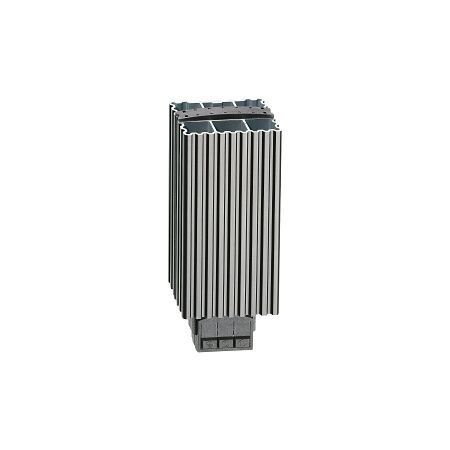
As a general starting point, heater output is usually matched to enclosure volume and expected temperature swing rather than picked off a shelf. It's a guide, not a substitute for a proper heat-loss calculation on critical or outdoor switchboards. For a small control cabinet, something like the 30W DIN rail convection heater is often enough to keep internal air above the dew point.
A single small heater won't do much inside a large floor-standing enclosure or main switchboard, though. For a 610 x 610mm cabinet or similar, a unit closer to the 2000W enclosure heater range is more realistic, and larger boards sometimes need more than one heater positioned to cover the whole volume evenly.
Not every enclosure has convenient 240V AC on hand, especially inside a control panel built around a 24V DC supply for PLCs and instrumentation. A 24v enclosure heater rated for DC input, such as this 12/24V insulated resistive heater, can run straight off the existing control supply without adding a separate transformer or AC circuit into the panel. Before wiring it in, it's worth checking the heater's DC draw against what's already left in the control panel's power budget, particularly on smaller 24V supplies running close to capacity.
Outdoor kiosks and street cabinets are usually the hardest-hit by condensation, since they see the full daily temperature swing plus whatever dust or moisture works its way in through cable entries. An outdoor enclosure heater should carry an IP rating that matches the exposure, not just the wattage — a unit like this IP44-rated 10W convection heater is built with that environment in mind. The heater's IP rating is only one part of the equation, though — it's worth checking the enclosure's own seals and cable glands are still doing their job too.
Mount the heater low in the enclosure where cold air tends to settle, with the clearance from cabling and terminals specified on the datasheet — most manufacturers call for at least 50–100mm depending on wattage. An electrical enclosure heater with thermostat control ties the whole setup together, since it only draws power when the internal temperature drops toward the dew point rather than running continuously. A separate hygrostat can be added where humidity, not just temperature, is the main driver.
Common mistake: Heaters often get bolted onto whatever DIN rail space is free, which sometimes puts them hard up against a cable bundle or terminal block. The consequence is localised heat that can soften cable insulation over time, or a heater left running 24/7 because it was never wired through a thermostat in the first place — both a fire risk and an ongoing running cost. The fix is straightforward: respect the manufacturer's clearance distance from wiring, and always control the heater with a thermostat rather than a permanent live feed.
What size enclosure heater do I need for a large switchboard?
It depends on enclosure volume and how exposed the board is, but many larger boards move up to a 250W fan-forced heater to circulate warm air through the full enclosure rather than relying on natural convection alone.
Do I need a fan heater or will a convection heater do the job?
Convection is usually fine for smaller, well-ventilated panels. Fan-forced heaters earn their keep in larger enclosures or where air movement inside the cabinet is restricted.
Is a 350W enclosure heater enough for a typical distribution board?
For many standard distribution boards, yes — a 350W enclosure heater covers a reasonable mid-size volume, though it's still worth checking against the board's actual dimensions.
Does fitting an enclosure heater require a licensed electrician?
Wiring a heater into a switchboard or control panel is electrical work and needs to be carried out and connected by a licensed electrician in line with the applicable wiring rules, even though the heater itself is a simple low-wattage device.
Can I run a 24V enclosure heater with a fan for faster warm-up?
Yes — a 24V DC fan-forced heater gives faster, more even heat distribution than a resistive-only unit on the same DC supply, provided the panel's 24V budget can carry the extra load.
How much clearance does an enclosure heater need from cabling?
This varies by model, but most datasheets call for a minimum clearance in the order of 50–100mm from cables and terminals, more for higher-wattage units — always check the specific heater's installation instructions before mounting.
Related Reading: Sorting out condensation is only half the job if moisture is also getting in through cable entries — see Cable Gland Sealant: Restoring IP66/68 After Installation.
Schnap stocks enclosure heaters across DIN rail, convection, fan-forced, and high-output ranges, with trade pricing and same-day dispatch from Kingsgrove NSW.
Compact DIN Rail Heaters
Convection & Fan Enclosure Heaters
High-Output Enclosure Heaters
Browse the full anti condensation heater range at Schnap.

SCHNAP Electrical Wholesaler - clear, upfront pricing that professional electricians trust

Get what you need in seconds. SCHNAP electrical wholesaler makes ordering quick and simple

Fast delivery anywhere - that's guaranteed. SCHNAP electrical wholesalers ship nationwide with same-day dispatch

Track your order every step of the way. SCHNAP electrical wholesale keeps you updated from click to delivery

SCHNAP is Australia's premier electrical wholesaler and electrical supplies, marketing thousands of quality products from leading brands. Trusted for nearly two decades by licensed electricians, contractors, and engineers, our range covers everything from basic electrical components to complex industrial electrical equipment
Our key categories include: LED lighting, designer switches, commercial switchboards, circuit protection, security systems & CCTV, and smart home automation
All products are certified to Australian standards (AS/NZS), backed by our 30-day, no-questions-asked return policy. Our expert technical team helps you quickly source the right solution for any residential, commercial, or industrial project, with daily dispatch from our Sydney electrical warehouse delivering Australia-wide
SCHNAP offers the most comprehensive electrical product range, with full technical specifications, application details, installation requirements, compliance standards, and warranties — giving professionals total confidence in every purchase


Kingsgrove Branch:
Opening hours:
Mon - Fri: 6:30 AM to 5 PM
Saturday: 8:00 AM to 2:00 PM
Sunday: 9:00 AM to 2:00 PM
Closed on public holidays
Jannali Branch:
Closed for Renovations
© 2004 - 2026 SCHNAP Electric Products